Neonatal Unit, Royal Hospital for Children, Glasgow, UK.
Health Economics & Outcomes Research, Strategen Limited, Basingstoke, UK.
Pediatr Pulmonol. 2020 May;55(5):1104-1110. doi: 10.1002/ppul.24676. Epub 2020 Feb 10.
Respiratory syncytial virus infection in early childhood has been linked to longer-term respiratory morbidity; however, debate persists around its impact on asthma. The objective was to assess the association between respiratory syncytial virus hospitalization and childhood asthma.
Asthma hospital admissions and medication use through 18 years were compared in children with (cases) and without (controls) respiratory syncytial virus hospitalization in the first 2 years of life. All children born in National Health Service Scotland between 1996 and 2011 were included.
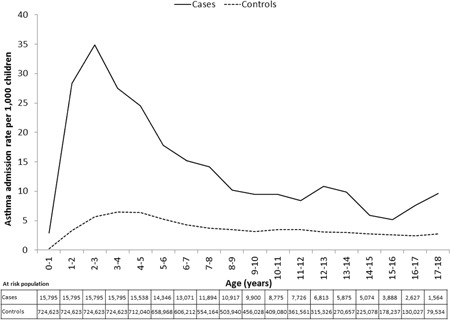
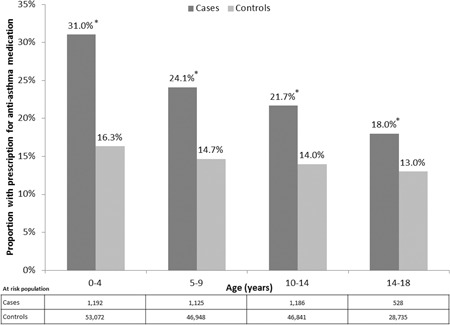
Of 740 418 children (median follow-up: 10.6 years), 15 795 (2.1%) had a respiratory syncytial virus hospitalization at ≤2 years (median age: 143 days). Asthma hospitalizations were three-fold higher in cases than controls (8.4% vs 2.4%; relative risk: 3.3, 95% confidence interval [CI]: 3.1-3.5; P < .0001) and admission rates were four-fold higher (193.2 vs 46.0/1000). Cases had two-fold higher asthma medication usage (25.5% vs 14.7%; relative risk: 1.7, 95% CI: 1.7-1.8; P < .0001) and a three-fold higher rate of having both an asthma admission and medication (4.8% vs 1.5%; relative risk 3.1, 95% CI: 2.9-3.3; P < .0001). Admission rates and medication use remained significantly (P < .001) higher for cases than controls throughout childhood (admissions: ≥2-fold higher; medication: ≥1.5-fold higher). Respiratory syncytial virus hospitalization was the most significant risk factor for asthma hospitalizations±medication use (odds ratio: 1.9-2.8; P < .001).
Respiratory syncytial virus hospitalization was associated with significantly increased rates and severity of asthma throughout childhood, which has important implications for preventive strategies.
儿童早期呼吸道合胞病毒感染与长期呼吸道疾病有关;然而,关于其对哮喘的影响仍存在争议。本研究旨在评估呼吸道合胞病毒住院与儿童哮喘之间的关联。
比较了在生命的头 2 年内因呼吸道合胞病毒住院的儿童(病例)和未住院的儿童(对照组)在 18 岁以下的哮喘住院和药物使用情况。所有于 1996 年至 2011 年期间在苏格兰国民保健系统出生的儿童均被纳入研究。
在 740418 名儿童中(中位随访时间:10.6 年),有 15795 名(2.1%)在≤2 岁时因呼吸道合胞病毒住院(中位年龄:143 天)。与对照组相比,病例组的哮喘住院率高 3 倍(8.4% vs 2.4%;相对风险:3.3,95%置信区间[CI]:3.1-3.5;P<.0001),住院率高 4 倍(193.2 vs 46.0/1000)。病例组的哮喘药物使用率高 2 倍(25.5% vs 14.7%;相对风险:1.7,95%CI:1.7-1.8;P<.0001),同时有哮喘住院和用药的比例高 3 倍(4.8% vs 1.5%;相对风险 3.1,95%CI:2.9-3.3;P<.0001)。与对照组相比,病例组在整个儿童期的哮喘住院率和药物使用率(P<.001)均显著升高(住院率:高 2 倍以上;药物使用:高 1.5 倍以上)。呼吸道合胞病毒住院是哮喘住院和用药的最显著危险因素(比值比:1.9-2.8;P<.001)。
呼吸道合胞病毒住院与儿童期哮喘的发生和严重程度显著相关,这对预防策略具有重要意义。