Yang Qinghua, Zhu Shujuan, Xu Jin, Tang Chenglin, Wu Kaihui, Wu Yanjun, Wang Yiying, Sheng Huajun
Institute of Neuroscience, Chongqing Medical University, Chongqing, China.
College of Traditional Chinese Medicine, Chongqing Medical University, Chongqing, China.
Genes Dis. 2018 Jun 15;6(3):282-289. doi: 10.1016/j.gendis.2018.06.002. eCollection 2019 Sep.
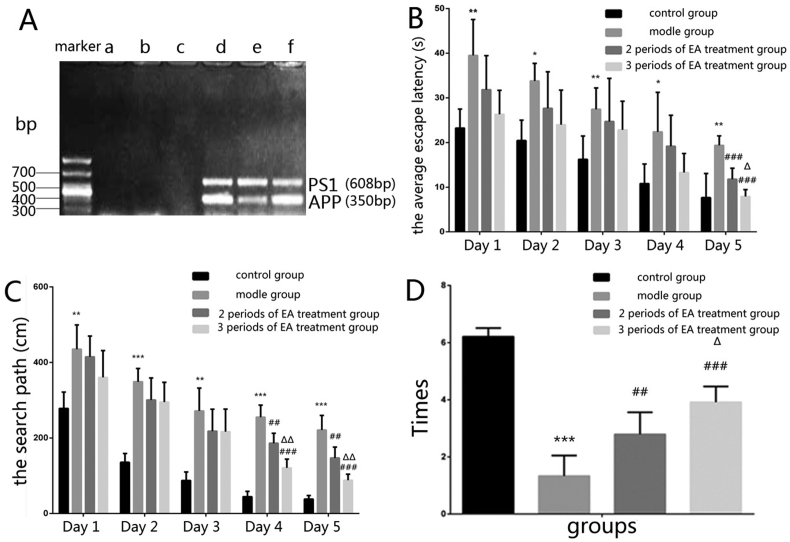
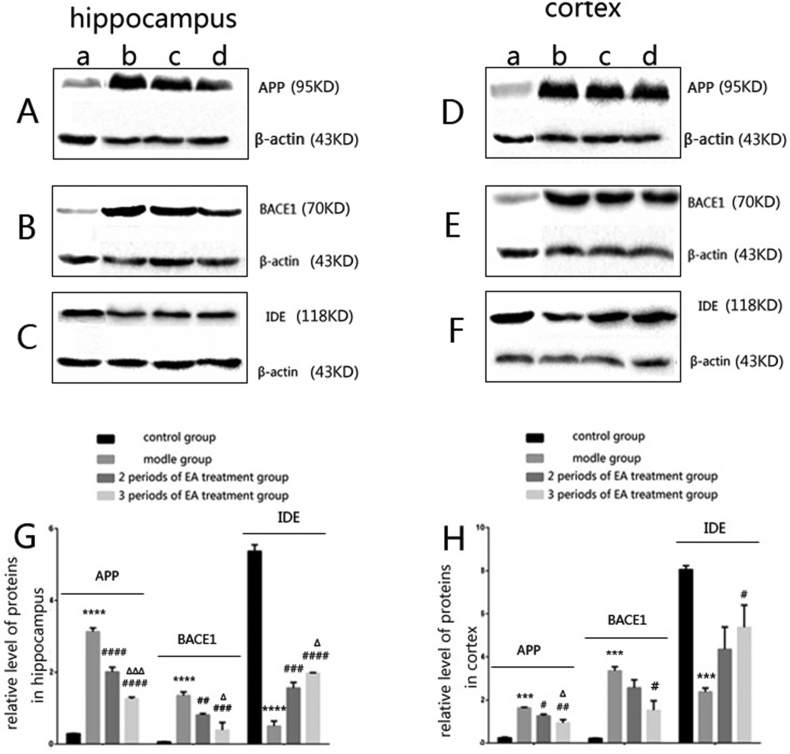
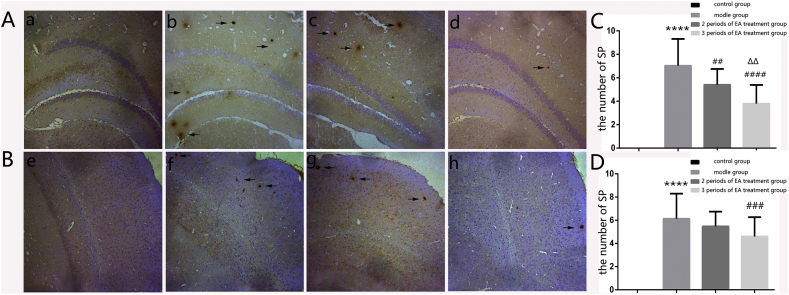
Alzheimer's disease (AD) is a progressive neurodegenerative disease and its incidence will increase with age and is aggravating. The senile plaques (SPs) are one of three main pathological features in AD patients, which are formed by amyloid β-protein (Aβ) over-accumulation. β-amyloid precursor protein (APP), β-site APP cleavage (BACE1), and insulin degrading enzyme (IDE) proteins participate in the process of Aβ production and degradation. At present, the pathogenesis of AD is not yet clear and the current treatment methods can only relief the related symptoms of AD. The electro-acupuncture (EA) is a traditional Chinese medicine treatment combined the acupuncture and electrical stimulation and the treatment effect can also be controlled by transform the electrical frequency. Thus, in this experiment, we carried out behavioral test, immunohistochemistry (IHC), and Western Blot (WB) after different period treatments to the model mice by electro-acupuncturing "Baihui" and "Shenshu" acupoints in APP/PS1 double transgenic mice. It was found that the EA therapy can improve the ability of learning, memory and spatial exploration, and reduce the deposition of SPs in brain of AD model mice, and reduce the expressions of APP and BACE1, increase the expression of IDE protein. These results prompt that EA can effectively alleviate the pathological process of AD. We speculate that EA may play a comprehensive role in preventing the development of AD, considering the previous data.
阿尔茨海默病(AD)是一种进行性神经退行性疾病,其发病率会随着年龄增长而增加且病情日益加重。老年斑(SPs)是AD患者的三个主要病理特征之一,由淀粉样β蛋白(Aβ)过度积累形成。β淀粉样前体蛋白(APP)、β位点APP裂解酶(BACE1)和胰岛素降解酶(IDE)蛋白参与Aβ的产生和降解过程。目前,AD的发病机制尚不清楚,当前的治疗方法只能缓解AD的相关症状。电针(EA)是一种将针刺与电刺激相结合的中医疗法,其治疗效果也可通过改变电频率来控制。因此,在本实验中,我们对APP/PS1双转基因小鼠针刺“百会”和“肾俞”穴位,在不同时间段治疗后对模型小鼠进行行为测试、免疫组织化学(IHC)和蛋白质免疫印迹(WB)检测。结果发现,电针疗法可提高AD模型小鼠的学习、记忆和空间探索能力,减少其脑内SPs的沉积,降低APP和BACE1的表达,增加IDE蛋白的表达。这些结果提示,电针可有效缓解AD的病理进程。综合以往数据推测,电针可能在预防AD发展过程中发挥综合作用。