Johannesen Katrine M, Mitter Diana, Janowski Robert, Roth Christian, Toulouse Joseph, Poulat Anne-Lise, Ville Dorothee M, Chatron Nicolas, Brilstra Eva, Geleijns Karin, Born Alfred Peter, McLean Scott, Nugent Kimberly, Baynam Gareth, Poulton Cathryn, Dreyer Lauren, Gration Dylan, Schulz Solveig, Dieckmann Andrea, Helbig Katherine L, Merkenschlager Andreas, Jamra Rami, Finck Anja, Gardella Elena, Hjalgrim Helle, Mirzaa Ghayda, Brancati Francesco, Bierhals Tatjana, Denecke Jonas, Hempel Maja, Lemke Johannes R, Rubboli Guido, Muschke Petra, Guerrini Renzo, Vetro Annalisa, Niessing Dierk, Lesca Gaetan, Møller Rikke S
Department of Epilepsy Genetics and Precision Medicine (K.J.M., E.G., G.R., R.S.M.), The Danish Epilepsy Centre Filadelfia, Dianalund, Denmark; Institute for Regional Health Services (K.J.M., E.G., R.S.M.), University of Southern Denmark, Odense; Institute of Human Genetics (D.M., R. Jamra, A.F., J.R.L.), University of Leipzig Medical Center, Germany; Institute of Structural Biology (R. Janowski, D.N.), Helmholtz Zentrum München - German Research Center for Environmental Health, Neuherberg, Germany; Department of Paediatric Radiology (C.R.), University of Leipzig Medical Center, Germany; Department of Epilepsy, Sleep and Pediatric Neurophysiology (J.T.), Lyon University Hospital, France; Neuropediatric Unit (A.-L.P., D.M.V., G.L.), Lyon University Hospital, France; Department of Medical Genetics (N.C., G.L.), Lyon University Hospital, France; GenDev Team (N.C.), CNRS UMR 5292, INSERM U1028, CNRL and University of Lyon, France; Department of Genetics (E.B.), University Medical Center Utrecht, The Netherlands; Department of Child Neurology (K.G.), Brain Center Rudolf Magnus, University Medical Center Utrecht, The Netherlands; Department of Paediatrics (A.P.B.), Copenhagen University Hospital Rigshospitalet, Denmark; Baylor College of Medicine (S.M., K.N.), Children's Hospital of San Antonio; Undiagnosed Diseases Program (G.B., C.P.), Genetic Services of Western Australia, Department of Health, Government of Western Australia, Perth; Western Australian Register of Developmental Anomalies (G.B., D.G.), Australia; Telethon Kids Institute and the School of Paediatrics and Child Health (G.B.), University of Western Australia, Perth; Linear Clinical Research (L.D.), WA, Australia; Center of Human Genetics (S.S), Jena University Hospital, Germany; Department of Neuropediatrics (A.D.), Jena University Hospital, Germany; Division of Neurology (K.L.H.), Children's Hospital of Philadelphia, PA; Division of Neuropediatrics (A.M.), University of Leipzig Medical Center, Germany; Amplexa Genetics (H.H.), Odense, Denmark; Clinic for Children (H.H.), Værløse, Denmark; Center for Integrative Brain Research (G.M.), Seattle Children's Research Institute, WA; Department of Pediatrics (G.M.), University of Washington, Seattle; Medical Genetics Unit (F.B.), Department of Life, Health and Environmental Sciences, University of L'Aquila, Italy; Istituto Dermopatico dell'Immacolata (F.B.), IDI-IRCCS, Rome, Italy; Institute of Human Genetics (T.B., M.H.), University Medical Center Hamburg-Eppendorf, Germany; Childrens Hospital (J.D.), University Medical Center Hamburg-Eppendorf, Germany; University of Copenhagen (G.R.), Denmark; Institute for Human Genetics (P.M.), University Hospital Magdeburg, Germany; Children's Hospital A. Meyer (R.G., A.V.), University of Florence, Italy; and Institute of Pharmaceutical Biotechnology (D.N.), Ulm University, Germany.
Neurol Genet. 2019 Dec 10;5(6):e373. doi: 10.1212/NXG.0000000000000373. eCollection 2019 Dec.
The study is aimed at widening the clinical and genetic spectrum and at assessing genotype-phenotype associations in encephalopathy.
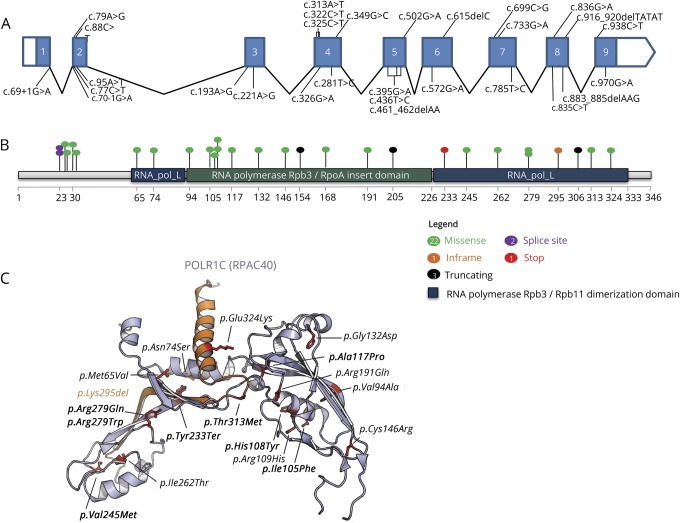
Through diagnostic gene panel screening in an epilepsy cohort, and recruiting through GeneMatcher and our international network, we collected 10 patients with biallelic variants. In addition, we collected data on 12 patients described in the literature to further delineate the associated phenotype in a total cohort of 22 patients. Computer modeling was used to assess changes on protein folding.
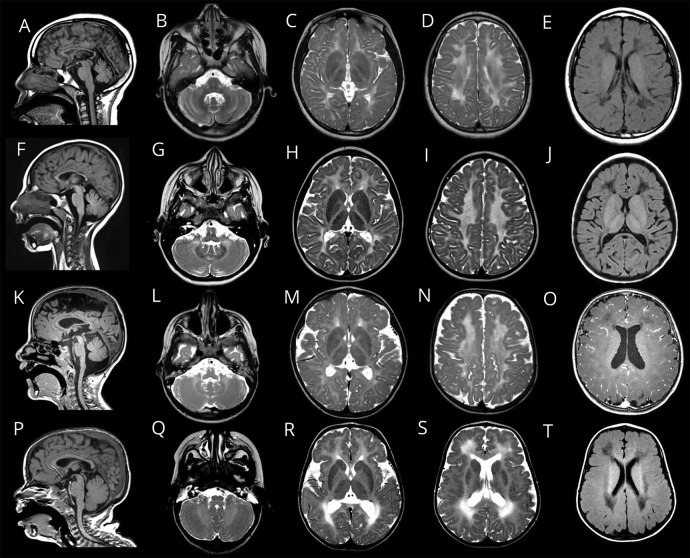
Biallelic pathogenic variants in cause a triad of progressive microcephaly, moderate to severe developmental delay, and early-onset epilepsy. Microcephaly was present at birth in 65%, and in all patients at follow-up. Moderate (14%) or severe (73%) developmental delay was characteristic, with no achievement of sitting (85%), walking (86%), or talking (90%). Additional features included irritability (91%), hypertonia/spasticity (75%), hypotonia (83%), stereotypic movements (75%), and short stature (56%). Seventy-nine percent had pharmacoresistant epilepsy with mainly neonatal onset. Characteristic cranial MRI findings include early-onset progressive atrophy of cerebral cortex (89%) and cerebellum (61%), enlargement of ventricles (95%), and age-dependent delayed myelination (88%). A small subset of patients displayed a less severe phenotype.
These data revealed first genotype-phenotype associations and may serve for improved interpretation of new variants and well-founded genetic counseling.
本研究旨在拓宽脑病的临床和基因谱,并评估脑病的基因型-表型关联。
通过对癫痫队列进行诊断性基因panel筛查,并通过GeneMatcher和我们的国际网络招募患者,我们收集了10例具有双等位基因变异的患者。此外,我们收集了文献中描述的12例患者的数据,以进一步描绘22例患者总队列中的相关表型。使用计算机建模来评估蛋白质折叠的变化。
双等位基因致病变异导致进行性小头畸形、中度至重度发育迟缓以及早发性癫痫三联征。65%的患者出生时即有小头畸形,随访时所有患者均有小头畸形。中度(14%)或重度(73%)发育迟缓是其特征,患者无法独坐(85%)、行走(86%)或说话(90%)。其他特征包括易激惹(91%)、张力亢进/痉挛(75%)、张力减退(83%)、刻板动作(75%)和身材矮小(56%)。79%的患者患有药物难治性癫痫,主要为新生儿期发病。典型的头颅MRI表现包括大脑皮质(89%)和小脑(61%)的早发性进行性萎缩、脑室扩大(95%)以及年龄依赖性髓鞘延迟形成(88%)。一小部分患者表现出较轻的表型。
这些数据揭示了首批基因型-表型关联,可能有助于更好地解释新变异,并为合理的遗传咨询提供依据。