Baynam Gareth, Broley Stephanie, Bauskis Alicia, Pachter Nicholas, McKenzie Fiona, Townshend Sharron, Slee Jennie, Kiraly-Borri Cathy, Vasudevan Anand, Hawkins Anne, Schofield Lyn, Helmholz Petra, Palmer Richard, Kung Stefanie, Walker Caroline E, Molster Caron, Lewis Barry, Mina Kym, Beilby John, Pathak Gargi, Poulton Cathryn, Groza Tudor, Zankl Andreas, Roscioli Tony, Dinger Marcel E, Mattick John S, Gahl William, Groft Stephen, Tifft Cynthia, Taruscio Domenica, Lasko Paul, Kosaki Kenjiro, Wilhelm Helene, Melegh Bela, Carapetis Jonathan, Jana Sayanta, Chaney Gervase, Johns Allison, Owen Peter Wynn, Daly Frank, Weeramanthri Tarun, Dawkins Hugh, Goldblatt Jack
Genetic Services of Western Australia, Department of Health, Government of Western Australia, Perth, WA, Australia.
School of Paediatrics and Child Health, University of Western Australia, Perth, WA, Australia.
Orphanet J Rare Dis. 2017 May 3;12(1):83. doi: 10.1186/s13023-017-0619-z.
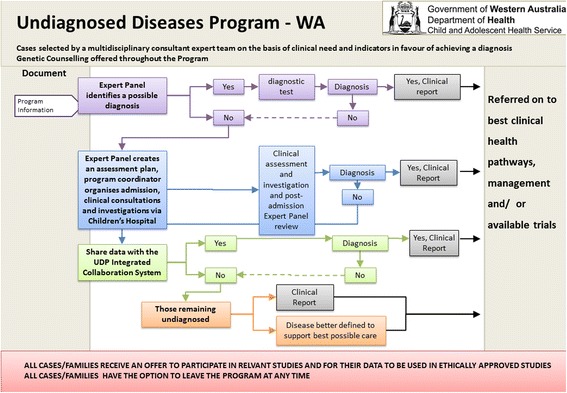
New approaches are required to address the needs of complex undiagnosed diseases patients. These approaches include clinical genomic diagnostic pipelines, utilizing intra- and multi-disciplinary platforms, as well as specialty-specific genomic clinics. Both are advancing diagnostic rates. However, complementary cross-disciplinary approaches are also critical to address those patients with multisystem disorders who traverse the bounds of multiple specialties and remain undiagnosed despite existing intra-specialty and genomic-focused approaches. The diagnostic possibilities of undiagnosed diseases include genetic and non-genetic conditions. The focus on genetic diseases addresses some of these disorders, however a cross-disciplinary approach is needed that also simultaneously addresses other disorder types. Herein, we describe the initiation and summary outcomes of a public health system approach for complex undiagnosed patients - the Undiagnosed Diseases Program-Western Australia (UDP-WA).
Briefly the UDP-WA is: i) one of a complementary suite of approaches that is being delivered within health service, and with community engagement, to address the needs of those with severe undiagnosed diseases; ii) delivered within a public health system to support equitable access to health care, including for those from remote and regional areas; iii) providing diagnoses and improved patient care; iv) delivering a platform for in-service and real time genomic and phenomic education for clinicians that traverses a diverse range of specialties; v) retaining and recapturing clinical expertise; vi) supporting the education of junior and more senior medical staff; vii) designed to integrate with clinical translational research; and viii) is supporting greater connectedness for patients, families and medical staff.
The UDP-WA has been initiated in the public health system to complement existing clinical genomic approaches; it has been targeted to those with a specific diagnostic need, and initiated by redirecting existing clinical and financial resources. The UDP-WA supports the provision of equitable and sustainable diagnostics and simultaneously supports capacity building in clinical care and translational research, for those with undiagnosed, typically rare, conditions.
需要新方法来满足复杂未确诊疾病患者的需求。这些方法包括临床基因组诊断流程,利用跨学科和多学科平台,以及特定专科的基因组诊所。两者都在提高诊断率。然而,互补的跨学科方法对于解决那些患有多系统疾病的患者也至关重要,这些患者跨越多个专科界限,尽管有现有的专科内和以基因组为重点的方法,但仍未得到诊断。未确诊疾病的诊断可能性包括遗传和非遗传疾病。对遗传疾病的关注解决了其中一些疾病,但需要一种跨学科方法,同时也能解决其他疾病类型。在此,我们描述了一种针对复杂未确诊患者的公共卫生系统方法——西澳大利亚未确诊疾病项目(UDP-WA)的启动和总结结果。
简而言之,UDP-WA是:i)在卫生服务机构内并通过社区参与实施的一套互补方法之一,以满足患有严重未确诊疾病者的需求;ii)在公共卫生系统内实施,以支持公平获得医疗保健,包括偏远和地区的患者;iii)提供诊断并改善患者护理;iv)为跨多个专科的临床医生提供在职和实时基因组学和表型组学教育平台;v)保留和重新获得临床专业知识;vi)支持初级和高级医务人员的教育;vii)旨在与临床转化研究相结合;viii)支持患者、家庭和医务人员之间建立更紧密的联系。
UDP-WA已在公共卫生系统中启动,以补充现有的临床基因组方法;它针对有特定诊断需求的人群,并通过重新分配现有的临床和财政资源启动。UDP-WA支持提供公平和可持续的诊断,同时支持针对未确诊的、通常罕见疾病患者的临床护理和转化研究能力建设。