Aquino-Jarquin Guillermo
Laboratorio de Investigación en Genómica, Genética y Bioinformática, Torre de Hemato-Oncología, 4to Piso, Sección 2, Hospital Infantil de México, Federico Gómez, Mexico City 06720, Mexico.
Mol Ther Nucleic Acids. 2020 Mar 6;19:1065-1072. doi: 10.1016/j.omtn.2019.12.042. Epub 2020 Jan 15.
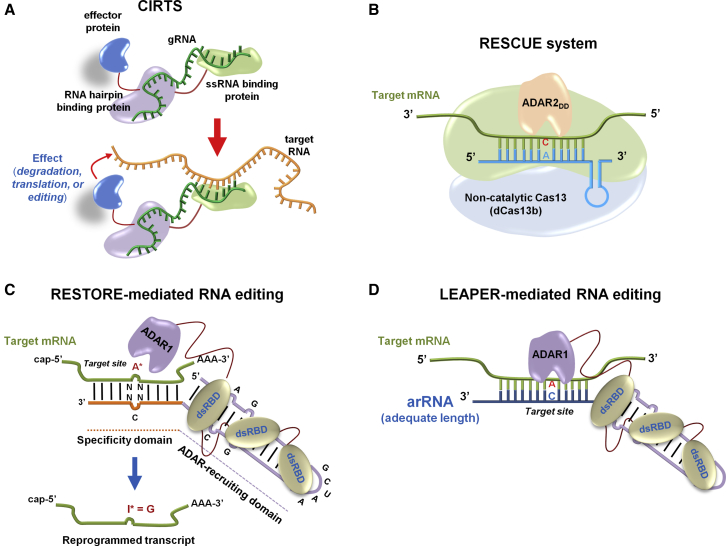
One of the most prevalent forms of post-transcriptional RNA modification is the conversion of adenosine-to-inosine (A-to-I), mediated by adenosine deaminase acting on RNA (ADAR) enzymes. The advent of the CRISPR/Cas systems inspires researchers to work actively in the engineering of programmable RNA-guided machines for basic research and biomedical applications. In this regard, CIRTS (CRISPR-Cas-Inspired RNA Targeting System), RESCUE (RNA Editing for Specific C to U Exchange), RESTORE (Recruiting Endogenous ADAR to Specific Transcripts for Oligonucleotide-mediated RNA Editing), and LEAPER (Leveraging Endogenous ADAR for Programmable Editing of RNA) are innovative RNA base-editing platforms that have recently been engineered to perform programmable base conversions on target RNAs mediated by ADAR enzymes in mammalian cells. Thus, these four currently characterized RNA-editing systems constitute novel molecular tools with compelling programmability, specificity, and efficiency that show us some creative ways to take advantage of the engineered deaminases for precise base editing. Moreover, the advanced engineering of these systems permits editing of full-length transcripts containing disease-causing point mutations without the loss of genomic information, providing an attractive alternative for in vivo research and in the therapeutic setting if the challenges encountered in off-target edits and delivery are appropriately addressed. Here, I present an analytical approach of the current status and rapid progress of the novel ADAR-mediated RNA-editing systems when highlighting the qualities of each new RNA-editing platform and how these RNA-targeting strategies could be used to recruit human ADARs on endogenous transcripts, not only for our understanding of RNA-modification-mediated regulation of gene expression but also for editing clinically relevant mutations in a programmable and straightforward manner.
转录后RNA修饰最普遍的形式之一是腺苷到次黄苷(A-to-I)的转化,这是由作用于RNA的腺苷脱氨酶(ADAR)介导的。CRISPR/Cas系统的出现激励研究人员积极致力于可编程RNA引导机器的工程设计,用于基础研究和生物医学应用。在这方面,CIRTS(受CRISPR-Cas启发的RNA靶向系统)、RESCUE(用于特定C到U交换的RNA编辑)、RESTORE(将内源性ADAR招募到特定转录本进行寡核苷酸介导的RNA编辑)和LEAPER(利用内源性ADAR进行RNA的可编程编辑)是创新的RNA碱基编辑平台,最近已被设计用于在哺乳动物细胞中对由ADAR酶介导的靶RNA进行可编程碱基转换。因此,这四个目前已表征的RNA编辑系统构成了具有引人注目的可编程性、特异性和效率的新型分子工具,为我们展示了一些利用工程脱氨酶进行精确碱基编辑的创新方法。此外,这些系统的先进工程设计允许编辑包含致病点突变的全长转录本,而不会丢失基因组信息,如果能够适当解决脱靶编辑和递送中遇到的挑战,这将为体内研究和治疗提供一个有吸引力的选择。在此,我提出一种分析方法,介绍新型ADAR介导的RNA编辑系统的现状和快速进展,同时突出每个新RNA编辑平台的特点,以及这些RNA靶向策略如何用于在内源转录本上招募人类ADAR,这不仅有助于我们理解RNA修饰介导的基因表达调控,还能以可编程且直接的方式编辑临床相关突变。