School of Optometry and Vision Science, UNSW Sydney, Sydney, Australia.
Centre for Vision Research, Department of Ophthalmology, The Westmead Institute for Medical Research, The University of Sydney, Sydney, Australia.
PLoS One. 2020 Feb 11;15(2):e0228858. doi: 10.1371/journal.pone.0228858. eCollection 2020.
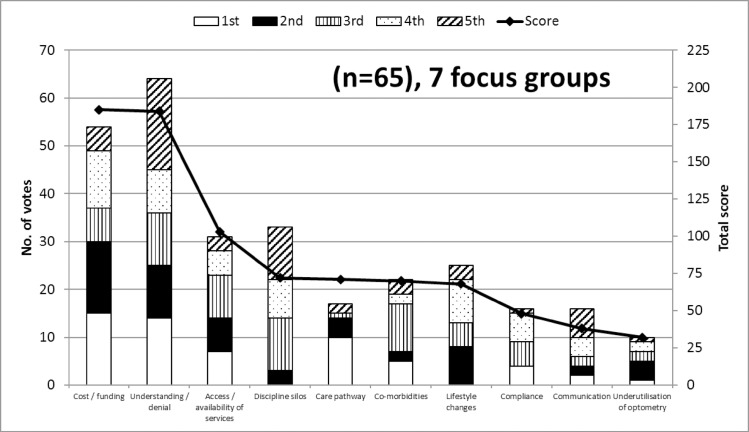
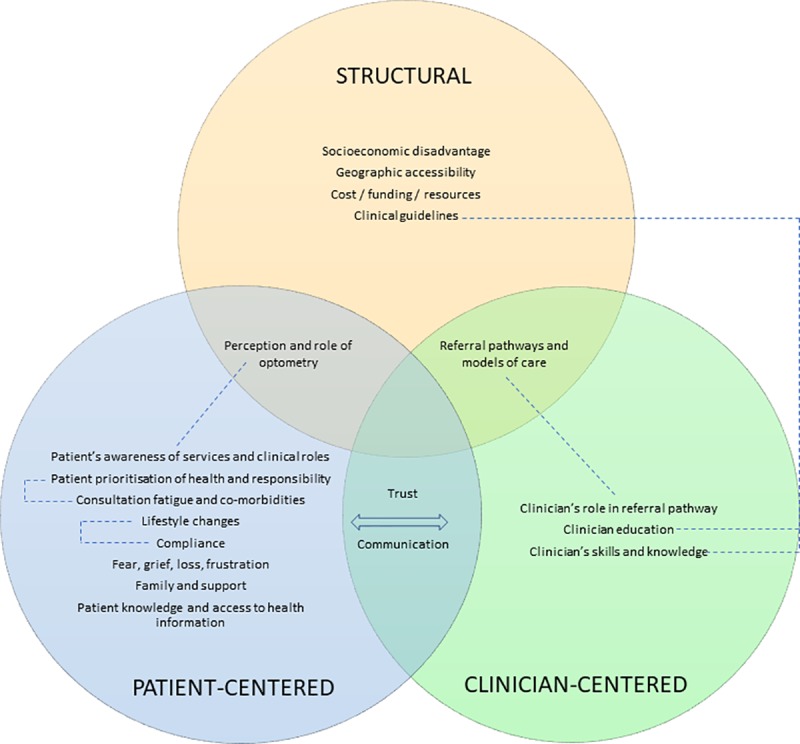
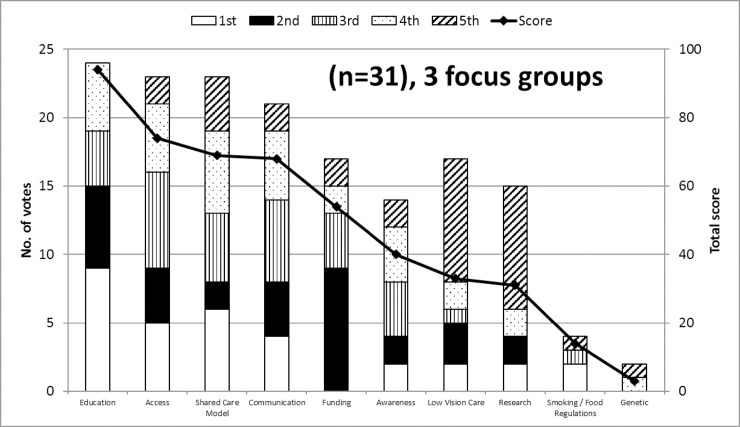
Despite the existence of evidence-based recommendations to decrease risk and progression of Age-Related Macular Degeneration (AMD) for some time, self-reported practices suggest that eyecare professionals' advice and people with AMD's adherence to these recommendations can be very poor. This study uses qualitative methods to explore Australian eyecare professionals' perspective on barriers to effective AMD care. Seven focus groups involving 65 optometrists were conducted by an experienced facilitator. A nominal group technique was used to identify, prioritize and semi-quantify barriers and enablers to AMD care. Participants individually ranked their perceived top five barriers and enablers with the most important granted a score of 5 and the least important a score of 1. For each barrier or enabler, the number of votes it received and its total score were recorded. Barriers and enablers selected by at least one participant in their top 5 were then qualitatively analysed, grouped using thematic analysis and total score calculated for each consolidated barrier or enabler. In-depth individual interviews were conducted with 10 ophthalmologists and 2 optometrists. Contributions were audio-recorded, transcribed verbatim and analysed with NVivo software. One hundred and sixty-nine barriers and 51 enablers to AMD care were identified in the focus groups. Of these, 102 barriers and 42 enablers were selected as one of their top 5 by at least one participant and further consolidated into 16 barriers and 10 enablers after thematic analysis. Factors impacting AMD care identified through analysis of the transcripts were coded to three categories of influence: patient-centered, practitioner-centered, and structural factors. Eyecare professionals considered poor care pathways, people with AMD's poor disease understanding / denial, and cost of care / lack of funding, as the most significant barriers to AMD care; they considered shared care model, access, and communication as the most significant enablers to good AMD care. These findings suggest that Australian eyecare professionals perceive that there is a need for improved patient support systems and appropriately funded, clearer care pathway to benefit people with AMD.
尽管一段时间以来一直存在基于证据的建议来降低年龄相关性黄斑变性(AMD)的风险和进展,但自我报告的做法表明,眼科保健专业人员的建议和 AMD 患者对这些建议的遵守情况可能非常差。本研究采用定性方法探讨澳大利亚眼科保健专业人员对有效 AMD 护理障碍的看法。由一位经验丰富的主持人进行了七次焦点小组,涉及 65 名验光师。使用名义群体技术来确定、优先排序和半定量分析 AMD 护理的障碍和促进因素。参与者单独对他们认为的前五项障碍和促进因素进行排名,最重要的给予 5 分,最不重要的给予 1 分。对于每个障碍或促进因素,记录它获得的票数及其总得分。然后对至少有一名参与者在其前 5 名中选择的障碍和促进因素进行定性分析,使用主题分析进行分组,并为每个综合障碍或促进因素计算总分。对 10 名眼科医生和 2 名验光师进行了深入的个人访谈。记录了贡献的音频记录、逐字转录和使用 NVivo 软件进行的分析。在焦点小组中确定了 169 个 AMD 护理障碍和 51 个促进因素。其中,有 102 个障碍和 42 个促进因素被至少一名参与者选为前 5 名,并在主题分析后进一步合并为 16 个障碍和 10 个促进因素。通过对转录本的分析确定的影响 AMD 护理的因素被编码为三个影响类别:以患者为中心、以从业者为中心和结构因素。眼科保健专业人员认为较差的护理途径、AMD 患者对疾病的理解/否认较差以及护理费用/缺乏资金是 AMD 护理的最大障碍;他们认为共享护理模式、可及性和沟通是良好 AMD 护理的最大促进因素。这些发现表明,澳大利亚眼科保健专业人员认为,需要改善患者支持系统和适当资助、更清晰的护理途径,以造福 AMD 患者。