Blakey Caroline M, O'Donnell John, Klaber Ianiv, Singh Parminder, Arora Manit, Takla Amir, Fitzpatrick Jane
Hip Arthroscopy Australia, Richmond, Australia.
Sheffield Children's Hospital, Sheffield, UK.
Orthop J Sports Med. 2020 Jan 24;8(1):2325967119895602. doi: 10.1177/2325967119895602. eCollection 2020 Jan.
Recalcitrant greater trochanteric pain is increasingly recognized as an indication for surgical intervention. The arthroscopic approach has become rapidly more common than the open alternative.
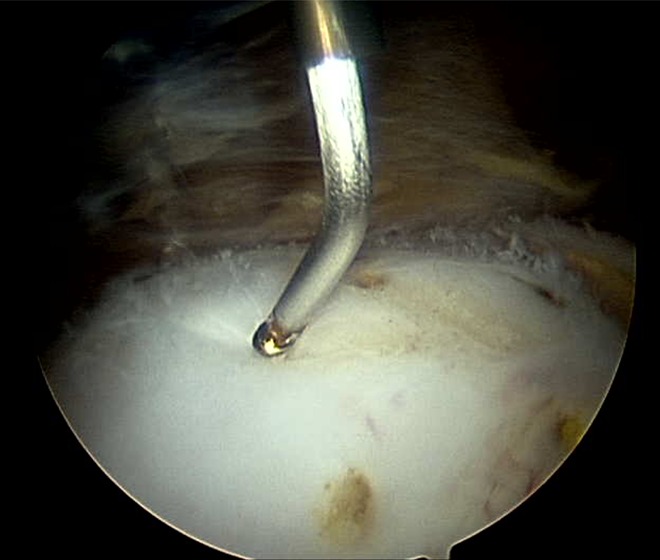
Patients undergoing radiofrequency microdebridement (RFMD) as an adjunct to arthroscopic gluteal bursectomy (AGB) and iliotibial band release (ITBR) will experience better functional improvement than AGB and ITBR alone at 1 year.
Randomized controlled trial; Level of evidence, 2.
A total of 33 patients with failed nonoperative treatment of gluteal tendinopathy were randomly allocated to undergo AGB/ITBR or AGB/ITBR + RFMD. Full-thickness tears were excluded. The primary outcome measure was the modified Harris Hip Score (mHHS) at 52 weeks. Secondary outcome measures included the mHHS, Western Ontario and McMaster Universities Osteoarthritis Index (WOMAC), visual analog scale (VAS) for pain, and 12-item Short Form Health Survey (SF-12), which were evaluated at 0, 6, 12, 24, and 52 weeks. Statistical significance was defined as < .05.
A total of 33 participants (33 hips; 30 female and 3 male; mean age, 58 years) were randomized; 16 patients underwent AGB/ITBR + RFMD, and 17 underwent AGB/ITBR. Participants' functionality improved in both groups at all time intervals. The mean mHHS score improved from 57.49 ± 10.61 to 77.76 ± 18.40 ( = .004) and from 58.98 ± 12.33 to 79.96 ± 18.86 ( = .001) at 52 weeks in the AGB/ITBR and AGB/ITBR + RFMD groups, respectively, although there was no statistically significant difference between groups. There were no device-related adverse events.
AGB/ITBR led to significant improvements in patients with recalcitrant gluteal tendinopathy. In this small RCT, the addition of RFMD showed no additional benefit to AGB/ITBR but provided a safe adjunct for the surgical management of recalcitrant gluteal tendinopathy.
NCT01562366 (ClinicalTrials.gov identifier).
顽固性大转子疼痛越来越被认为是手术干预的指征。关节镜手术方法已迅速比开放手术更常见。
接受射频微清创术(RFMD)作为关节镜下臀肌滑囊切除术(AGB)和髂胫束松解术(ITBR)辅助治疗的患者在1年时的功能改善将优于单纯进行AGB和ITBR的患者。
随机对照试验;证据等级,2级。
共有33例非手术治疗臀肌肌腱病失败的患者被随机分配接受AGB/ITBR或AGB/ITBR + RFMD。排除全层撕裂。主要结局指标是52周时的改良Harris髋关节评分(mHHS)。次要结局指标包括mHHS、西安大略和麦克马斯特大学骨关节炎指数(WOMAC)、疼痛视觉模拟量表(VAS)以及12项简短健康调查问卷(SF-12),在0、6、12、24和52周时进行评估。统计学显著性定义为P <.05。
共有33名参与者(33髋;30名女性和3名男性;平均年龄58岁)被随机分组;16例患者接受AGB/ITBR + RFMD,17例接受AGB/ITBR。两组在所有时间间隔的功能均有改善。在52周时,AGB/ITBR组和AGB/ITBR + RFMD组的平均mHHS评分分别从57.49±10.61提高到77.76±18.40(P =.004)和从58.98±12.33提高到79.96±18.86(P =.001),尽管两组之间无统计学显著差异。没有与器械相关的不良事件。
AGB/ITBR使顽固性臀肌肌腱病患者有显著改善。在这项小型随机对照试验中,添加RFMD对AGB/ITBR没有额外益处,但为顽固性臀肌肌腱病的手术治疗提供了一种安全的辅助方法。
NCT01562366(ClinicalTrials.gov标识符)