Department of Orthopaedic Surgery, Regionshospitalet Gødstrup, Central Denmark Region, Herning, 7400, Denmark.
Aarhus University, Aarhus, 8000, Denmark.
BMC Musculoskelet Disord. 2023 Jan 28;24(1):75. doi: 10.1186/s12891-023-06169-4.
Current literature presents a variety of surgical interventions aimed at modifying the iliotibial band (ITB) at the hip to relieve lateral hip pain (LHP). However, a focus towards the hip abductors as a main driver in LHP has evolved in the last decade, which could influence the indications for isolated ITB surgery. No previous review has been undertaken to evaluate isolated ITB surgery in LHP cases.
The purpose of this systematic review was to evaluate isolated ITB surgery in LHP patients in relation to pain, snapping, use of non-surgical treatments postoperatively, and repeated surgery.
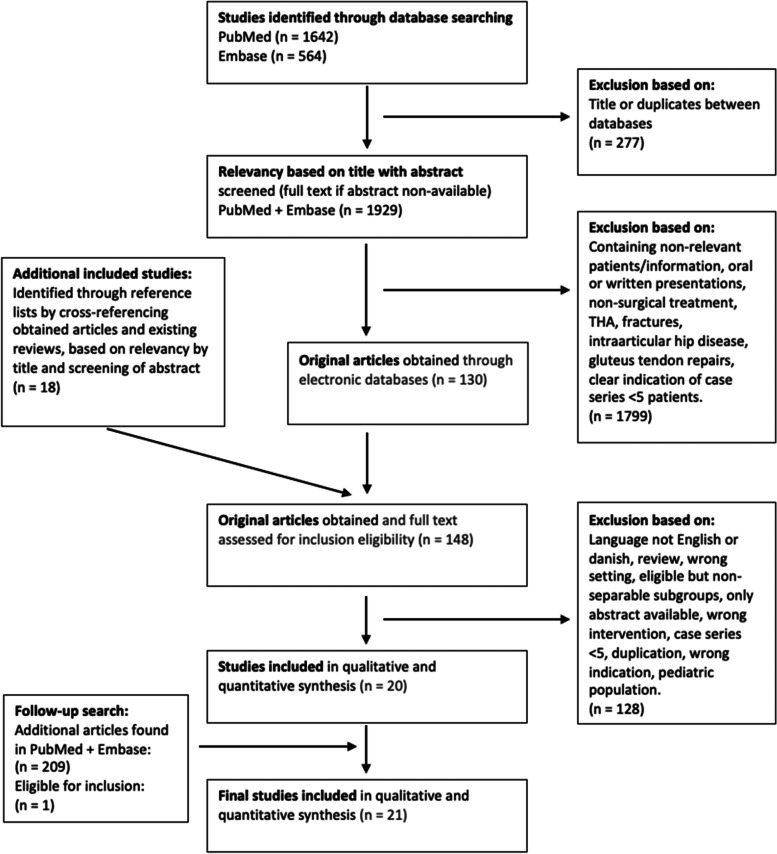
The study was reported in accordance with Preferred Reporting Items for Systematic Reviews and Meta-Analyses. The study was registered in Prospero (CRD42021216707) prior to initiation. A systematic search of literature on PubMed and Embase as well as bibliography screening on adult patients undergoing isolated ITB surgery with or without additional bursectomies was performed. Due to the lack of reliable data, no meta-analysis was performed.
A total of 21 studies (360 patients) were considered eligible for inclusion. The snapping and non-snapping group consisted of 150 and 210 patients, respectively. The mean follow-up time in the snapping group was 30 months and 19 months in the non-snapping group. Utilizing different surgical techniques, complete pain relief was not achieved in 12% of patients in the snapping group and 36% of the patients in the non-snapping group. In the snapping group, snapping was eliminated in 95% of patients, and five of 150 patients (3%) had repeated surgery. Eight of nine non-snapping studies reported information regarding repeated surgery, in which seven of 205 patients (3%) received repeated surgery.
ITB surgery at the hip remains widely adopted, although only level 4 studies are available, and little information exists on the long-term clinical, as well as patient reported outcomes. Based on the available data, we found indication of a positive short-term outcome in LHP with snapping regarding elimination of snapping, pain reduction, reuse of non-surgical treatment, and repeated surgery. In LHP with no snapping, we found limited evidence supporting ITB surgery based on current literature.
目前的文献提出了多种旨在改变髋关节处阔筋膜张肌(ITB)的手术干预措施,以缓解髋关节外侧疼痛(LHP)。然而,在过去十年中,人们越来越关注髋关节外展肌作为 LHP 的主要驱动因素,这可能会影响 ITB 手术的适应证。以前没有进行过专门评估 LHP 患者 ITB 手术的综述。
本系统评价的目的是评估 LHP 患者接受 ITB 手术的效果,包括疼痛、弹响、术后非手术治疗的使用以及再次手术的情况。
本研究按照系统评价和荟萃分析的首选报告项目进行报告。在开始之前,已在 Prospero(CRD42021216707)中进行了研究注册。对接受 ITB 手术(伴或不伴滑囊切除术)的成年患者的文献进行了 PubMed 和 Embase 的系统搜索,并进行了参考文献筛选。由于缺乏可靠的数据,因此未进行荟萃分析。
共有 21 项研究(360 例患者)被认为符合纳入标准。弹响组和非弹响组分别有 150 例和 210 例患者。弹响组的平均随访时间为 30 个月,非弹响组为 19 个月。采用不同的手术技术,弹响组中 12%的患者和非弹响组中 36%的患者未能完全缓解疼痛。在弹响组中,95%的患者弹响消除,150 例患者中有 5 例(3%)接受了再次手术。9 项非弹响研究中有 8 项报告了再次手术的信息,205 例患者中有 7 例(3%)接受了再次手术。
尽管只有 4 级研究可用,但髋关节处 ITB 手术仍被广泛采用,关于长期临床和患者报告的结果信息很少。根据现有数据,我们发现对于伴有弹响的 LHP,ITB 手术具有短期积极的结果,表现为弹响消除、疼痛减轻、非手术治疗再次使用和再次手术减少。对于不伴有弹响的 LHP,我们发现根据现有文献,支持 ITB 手术的证据有限。