Faculty of Geology, Geophysics and Environmental Protection, AGH - University of Science and Technology, Mickiewicza 30 Av., 30-059, Kraków, Poland.
Faculty of Geology, University of Warsaw, Warsaw, Poland.
Int J Biometeorol. 2020 May;64(5):815-826. doi: 10.1007/s00484-020-01871-7. Epub 2020 Feb 11.
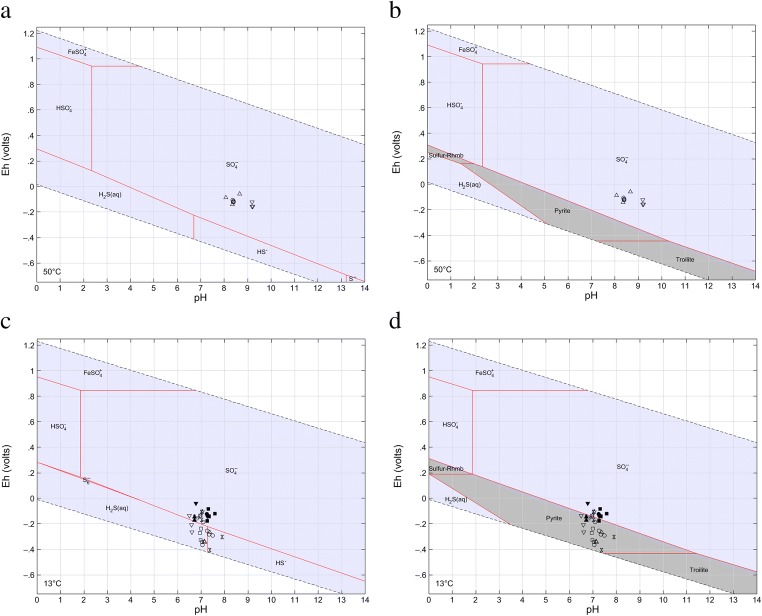
In some countries (e.g. Poland, Czechia, Slovakia, Russia, Germany), oxidation-reduction potential (ORP) measurements are required to document the quality of groundwater which are planned to be used as therapeutic waters. ORP is still rarely studied and not fully availed in therapeutic water research. Studies of ORP in various types of therapeutic, mineral and thermal waters in sites of Poland integrated with geochemical equilibrium approach were employed to characterize two redox-sensitive and bioactive elements, i.e. iron and sulphur. Studied waters present reducing conditions (E between - 406 and - 41 mV) at outflow or extraction sites; however, they significantly differ in terms of total dissolved solids, temperature, and iron, sulphur(II) and sulphate concentrations. These result in recognizable differences, e.g. in terms of saturation state with respect to aquifer rock minerals and the dominating forms of occurrence of elements studied disclosed on the stability field diagrams. Considering the methodological determinants, ORP orchestrated with geochemical modelling tools might be successfully applied for studying natural linkages between various groundwater in natural systems, protecting the therapeutic water resource, and identifying the changes of water quality both at exploitation sites (springs, wells) and treatment places.
在一些国家(如波兰、捷克、斯洛伐克、俄罗斯、德国),需要进行氧化还原电位 (ORP) 测量,以记录计划用作治疗水的地下水的质量。ORP 仍然很少被研究,并且在治疗水研究中尚未得到充分利用。采用波兰各地区各种类型的治疗性、矿泉性和温泉水与地球化学平衡方法相结合的 ORP 研究,用于表征两个氧化还原敏感和生物活性元素,即铁和硫。研究中的水在流出或抽取点处呈现还原条件(E 值介于-406 至-41 mV 之间);然而,它们在总溶解固体、温度以及铁、硫(II)和硫酸盐浓度方面存在显著差异。这些差异导致了明显的差异,例如在含水层岩石矿物的饱和度方面,以及在稳定场图上揭示的所研究元素的主要存在形式方面。考虑到方法学决定因素,ORP 与地球化学建模工具相结合,可能会成功地应用于研究自然系统中各种地下水之间的自然联系,保护治疗性水资源,并识别开采点(泉、井)和处理地点的水质变化。