Department of Clinical Pharmacy and Pharmacology, University of Groningen, University Medical Center Groningen, Groningen, The Netherlands.
Netherlands Pharmacovigilance Center Lareb, 's-Hertogenbosch, The Netherlands.
Drug Saf. 2020 May;43(5):489-495. doi: 10.1007/s40264-020-00913-8.
In general, women more often experience metformin-associated adverse drug reactions (ADRs) than men.
We aimed to assess whether sex differences in reported ADRs for metformin are observed at different times after initiation, and to explore their concurrence with sex differences in the dose of metformin over time. This may guide future studies in assessing the involved mechanisms of sex differences in metformin-associated ADRs and may guide sex-specific management of ADRs in clinical practice.
This study has a longitudinal design using data about patients initiating metformin collected by the Dutch National Pharmacovigilance Center Lareb through their Intensive Monitoring program. Patients were asked to complete a web-based questionnaire six times after initiation (i.e., at 2 weeks, 6 weeks and at 3, 6, 9, and 12 months). The outcome variables were the proportion of patients reporting any ADR (primary) and the dose of metformin (secondary). Sex differences in the proportions of ADRs and in the dose were tested at each assessment using Pearson Chi-Squared tests and Wilcoxon rank-sum tests, respectively. Using Bonferroni adjustment for multiple testing, a p value < 0.01 was considered statistically significant.
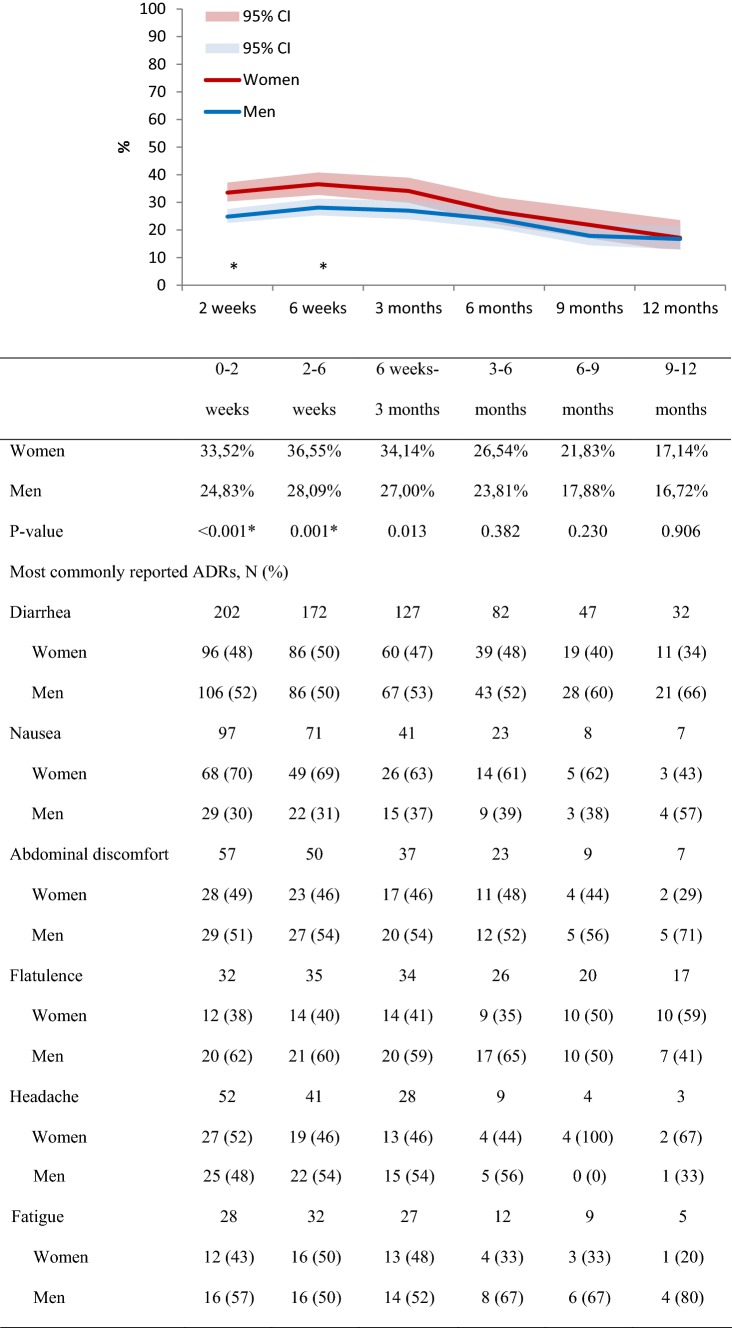
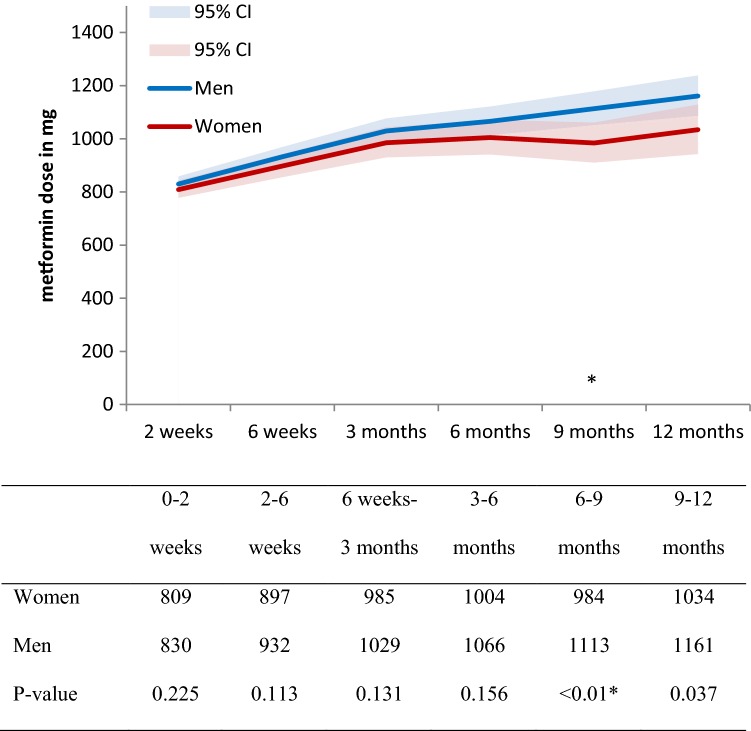
The number of included patients was 1712 (40.9% women). Women reported an ADR more often than men, which was statistically significant at the assessment at 2 weeks (34% vs 25%, p < 0.001), and 6 weeks (37% vs 28%, p = 0.001) after initiation. In general, women were reported to be prescribed a lower dose than men, which became statistically significant at the 9-month assessment (p < 0.01).
Sex differences in reported ADRs were seen in the first weeks after metformin initiation, whereas statistically significant differences in self-reported prescribed dosing were observed after several months. Patients, in particular women, might benefit from being prescribed lower metformin doses at treatment initiation.
一般来说,女性比男性更容易出现与二甲双胍相关的药物不良反应(ADR)。
我们旨在评估在开始使用二甲双胍后不同时间报告的 ADR 是否存在性别差异,并探讨其与随时间推移二甲双胍剂量性别差异的相关性。这可能有助于未来研究评估与二甲双胍相关 ADR 性别差异的相关机制,并为临床实践中 ADR 的性别特异性管理提供指导。
本研究采用纵向设计,使用荷兰国家药物警戒中心 Lareb 通过其强化监测计划收集的开始使用二甲双胍的患者数据。患者在开始使用后 6 次被要求完成在线问卷(即第 2 周、第 6 周以及第 3、6、9 和 12 个月)。主要结局变量为报告任何 ADR(主要)和二甲双胍剂量(次要)的患者比例。使用 Pearson Chi-Squared 检验和 Wilcoxon 秩和检验分别测试每个评估时 ADR 比例和剂量的性别差异。使用 Bonferroni 多重检验调整,p 值<0.01 被认为具有统计学意义。
纳入患者人数为 1712 名(40.9%为女性)。与男性相比,女性更常报告 ADR,这在开始使用后第 2 周(34%比 25%,p<0.001)和第 6 周(37%比 28%,p=0.001)时具有统计学意义。一般来说,女性的处方剂量低于男性,这在第 9 个月评估时具有统计学意义(p<0.01)。
在开始使用二甲双胍后的最初几周内观察到报告的 ADR 存在性别差异,而在几个月后观察到自我报告的处方剂量存在统计学显著差异。患者,尤其是女性,可能受益于在治疗开始时开较低剂量的二甲双胍。