Li Ying, Liu Jiaqiang
Department of Obstetrics.
Department of Hematology, People's Hospital of Rizhao, Shandong, China.
Medicine (Baltimore). 2020 Feb;99(7):e18897. doi: 10.1097/MD.0000000000018897.
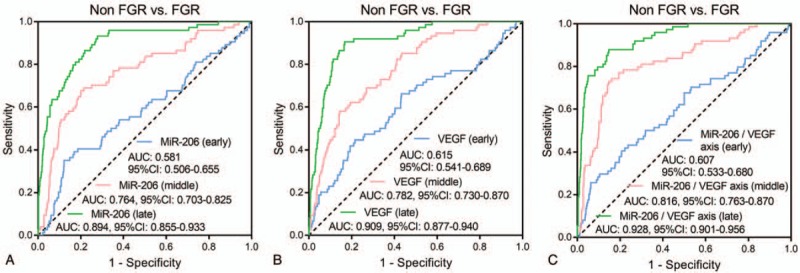
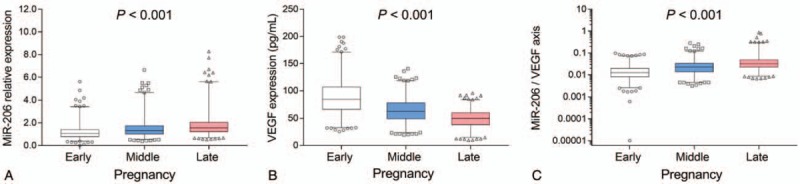
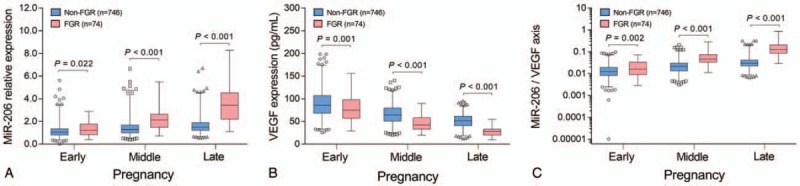
This study aimed to investigate the correlation of microRNA (miR)-206, vascular endothelial growth factor (VEGF) and miR-206/VEGF axis at different gestational ages with fetal growth retardation (FGR) risk in pregnancies.Eight hundred twenty pregnancies were consecutively recruited and their plasma samples were collected at early pregnancy (gestational age ≤ 13 weeks), middle pregnancy (gestational age: 14-27 weeks) and late pregnancy (gestational age ≥ 28 weeks), respectively. miR-206 expression and VEGF level in plasma were detected by quantitative polymerase chain reaction and enzyme-linked immunosorbent assay respectively. FGR was diagnosed based on the actual birth weight of fetus.miR-206 expression was negatively correlated with VEGF expression at early pregnancy, middle pregnancy and late pregnancy. Besides, miR-206 expression and miR-206/VEGF axis were elevated, but VEGF expression was decreased along with the increased gestational age. There were 74 FGR pregnancies and 746 non-FGR pregnancies. And both miR-206 expression and miR-206/VEGF axis were increased, but VEGF expression was reduced in FGR group compared to non-FGR group at early pregnancy, middle pregnancy and late pregnancy. Additionally, miR-206, VEGF and miR-206/VEGF axis at middle pregnancy and late pregnancy all showed good predictive values for FGR risk, and these indexes at late pregnancy exhibited the numerically highest predictive value for FGR risk. Furthermore, compared to miR-206 or VEGF alone, miR-206/VEGF axis presented with numerically higher predictive value for FGR risk.miR-206 predicts raised FGR risk through the interaction with VEGF in pregnancies, and it may serve as a novel biomarker for FGR prevention.
本研究旨在探讨不同孕周的微小RNA(miR)-206、血管内皮生长因子(VEGF)及miR-206/VEGF轴与妊娠胎儿生长受限(FGR)风险的相关性。连续纳入820例妊娠孕妇,分别于孕早期(孕周≤13周)、孕中期(孕周:14~27周)及孕晚期(孕周≥28周)采集其血浆样本。分别采用定量聚合酶链反应和酶联免疫吸附测定法检测血浆中miR-206表达水平和VEGF含量。根据胎儿实际出生体重诊断FGR。孕早期、孕中期及孕晚期miR-206表达与VEGF表达呈负相关。此外,随着孕周增加,miR-206表达及miR-206/VEGF轴升高,但VEGF表达降低。FGR妊娠74例,非FGR妊娠746例。孕早期、孕中期及孕晚期,FGR组较非FGR组miR-206表达及miR-206/VEGF轴均升高,但VEGF表达降低。此外,孕中期和孕晚期的miR-206、VEGF及miR-206/VEGF轴对FGR风险均具有良好的预测价值,且孕晚期这些指标对FGR风险的预测价值在数值上最高。此外,与单独的miR-206或VEGF相比,miR-206/VEGF轴对FGR风险的预测价值在数值上更高。miR-206通过与VEGF相互作用预测妊娠FGR风险升高,其可能成为预防FGR的新型生物标志物。