Laboratory of Muscle Pathology, Fragility and Aging, Department of Biological Sciences, Faculty of Life Sciences, Universidad Andres Bello, 8370146 Santiago, Chile.
Millennium Institute on Immunology and Immunotherapy, 8370146 Santiago, Chile.
Int J Mol Sci. 2020 Feb 10;21(3):1167. doi: 10.3390/ijms21031167.
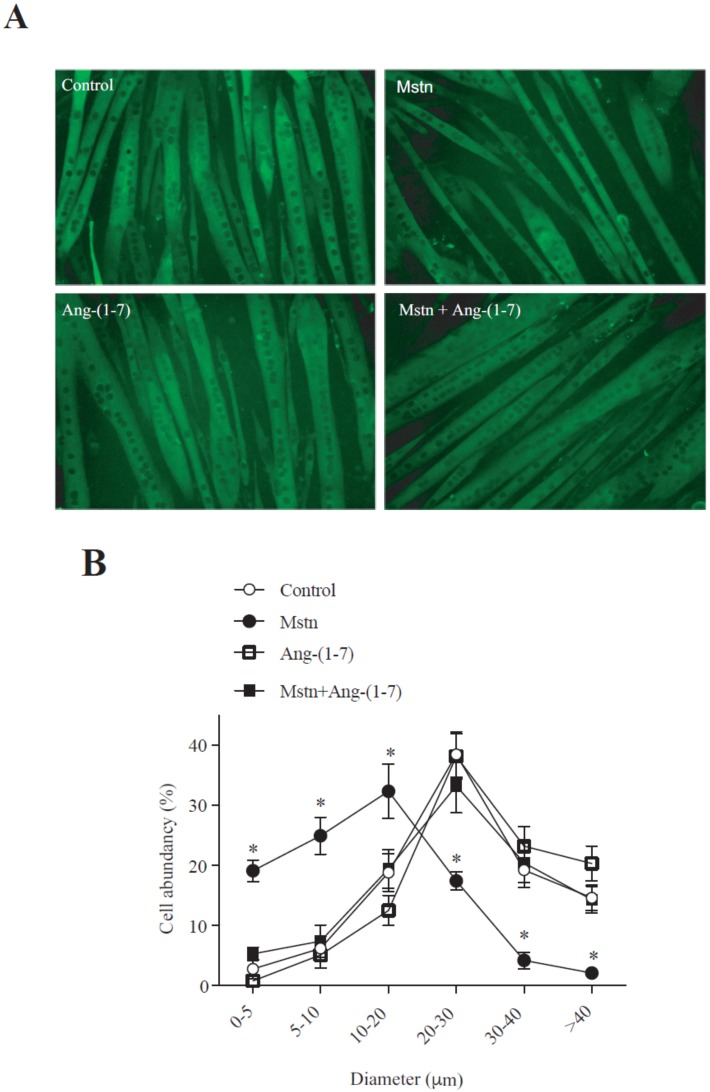
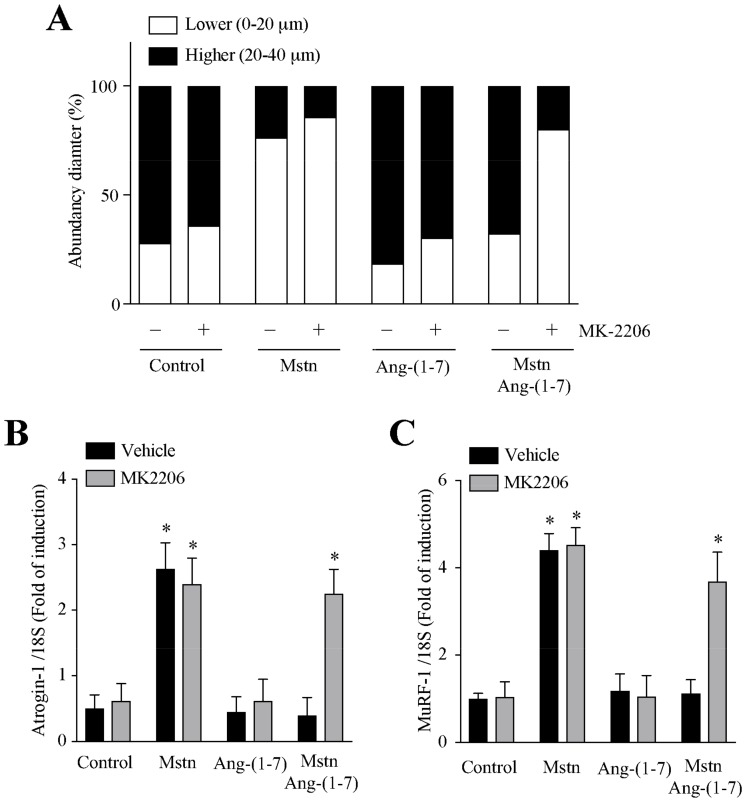
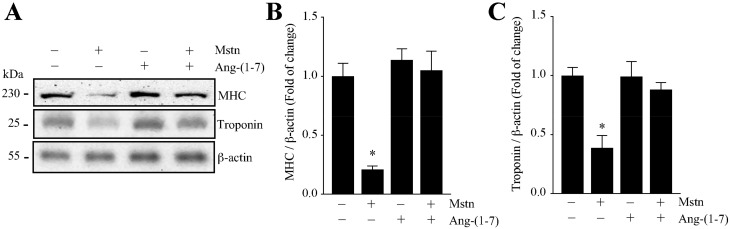
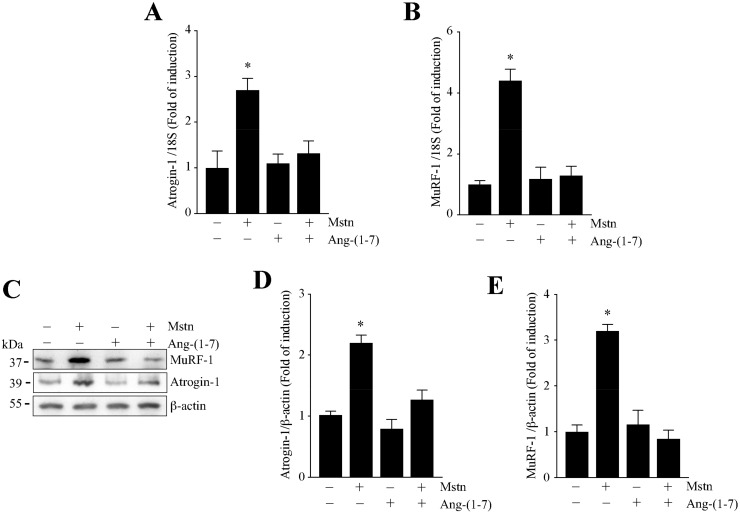
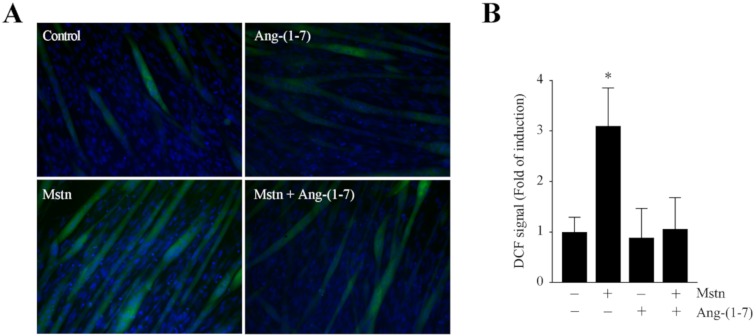
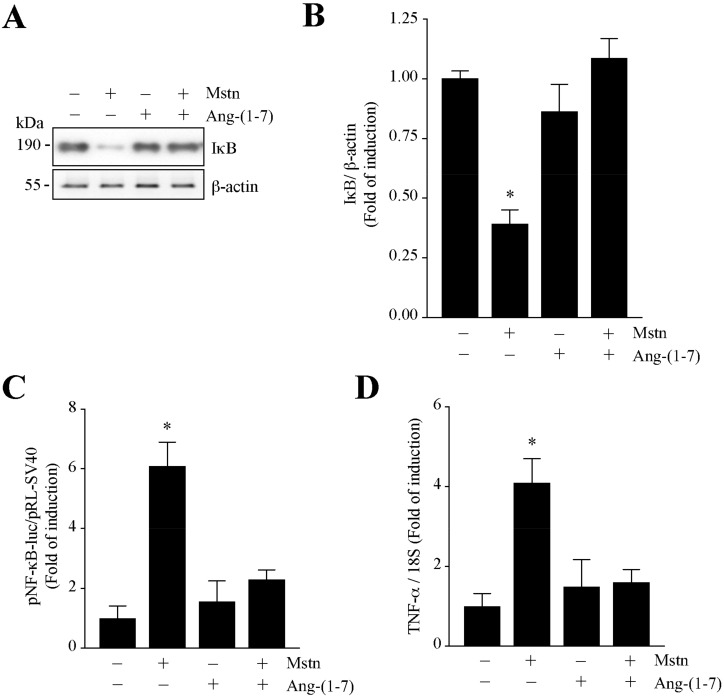
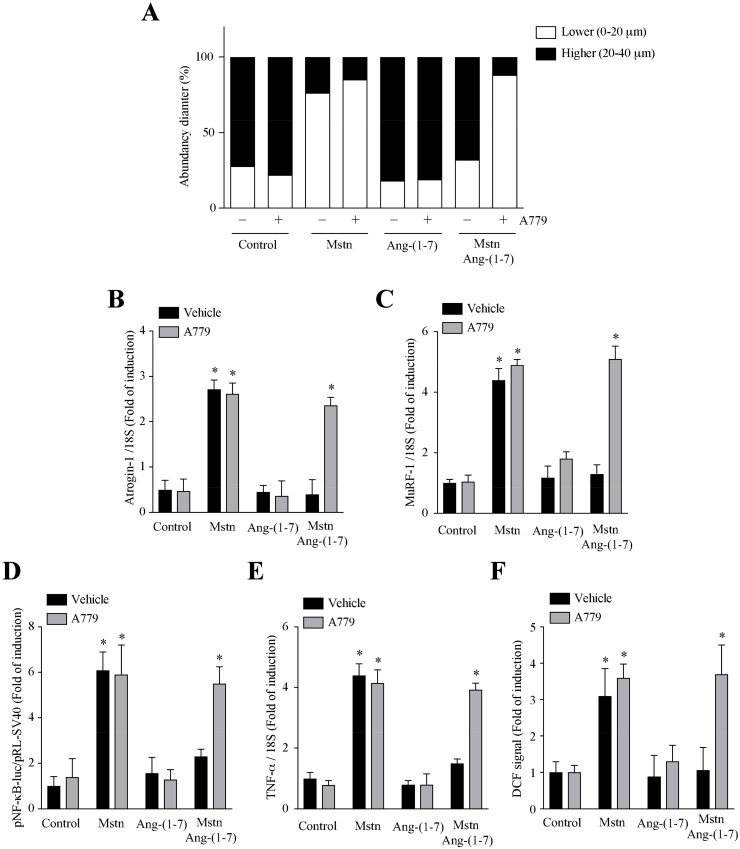
Myostatin is a myokine that regulates muscle function and mass, producing muscle atrophy. Myostatin induces the degradation of myofibrillar proteins, such as myosin heavy chain or troponin. The main pathway that mediates protein degradation during muscle atrophy is the ubiquitin proteasome system, by increasing the expression of atrogin-1 and MuRF-1. In addition, myostatin activates the NF-κB signaling pathway. Renin-angiotensin system (RAS) also regulates muscle mass. Angiotensin (1-7) (Ang-(1-7)) has anti-atrophic properties in skeletal muscle. In this paper, we evaluated the effect of Ang-(1-7) on muscle atrophy and signaling induced by myostatin. The results show that Ang-(1-7) prevented the decrease of the myotube diameter and myofibrillar protein levels induced by myostatin. Ang-(1-7) also abolished the increase of myostatin-induced reactive oxygen species production, atrogin-1, MuRF-1, and TNF-α gene expressions and NF-κB signaling activation. Ang-(1-7) inhibited the activity mediated by myostatin through Mas receptor, as is demonstrated by the loss of all Ang-(1-7)-induced effects when the Mas receptor antagonist A779 was used. Our results show that the effects of Ang-(1-7) on the myostatin-dependent muscle atrophy and signaling are blocked by MK-2206, an inhibitor of Akt/PKB. Together, these data indicate that Ang-(1-7) inhibited muscle atrophy and signaling induced by myostatin through a mechanism dependent on Mas receptor and Akt/PKB.
肌肉生长抑制素是一种肌因子,调节肌肉功能和质量,导致肌肉萎缩。肌肉生长抑制素诱导肌原纤维蛋白的降解,如肌球蛋白重链或肌钙蛋白。介导肌肉萎缩过程中蛋白质降解的主要途径是泛素蛋白酶体系统,通过增加肌萎缩蛋白-1(atrogin-1)和 MuRF-1 的表达。此外,肌肉生长抑制素激活 NF-κB 信号通路。肾素-血管紧张素系统(RAS)也调节肌肉质量。血管紧张素(1-7)(Ang-(1-7))在骨骼肌中具有抗萎缩作用。在本文中,我们评估了 Ang-(1-7)对肌肉生长抑制素诱导的肌肉萎缩和信号的影响。结果表明,Ang-(1-7)可防止肌肉生长抑制素诱导的肌管直径和肌原纤维蛋白水平的降低。Ang-(1-7)还消除了肌肉生长抑制素诱导的活性氧产生、肌萎缩蛋白-1(atrogin-1)、MuRF-1 和 TNF-α基因表达以及 NF-κB 信号激活的增加。Ang-(1-7)通过 Mas 受体抑制由肌肉生长抑制素介导的活性,如使用 Mas 受体拮抗剂 A779 时,所有 Ang-(1-7)诱导的效应均丧失。我们的结果表明,Ang-(1-7)对肌肉生长抑制素依赖性肌肉萎缩和信号的作用被 Akt/PKB 的抑制剂 MK-2206 阻断。总之,这些数据表明,Ang-(1-7)通过依赖 Mas 受体和 Akt/PKB 的机制抑制肌肉生长抑制素诱导的肌肉萎缩和信号。