School of Biological Sciences, University of Bristol, Life Sciences Building, 24 Tyndall Avenue, Bristol, BS8 1TQ, UK.
Biology Department, Faculty of Sciences, Prince Nourah Bin Abdulrahman University, Riyadh, Saudi Arabia.
Parasit Vectors. 2020 Feb 12;13(1):63. doi: 10.1186/s13071-020-3941-6.
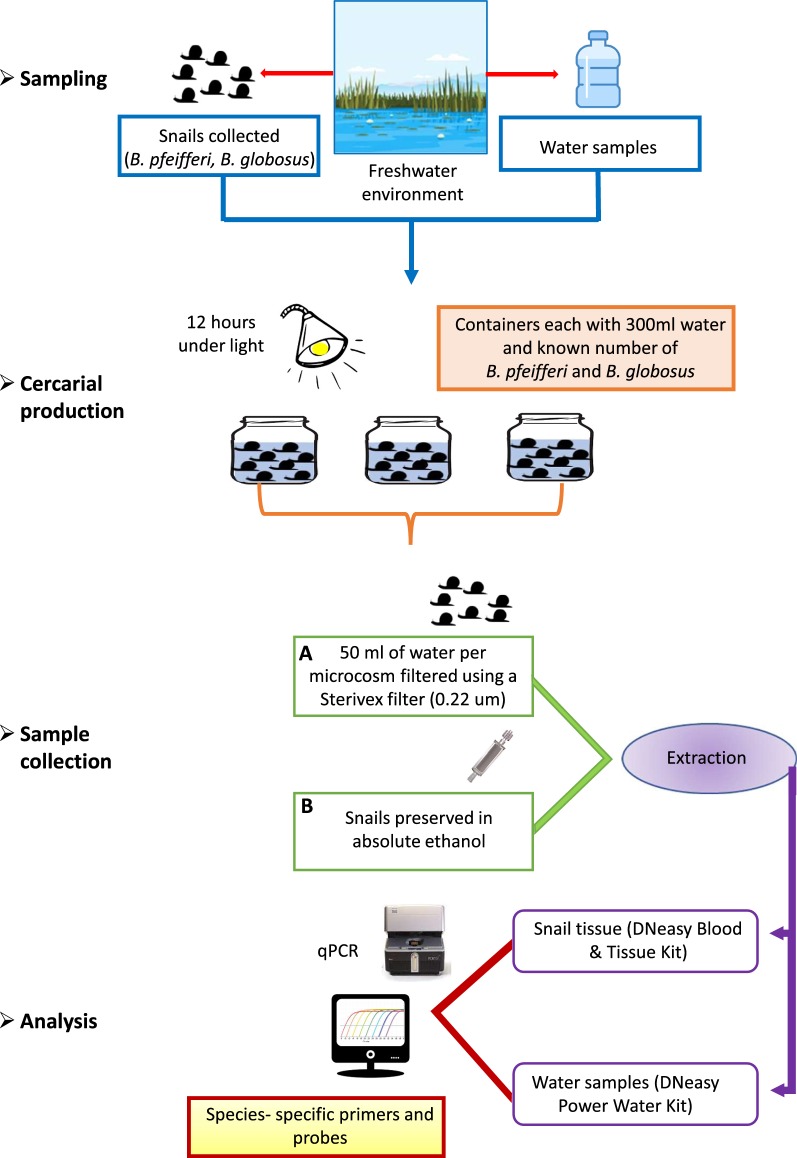
Schistosomiasis is a neglected tropical disease that infects over 200 million people worldwide. Control measures can benefit from improved surveillance methods in freshwaters, with environmental DNA (eDNA) surveys having the potential to offer effective and rapid detection of schistosomes. However, sampling eDNA directly from natural water bodies can lead to inaccurate estimation of infection risk if schistosome eDNA is rare in the environment. Here we report a xenomonitoring method that allows schistosome infections of host snail species to be determined from eDNA in water used to house those snails.
Host snail species were collected and placed in containers of water and allowed to shed cercariae, and then water samples were filtered and tested using qPCR assays specific to the African species Schistosoma mansoni and Schistosoma haematobium. We evaluated this "eDNA-based xenomonitoring" approach by experimentally comparing the results to those obtained from direct qPCR screening of tissue sourced from the snails in the experiment.
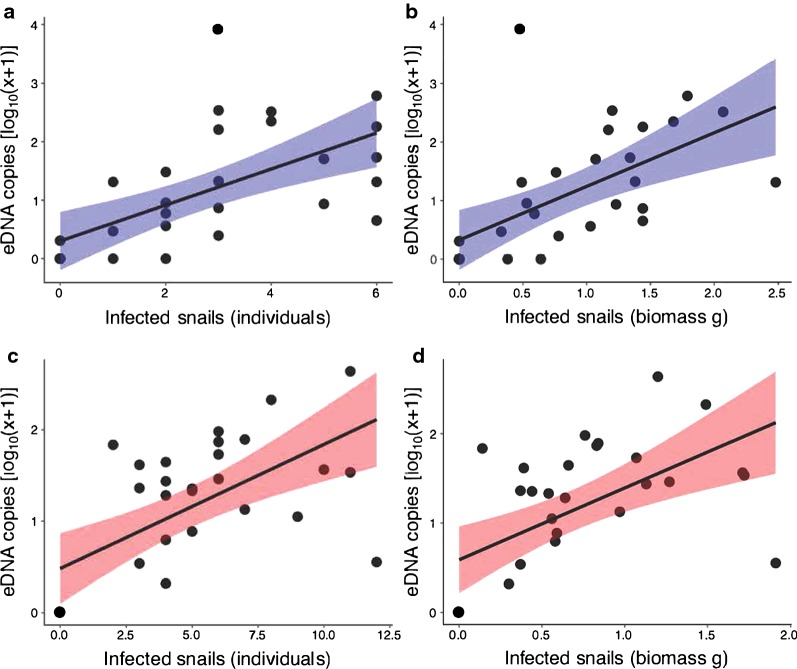
We found that our method accurately diagnosed the presence of S. mansoni-infected snails in all tests, and S. haematobium-infected snails in 92% of tests. Moreover, we found that the abundance of Schistosoma eDNA in experiments was directly dependent on the number and biomass of infected snails.
These results provide a strong indication that this surveillance method combining the utility of eDNA-based monitoring with the reliability of traditional xenomonitoring approaches could be used to accurately assay the presence of Schistosoma species in natural habitats. This approach may be well-suited for epidemiological studies and monitoring in endemic areas, where it can assist schistosomiasis control by indicating infection risk from freshwaters and guiding necessary interventions to eliminate the disease.
血吸虫病是一种被忽视的热带病,全球有超过 2 亿人感染。控制措施可以从改进淡水监测方法中受益,环境 DNA(eDNA)调查有可能提供有效的快速检测血吸虫的方法。然而,如果环境中血吸虫 eDNA 很少,直接从天然水体中采集 eDNA 可能会导致对感染风险的估计不准确。在这里,我们报告了一种 Xenomonitoring 方法,该方法允许从用于饲养这些蜗牛的水中的 eDNA 中确定宿主蜗牛物种的血吸虫感染。
收集宿主蜗牛物种并将其放置在盛水的容器中,让它们释放尾蚴,然后过滤水样并使用针对非洲种曼氏血吸虫和埃及血吸虫的 qPCR 检测方法进行检测。我们通过将实验结果与直接从实验中蜗牛组织中获得的 qPCR 筛查结果进行实验比较,评估了这种“基于 eDNA 的 Xenomonitoring”方法。
我们发现,我们的方法在所有测试中准确诊断出存在感染曼氏血吸虫的蜗牛,在 92%的测试中诊断出感染埃及血吸虫的蜗牛。此外,我们发现实验中 Schistosoma eDNA 的丰度与感染蜗牛的数量和生物量直接相关。
这些结果强烈表明,这种将 eDNA 监测与传统 Xenomonitoring 方法的可靠性相结合的监测方法可以用于准确检测自然栖息地中的血吸虫种。这种方法可能非常适合在流行地区进行流行病学研究和监测,通过指示来自淡水的感染风险并指导消除疾病的必要干预措施,它可以协助血吸虫病的控制。