Archer John, O'Halloran Lisa, Al-Shehri Hajri, Summers Shannan, Bhattacharyya Tapan, Kabaterine Narcis B, Atuhaire Aaron, Adriko Moses, Arianaitwe Moses, Stewart Martyn, LaCourse E James, Webster Bonnie L, Bustinduy Amaya L, Stothard J Russell
Wolfson Wellcome Biomedical Laboratories, Department of Zoology, Natural History Museum, Cromwell Road, London SW7 5BD, UK.
Department of Tropical Disease Biology, Liverpool School of Tropical Medicine, Pembroke Place, Liverpool L3 5QA, UK.
Trop Med Infect Dis. 2020 Aug 25;5(3):137. doi: 10.3390/tropicalmed5030137.
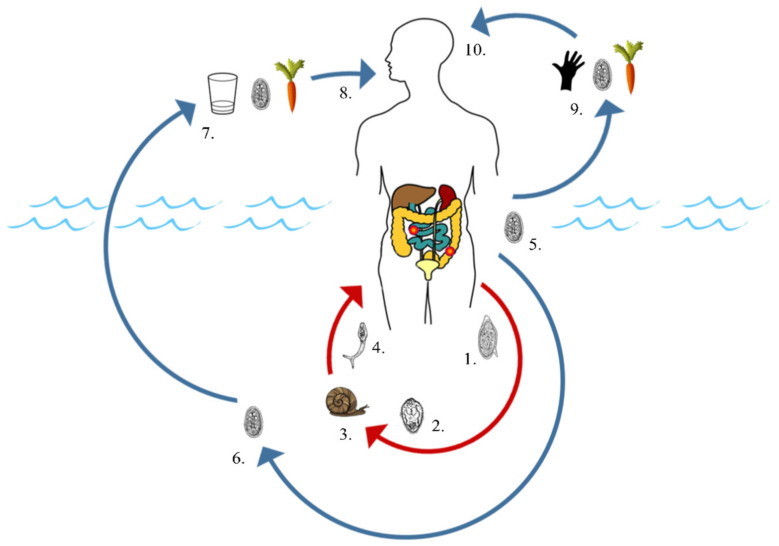
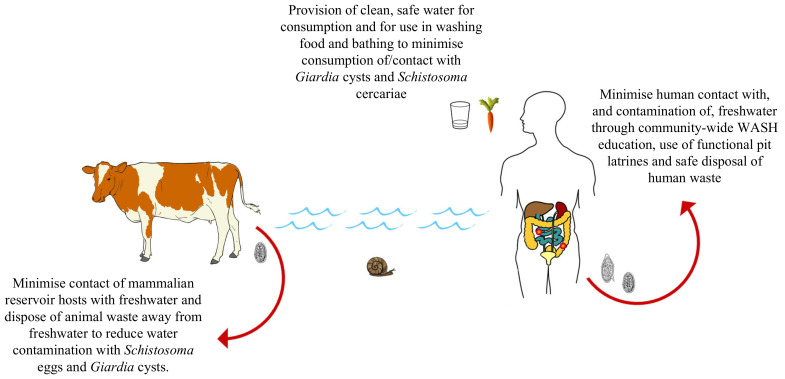
Both intestinal schistosomiasis and giardiasis are co-endemic throughout many areas of sub-Saharan Africa, significantly impacting the health of millions of children in endemic areas. While giardiasis is not considered a neglected tropical disease (NTD), intestinal schistosomiasis is formally grouped under the NTD umbrella and receives significant advocacy and financial support for large-scale control. Although there are differences in the epidemiology between these two diseases, there are also key similarities that might be exploited within potential integrated control strategies permitting tandem interventions. In this review, we highlight these similarities and discuss opportunities for integrated control of giardiasis in low and middle-income countries where intestinal schistosomiasis is co-endemic. By applying new, advanced methods of disease surveillance, and by improving the provision of water, sanitation and hygiene (WASH) initiatives, (co)infection with intestinal schistosomiasis and/or giardiasis could not only be more effectively controlled but also better understood. In this light, we appraise the suitability of a One Health approach targeting both intestinal schistosomiasis and giardiasis, for if adopted more broadly, transmission of both diseases could be reduced to gain improvements in health and wellbeing.
肠道血吸虫病和贾第虫病在撒哈拉以南非洲的许多地区都是共同流行的,对流行地区数百万儿童的健康产生了重大影响。虽然贾第虫病不被视为被忽视的热带病(NTD),但肠道血吸虫病被正式归类在NTD范围内,并在大规模控制方面获得了大量宣传和财政支持。尽管这两种疾病在流行病学上存在差异,但也有一些关键的相似之处,可能会在潜在的综合控制策略中得到利用,从而实现串联干预。在本综述中,我们强调了这些相似之处,并讨论了在肠道血吸虫病共同流行的低收入和中等收入国家综合控制贾第虫病的机会。通过应用新的、先进的疾病监测方法,并改善水、环境卫生和个人卫生(WASH)措施,肠道血吸虫病和/或贾第虫病的(合并)感染不仅可以得到更有效的控制,而且可以得到更好的了解。有鉴于此,我们评估了针对肠道血吸虫病和贾第虫病的“同一健康”方法的适用性,因为如果更广泛地采用该方法,这两种疾病的传播都可以减少,从而改善健康和福祉。