Department of Anatomy, Faculty of Medicine, Khon Kaen University, 123 Moo 16 Mittraphap Road, Nai-Muang, Muang District, Khon Kaen 40002, Thailand.
Center for Research and Development of Herbal Health Products, Faculty of Pharmaceutical Sciences, Khon Kaen University, 123 Moo 16 Mittraphap Road, Nai-Muang, Muang District, Khon Kaen 40002, Thailand.
Exp Anim. 2020 Aug 5;69(3):269-278. doi: 10.1538/expanim.19-0123. Epub 2020 Feb 11.
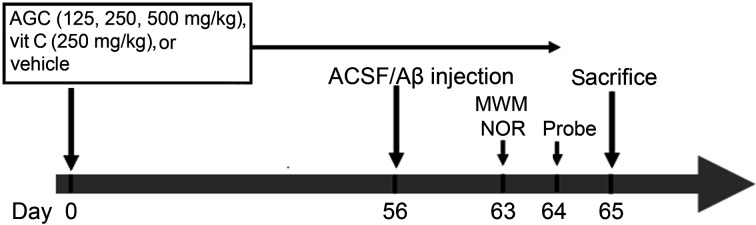
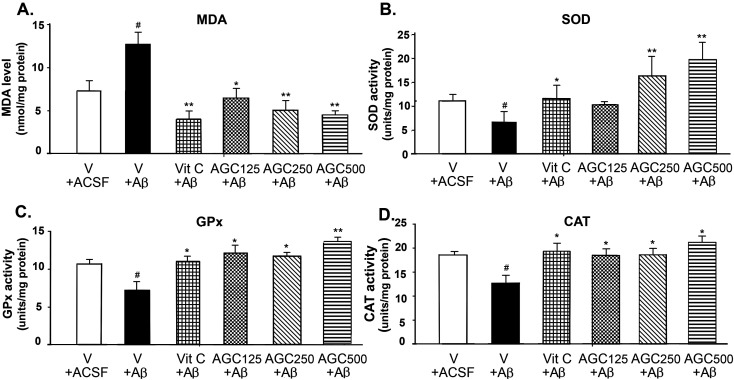
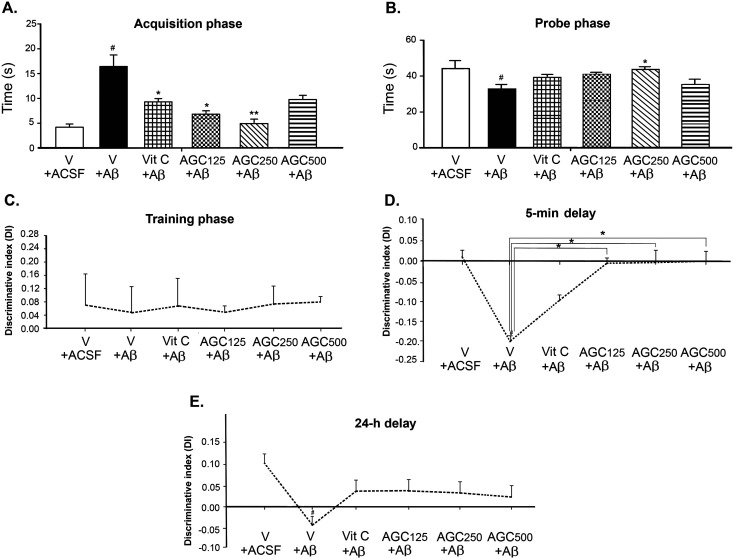
A combination of aged garlic, ginger, and chili peppers extracts (AGC) was studied by high-performance liquid chromatography, 2,2-diphenyl-1-picrylhydrazyl, and ferric-reducing antioxidant assays, and oxidative stress markers were analyzed in Aβ1-42-induced rats. The AGC was orally administered to Wistar rats at doses of 125, 250, and 500 mg/kg body weight (AGC125, AGC250, AGC500, respectively) for 64 days. At day 56, Aβ1-42 was injected via both sides of the lateral ventricles. The effects of the AGC on spatial and recognition memory were examined using a Morris water maze and novel object recognition tasks. Rats induced with Aβ1-42 exhibited obvious cognitive deficits, as demonstrated by their increased escape latency time (ET) and decreased retention time (RT) and percentage of discriminative index (DI). When compared with the control group, all AGC-treated rats showed significantly shorter ETs and higher DIs during the 5-min delay testing phase. Rats treated with AGC250 also had significantly longer RTs. Administration of Aβ1-42 significantly increased malondialdehyde (MDA) levels and decreased superoxide dismutase (SOD), catalase (CAT), and glutathione peroxidase (GPx) levels in the rat brain homogenate. Pretreatment with the AGC caused significant increases in SOD, GPx, and CAT activities, as well as a significant decrease in MDA in the rat brain homogenates after Aβ-induced neurotoxicity. Our results suggested that an AGC may ameliorate cognitive dysfunction in Aβ-treated rats due to its role in the upregulation of SOD, GPx, and CAT.
大蒜、生姜和辣椒提取物(AGC)的组合通过高效液相色谱法、2,2-二苯基-1-苦基肼(DPPH)和铁还原抗氧化测定法进行了研究,并分析了 Aβ1-42 诱导的大鼠中的氧化应激标志物。AGC 以 125、250 和 500 mg/kg 体重(AGC125、AGC250 和 AGC500)的剂量口服给予 Wistar 大鼠,共 64 天。在第 56 天,通过侧脑室两侧注射 Aβ1-42。使用 Morris 水迷宫和新物体识别任务来检查 AGC 对空间和识别记忆的影响。用 Aβ1-42 诱导的大鼠表现出明显的认知缺陷,表现在其逃避潜伏期(ET)延长,保留时间(RT)和辨别指数(DI)百分比降低。与对照组相比,所有 AGC 处理的大鼠在 5 分钟延迟测试阶段的 ET 明显缩短,DI 明显升高。AGC250 治疗的大鼠 RT 也明显延长。用 Aβ1-42 处理大鼠显著增加了脑匀浆中的丙二醛(MDA)水平,降低了超氧化物歧化酶(SOD)、过氧化氢酶(CAT)和谷胱甘肽过氧化物酶(GPx)水平。AGC 的预处理导致 SOD、GPx 和 CAT 活性显著增加,以及 Aβ 诱导的神经毒性后大鼠脑匀浆 MDA 显著降低。我们的结果表明,AGC 可能通过上调 SOD、GPx 和 CAT 来改善 Aβ 处理大鼠的认知功能障碍。