State Key Laboratory of Reproductive Regulation & Breeding of Grassland Livestock, School of Life Sciences, Inner Mongolia University, Hohhot, Inner Mongolia, People's Republic of China.
Sci Rep. 2020 Feb 12;10(1):2475. doi: 10.1038/s41598-020-59424-2.
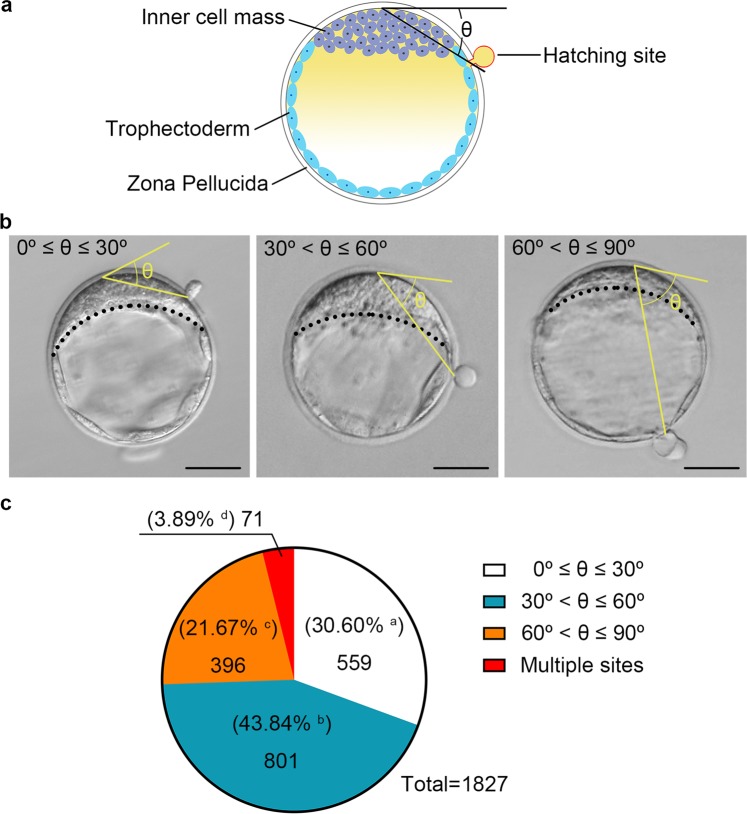
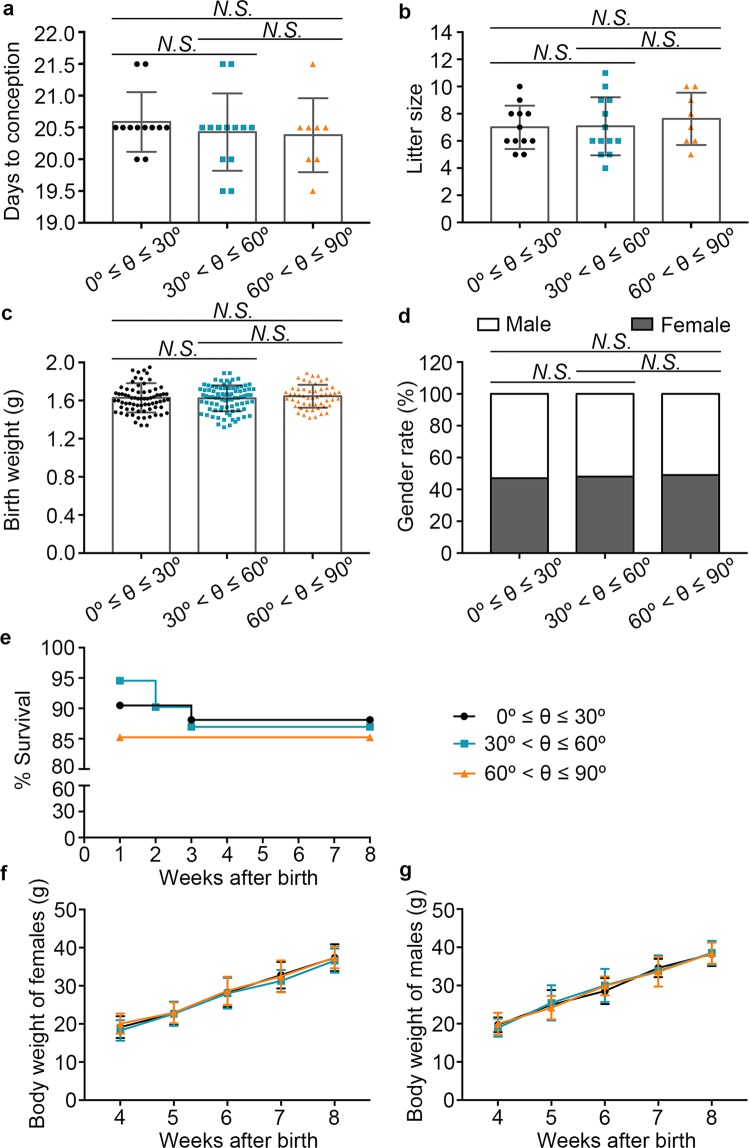
Hatching out from the zona pellucida (ZP) is a crucial step for blastocyst implantation and development. However, it is still unknown whether the location of the hatching site relative to the inner cell mass (ICM) affects embryo implantation and foetal development. Here, we classified hatching blastocysts into three categories, 0° ≤ θ ≤ 30°, 30° < θ ≤ 60°, and 60° < θ ≤ 90°, in which θ is determined based on the relative position of the hatching site to the arc midpoint of the ICM. Non-surgical embryo transfer (NSET) devices were employed to evaluate blastocyst implantation and embryo development. Of 1,827 hatching blastocysts, 43.84%, 30.60%, and 21.67% were categorized as 30° < θ ≤ 60°, 0° ≤ θ ≤ 30°, and 60° < θ ≤ 90°, respectively. Embryos with different hatching sites showed no distinct differences in blastocyst implantation; surrogate female pregnancy; embryo development to term; litter size, or offspring survival, gender, or body weight. Our results indicate that mouse blastocyst hatching site is not randomly distributed. Embryo implantation and development are not correlated with the blastocyst hatching site in mice. Thus, assessment of the blastocyst hatching site should not be recommended to evaluate mouse blastocyst implantation and developmental potential.
从透明带(ZP)孵化出来是囊胚着床和发育的关键步骤。然而,尚不清楚相对于内细胞团(ICM)的孵出部位的位置是否会影响胚胎着床和胎儿发育。在这里,我们将孵出的囊胚分为三类,0°≤θ≤30°、30°<θ≤60°和 60°<θ≤90°,其中θ是根据孵出部位相对于 ICM 弧形中点的相对位置来确定的。我们采用非手术胚胎移植(NSET)装置来评估囊胚着床和胚胎发育。在 1827 个孵出的囊胚中,分别有 43.84%、30.60%和 21.67%被归类为 30°<θ≤60°、0°≤θ≤30°和 60°<θ≤90°。具有不同孵出部位的胚胎在囊胚着床、代孕雌性妊娠、胚胎发育至足月、产仔数或后代存活率、性别或体重方面没有明显差异。我们的结果表明,小鼠囊胚的孵出部位不是随机分布的。胚胎着床和发育与小鼠囊胚的孵出部位无关。因此,评估囊胚的孵出部位不应该被推荐用来评估小鼠囊胚的着床和发育潜能。