Department of Psychiatry, Saitama Medical Center, Saitama Medical University, Saitama, Japan.
Department of Neuropsychiatry, Keio University School of Medicine, Tokyo, Japan.
Am J Alzheimers Dis Other Demen. 2020 Jan-Dec;35:1533317520904551. doi: 10.1177/1533317520904551.
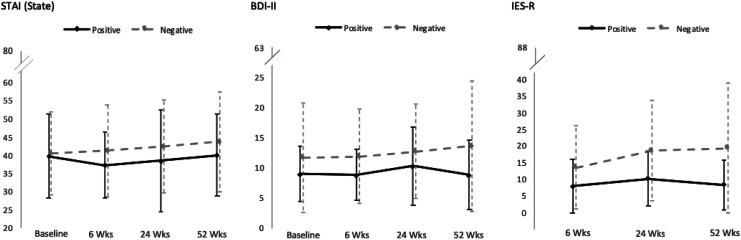
This study aimed to investigate the long-term impacts of disclosing amyloid status for a risk of Alzheimer disease (AD) to cognitively normal research participants with subjective cognitive decline (SCD), which represents an initial manifestation of AD. Forty-two participants were classified as the amyloid-positive ( = 10) or amyloid-negative ( = 32) groups. We assessed symptoms of anxiety, depression, and test-related distress at 6, 24, and 52 weeks after results disclosure. No difference was found over time in anxiety, depression, and test-related distress in either group. Although no significant differences were observed between groups in anxiety or depression, the amyloid-negative group had a significantly higher level of test-related distress than the amyloid-positive group at 52 weeks. Disclosing amyloid status to cognitively healthy research participants with SCD did not cause significant long-term psychological risks. However, a theoretical spectrum of subjective concern may exist about cognitive decline in amyloid-negative individuals.
本研究旨在探究向有主观认知下降(SCD)的认知正常的研究参与者透露阿尔茨海默病(AD)风险的淀粉样蛋白状态的长期影响,SCD 是 AD 的初始表现之一。42 名参与者被分为淀粉样蛋白阳性组(n=10)或淀粉样蛋白阴性组(n=32)。我们在结果披露后 6、24 和 52 周时评估了焦虑、抑郁和与测试相关的困扰症状。两组在焦虑、抑郁和与测试相关的困扰方面在时间上均无差异。尽管两组在焦虑或抑郁方面没有观察到显著差异,但在 52 周时,淀粉样蛋白阴性组的与测试相关的困扰显著高于淀粉样蛋白阳性组。向有 SCD 的认知健康研究参与者透露淀粉样蛋白状态并未导致明显的长期心理风险。然而,对于淀粉样蛋白阴性个体的认知下降,可能存在一种理论上的主观关注谱。