Lee Eun-Gyeong, Jung So-Youn, Lim Myong Cheol, Lim Jiwon, Kang Han-Sung, Lee Seeyoun, Han Jai Hong, Jo Heein, Won Young-Joo, Lee Eun Sook
Center for Breast Cancer, National Cancer Center, Goyang, Korea.
Cancer Healthcare Research Branch, Research Institute, National Cancer Center, Goyang, Korea.
Cancer Res Treat. 2020 Jul;52(3):739-746. doi: 10.4143/crt.2019.639. Epub 2020 Feb 13.
This study aimed to determine the incidence of male breast cancer (MBC) and its survival outcomes in Korea, and to compare these results to those for female breast cancer (FBC).
We searched the Korea Central Cancer Registry and identified 227,122 breast cancer cases that were diagnosed between 1999 and 2016. Demographic and clinical characteristics and overall survival (OS) rates were estimated according to sex, age, histological type, and cancer stage.
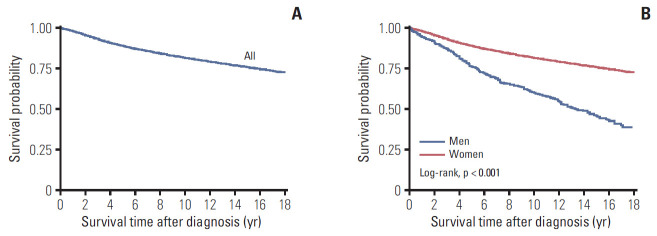
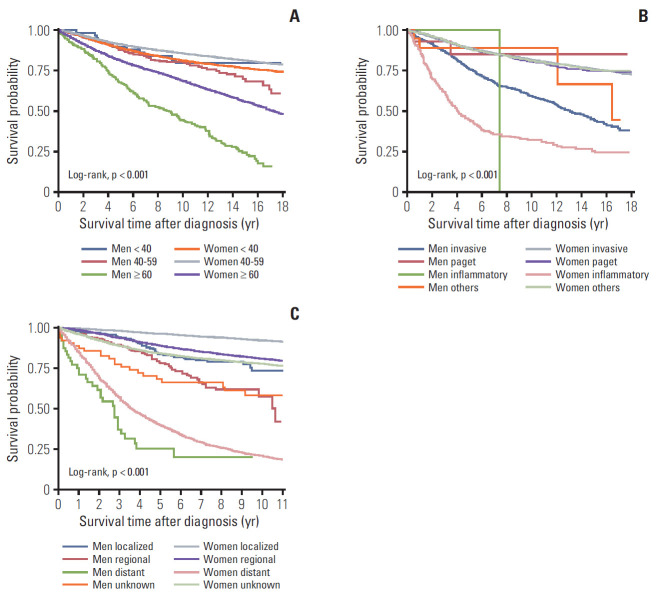
The 227,122 patients included 1,094 MBC cases and 226,028 FBC cases. Based on the age-standardized rate, the male: female ratio was 0.0055:1. The most common ages at diagnosis were 60-69 years for MBC and 40-49 years for FBC (p < 0.001). Male patients were less likely than female patients to receive adjuvant radiotherapy (7.5% vs. 21.8%, p < 0.001) or adjuvant chemotherapy (40.1% vs. 55.4%, p < 0.001). The 5-year OS rates after diagnosis were 88.8% for all patients, although it was significantly lower for MBC than for FBC (76.2% vs. 88.9%, p < 0.001). In both groups, older age (≥ 60 years) was associated with shorter survival. The 5-year OS rates for the invasive histological types were 75.8% for men and 89.0% for women. The 5-year OS rates in both groups decreased with increasing cancer stage.
MBC was diagnosed at older ages than FBC, and male patients were less likely to receive radiotherapy and chemotherapy. The survival outcomes were worse for MBC than for FBC, with even poorer outcomes related to older age, the inflammatory histological types, and advanced stage. It is important that clinicians recognize the differences between FBC and MBC when treating these patients.
本研究旨在确定韩国男性乳腺癌(MBC)的发病率及其生存结局,并将这些结果与女性乳腺癌(FBC)的结果进行比较。
我们检索了韩国中央癌症登记处,确定了1999年至2016年间诊断出的227,122例乳腺癌病例。根据性别、年龄、组织学类型和癌症分期估计人口统计学和临床特征以及总生存率(OS)。
227,122例患者中包括1,094例MBC病例和226,028例FBC病例。基于年龄标准化率,男性与女性的比例为0.0055:1。MBC最常见的诊断年龄为60-69岁,FBC为40-49岁(p<0.001)。男性患者接受辅助放疗(7.5%对21.8%,p<0.001)或辅助化疗(40.1%对55.4%,p<0.001)的可能性低于女性患者。所有患者诊断后的5年总生存率为88.8%,尽管MBC的5年总生存率显著低于FBC(76.2%对88.9%,p<0.001)。在两组中,年龄较大(≥60岁)与较短的生存期相关。浸润性组织学类型的男性5年总生存率为75.8%,女性为89.0%。两组的5年总生存率均随癌症分期的增加而降低。
MBC的诊断年龄比FBC大,男性患者接受放疗和化疗的可能性较小。MBC的生存结局比FBC差,年龄较大、炎症性组织学类型和晚期的结局更差。临床医生在治疗这些患者时认识到FBC和MBC之间的差异很重要。