Division of Health Services Research, National Cancer Center, Tokyo, Japan.
Department of Medical Oncology, St. Luke's International Hospital, Tokyo, Japan.
Cancer Med. 2020 Aug;9(16):6069-6075. doi: 10.1002/cam4.3267. Epub 2020 Jul 1.
The incidence of male breast cancer (MBC), although rare, has shown an increase. However, the current epidemiology of and practice patterns for MBC remain unclear. This study evaluated the characteristics and care patterns for MBC compared with female breast cancer (FBC) in Japan.
Using the National Database of Hospital-Based Cancer Registries (HBCR) linked to the Diagnosis Procedure Combination data, we analyzed newly diagnosed breast cancer cases between January 2012 and December 2015 at participating hospitals in a large quality-of-care monitoring project. We employed logistic regression models to assess cancer treatment differences between MBC and FBC in patients who were indicated for adjuvant radiation therapy and neo-adjuvant/adjuvant chemotherapy.
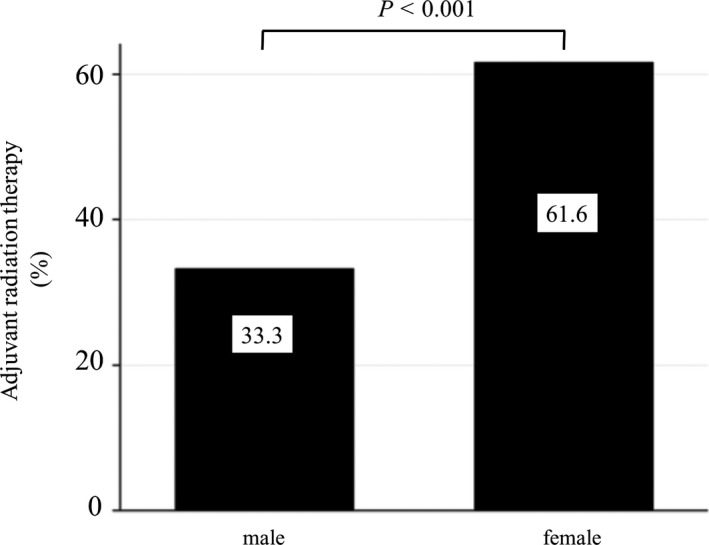
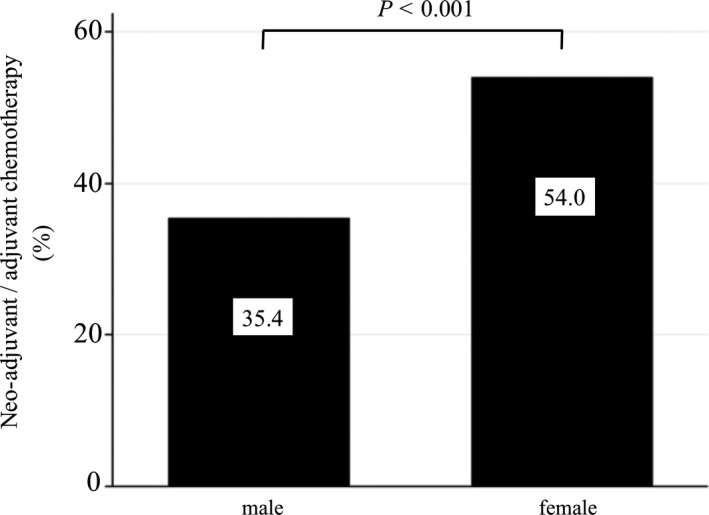
Of 142,636 breast cancer patients, 870 (0.61%) were MBC patients. At diagnosis, the mean age of MBC patients was 10 years older than FBC patients (70 vs 60 years; P < .001). Advanced-stage cancer was more frequently observed in MBC than in FBC (stage III/IV 18.9%/6.1% vs 10.6%/5.2%). Despite this, MBC patients were less likely to receive adjuvant radiation therapy and neo-adjuvant/adjuvant chemotherapy. Gender was an independent treatment determinant factor for chemotherapy decisions.
MBC patients were older and had higher stages of cancer than FBC patients at diagnosis, but received suboptimal treatment.
男性乳腺癌(MBC)的发病率虽然较低,但呈上升趋势。然而,目前 MBC 的流行病学和治疗模式仍不清楚。本研究评估了日本 MBC 与女性乳腺癌(FBC)的特征和治疗模式。
利用与诊断程序组合数据相关联的国家医院癌症登记数据库(HBCR),我们分析了 2012 年 1 月至 2015 年 12 月期间参与大型质量监测项目的医院中确诊的乳腺癌病例。我们采用逻辑回归模型评估了辅助放疗和新辅助/辅助化疗适应证患者中 MBC 和 FBC 之间的癌症治疗差异。
在 142636 例乳腺癌患者中,870 例(0.61%)为 MBC 患者。在诊断时,MBC 患者的平均年龄比 FBC 患者大 10 岁(70 岁比 60 岁;P<0.001)。MBC 比 FBC 更常出现晚期癌症(III/IV 期 18.9%/6.1%比 10.6%/5.2%)。尽管如此,MBC 患者接受辅助放疗和新辅助/辅助化疗的可能性较小。性别是化疗决策的独立治疗决定因素。
与 FBC 患者相比,MBC 患者在诊断时年龄更大,癌症分期更高,但治疗效果不理想。