Bone & Joint Research Group, Faculty of Medicine, University of Auckland, Auckland, New Zealand.
School of Clinical Medicine, Faculty of Medicine, University of Queensland, Brisbane, Australia.
Arthritis Res Ther. 2020 Feb 13;22(1):28. doi: 10.1186/s13075-020-2120-7.
Colchicine is a widely used drug to treat inflammatory diseases. Due to its long historical use in medicine, controlled clinical trials have been small and there remains some caution with the use of this drug in patients with co-morbidities. The aim of the study is to systematically examine the side effect profile of colchicine in controlled clinical trials across all published indications.
A systematic review was conducted in accordance with PRISMA methodology. The Cochrane Library, MEDLINE and EMBASE were searched for double-blind controlled trials of oral colchicine in adult patients that reported adverse event data. Meta-analyses were used to determine the relative risk (RR) of adverse events in colchicine users compared to comparator groups.
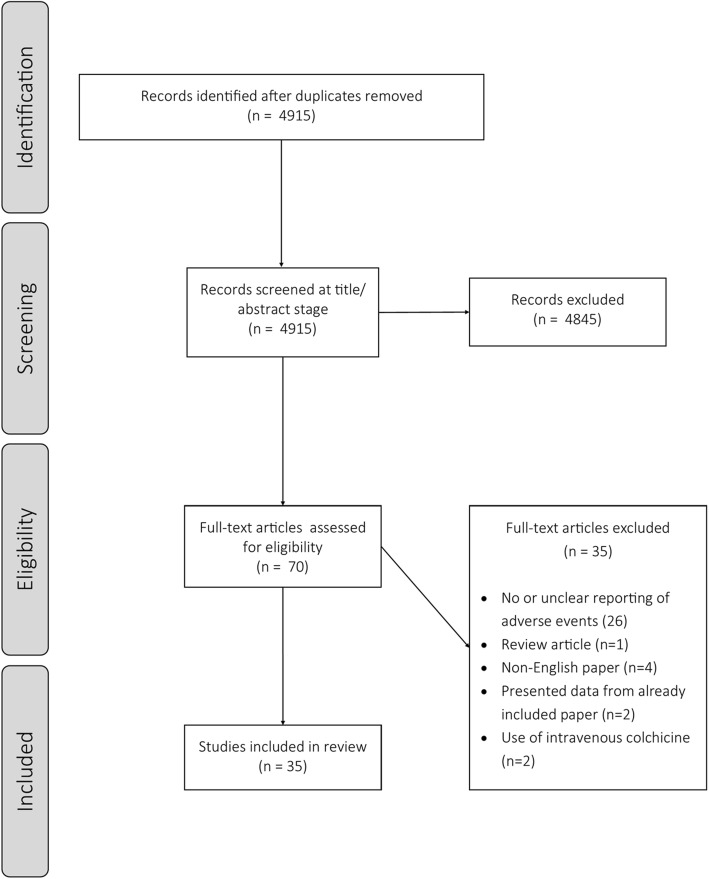
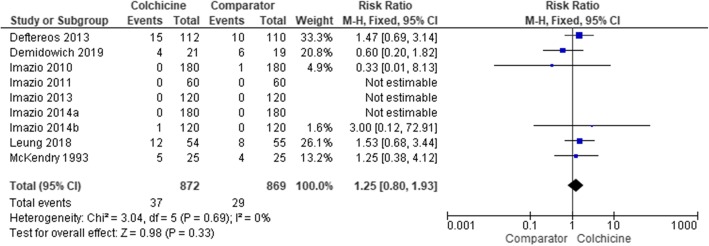
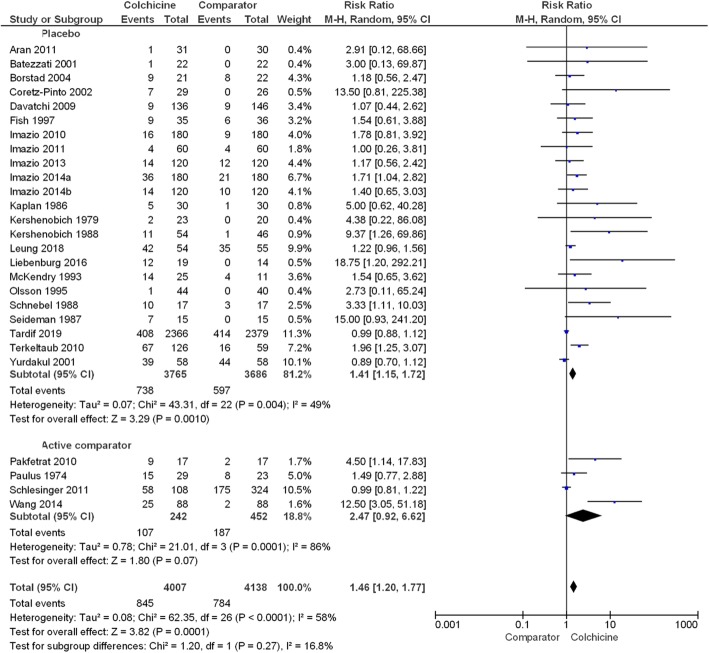
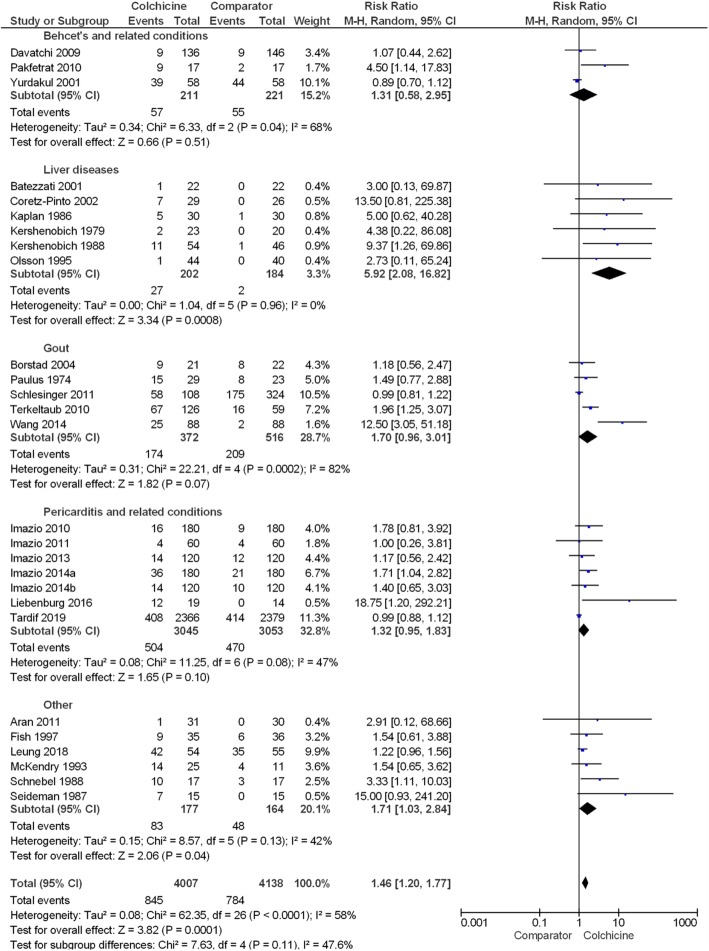
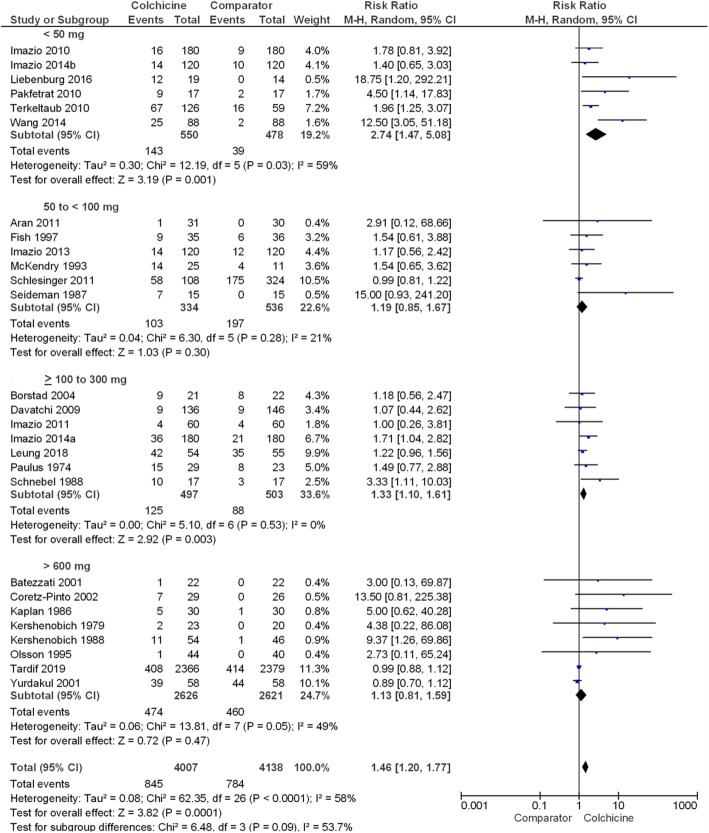
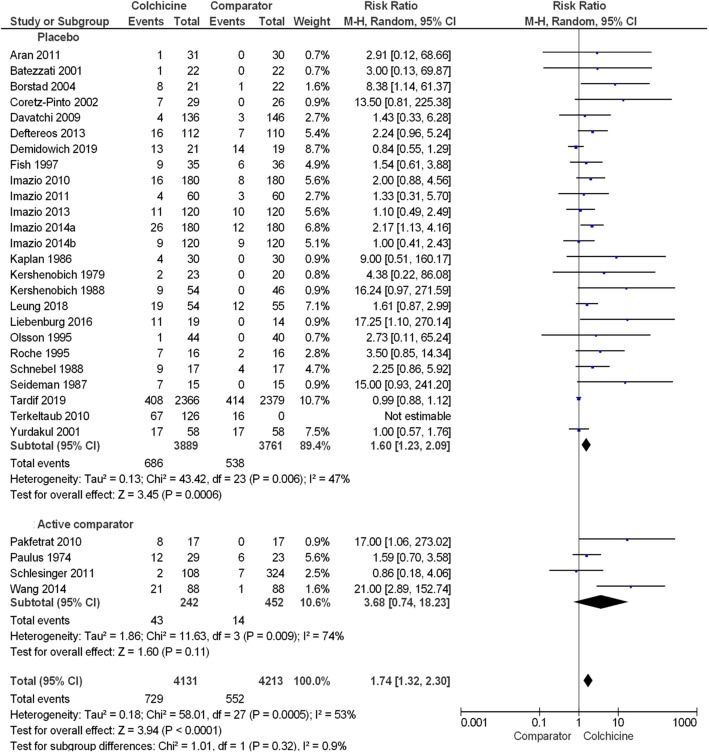
A total of 4915 studies were initially identified and after exclusions, 35 randomised controlled trials with placebo (n = 35) or active comparators (n = 5) were included. The most common diseases studied were gout, liver cirrhosis and pericarditis. There were a total of 8659 pooled participants, 4225 participants were randomised to receive colchicine, 3956 to placebo and 411 to an active comparator. Diarrhoea was reported in 17.9% of colchicine users versus 13.1% in comparator groups (RR 2.4, 95% confidence interval (CI) 1.6, 3.7). Any gastrointestinal event was reported in 17.6% of colchicine users and 13.1% of comparators (RR 1.7, 95% CI 1.3, 2.3). Adverse liver events were reported in 1.9% of colchicine users versus 1.1% in the comparator groups (RR 1.6, 95% CI 0.9, 3.0). Muscle events were reported in 4.2% of colchicine users and 3.3% in the comparator groups (RR 1.3, 95% CI 0.8, 1.9). Haematology events were reported in 0.6% of colchicine users and 0.4% of comparator groups (RR 1.34 (0.64, 2.82). No study reported neuropathy events. Other sensory events were reported in 1.1% of colchicine users and 1.5% of comparator groups (RR 1.4, 95% CI 0.3, 6.7). Infectious events were reported in 0.4% of colchicine users and 2.1% of comparator groups (RR 1.0, 95% CI 0.7, 1.5). No study reported death as an adverse event.
Colchicine increases the rate of diarrhoea and gastrointestinal adverse events but does not increase the rate of liver, sensory, muscle, infectious or haematology adverse events or death.
秋水仙碱是一种广泛用于治疗炎症性疾病的药物。由于其在医学上的长期应用,对照临床试验规模较小,因此在伴有合并症的患者中使用该药仍需谨慎。本研究旨在系统地检查秋水仙碱在所有已发表适应证的对照临床试验中的副作用情况。
按照 PRISMA 方法进行系统评价。检索了 Cochrane 图书馆、MEDLINE 和 EMBASE 中关于口服秋水仙碱治疗成年患者不良事件数据的双盲对照试验。采用荟萃分析确定秋水仙碱使用者与对照组相比不良事件的相对风险(RR)。
最初共确定了 4915 项研究,排除后纳入 35 项随机对照试验,其中安慰剂(n=35)或阳性对照药(n=5)。最常见的疾病是痛风、肝硬化和心包炎。共有 8659 名汇总参与者,其中 4225 名参与者被随机分配接受秋水仙碱,3956 名接受安慰剂,411 名接受阳性对照药。秋水仙碱使用者腹泻发生率为 17.9%,对照组为 13.1%(RR 2.4,95%置信区间(CI)1.6,3.7)。秋水仙碱使用者发生任何胃肠道不良事件的比例为 17.6%,对照组为 13.1%(RR 1.7,95%CI 1.3,2.3)。秋水仙碱使用者发生肝不良事件的比例为 1.9%,对照组为 1.1%(RR 1.6,95%CI 0.9,3.0)。肌肉不良事件在秋水仙碱使用者中发生率为 4.2%,在对照组中为 3.3%(RR 1.3,95%CI 0.8,1.9)。秋水仙碱使用者血液不良事件发生率为 0.6%,对照组为 0.4%(RR 1.34(0.64,2.82)。没有研究报告神经病事件。秋水仙碱使用者发生其他感觉异常的比例为 1.1%,对照组为 1.5%(RR 1.4,95%CI 0.3,6.7)。感染不良事件在秋水仙碱使用者中发生率为 0.4%,在对照组中发生率为 2.1%(RR 1.0,95%CI 0.7,1.5)。没有研究报告死亡作为不良事件。
秋水仙碱增加腹泻和胃肠道不良事件的发生率,但不增加肝、感觉、肌肉、感染或血液不良事件或死亡的发生率。