Wang YanGang, Wang Luan, Li EnZe, Li Yang, Wang ZhongChao, Sun XiaoFang, Yu XiaoLong, Ma Lin, Wang YunLong, Wang YouXin
1. Department of endocrinology, The Affiliated Hospital of Medical College Qingdao University, 16 Jiangsu Road, Qingdao, 266003, China.
2. Department of pharmacy, The Affiliated Hospital of Medical College Qingdao University, 16 Jiangsu Road, Qingdao, 266003, China.
Int J Med Sci. 2014 Jun 14;11(9):880-5. doi: 10.7150/ijms.9165. eCollection 2014.
The Chuanhu anti-gout mixture has been used for many years in the treatment of gout in Chinese Traditional Medicine, and current methods for treatments for acute gouty arthritis have been either less effective or have had serious side effects.
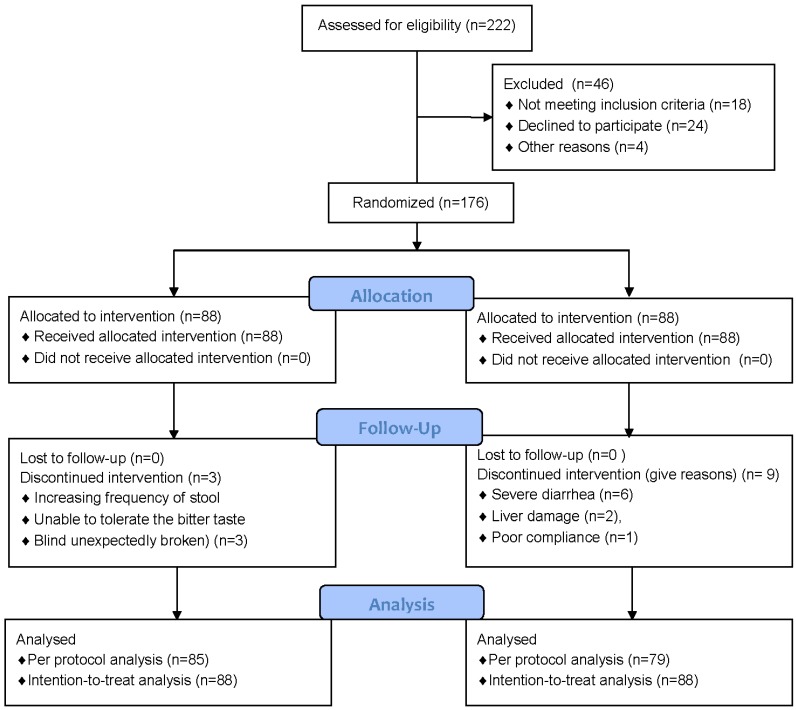
In this 12-week, double-blind, double-dummy, non-inferiority study, outpatient individuals with newly diagnosed acute gouty arthritis were randomly assigned to receive Chuanhu anti-gout mixture or colchicine. Both the study investigators and the participants were masked to the treatment assignments. The primary outcome was the recurrence rate of acute gouty arthritis, and the secondary outcomes were changes in white blood cells (WHC) and C-reactive protein (CRP). This trial is registered at ISRCTN.org as trial ISRCTN65219941.
A total of 176 patients were randomly assigned to receive either the Chuanhu anti-gout mixture or Colchicine. The overall recurrence rates in the Chuanhu anti-gout mixture group (CH group) and the Colchicine group (Col group) were 12.50% vs 14.77% (difference -2.22%, 95% confidence interval (95% CI): -10.78%6.23%), meeting the predefined non-inferiority criterion of 15%, as did the data for WHC and CRP. The incidence of adverse events (mainly diarrhea) was less in the Col group than in the CH group (2.27% vs 28.41%, 95% CI 0.010.26). In addition, changes in blood uric acid, alanine aminotransferase, aspartate aminotransferase and creatinine in the CH group were significantly larger compared to those in the Col group (P<0.05).
The Chuanhu anti-gout mixture was non-inferior to colchicine for the treatment of acute gouty arthritis. The study suggested that the Chuanhu anti-gout mixture can be considered an alternative choice for the treatment of acute gouty arthritis because of its lower incidence of adverse events and its protection of kidney and renal function.
在中医中,川胡抗痛风合剂已用于治疗痛风多年,而目前治疗急性痛风性关节炎的方法要么效果不佳,要么有严重的副作用。
在这项为期12周的双盲、双模拟、非劣效性研究中,将新诊断为急性痛风性关节炎的门诊患者随机分配接受川胡抗痛风合剂或秋水仙碱治疗。研究调查人员和参与者均对治疗分配情况不知情。主要结局是急性痛风性关节炎的复发率,次要结局是白细胞(WHC)和C反应蛋白(CRP)的变化。该试验在ISRCTN.org上注册为试验ISRCTN65219941。
共有176例患者被随机分配接受川胡抗痛风合剂或秋水仙碱治疗。川胡抗痛风合剂组(CH组)和秋水仙碱组(Col组)的总体复发率分别为12.50%和14.77%(差异为-2.22%;95%置信区间(95%CI):-10.78%至6.23%),达到了预先定义的15%的非劣效性标准,WHC和CRP的数据也是如此。Col组不良事件(主要为腹泻)的发生率低于CH组(2.27%对28.41%;95%CI 0.01至0.26)此外,与Col组相比,CH组血尿酸、丙氨酸氨基转移酶、天冬氨酸氨基转移酶和肌酐的变化明显更大(P<0.05)。
川胡抗痛风合剂在治疗急性痛风性关节炎方面不劣于秋水仙碱。该研究表明,川胡抗痛风合剂因其不良事件发生率较低且对肾脏和肾功能有保护作用,可被视为治疗急性痛风性关节炎的替代选择