Centre for Ecological and Evolutionary Synthesis, Department of Biosciences, University of Oslo, 0317 Oslo, Norway.
Department of Biology, University of Florida, Gainesville, FL 32611.
Proc Natl Acad Sci U S A. 2020 Feb 25;117(8):4273-4280. doi: 10.1073/pnas.1920790117. Epub 2020 Feb 13.
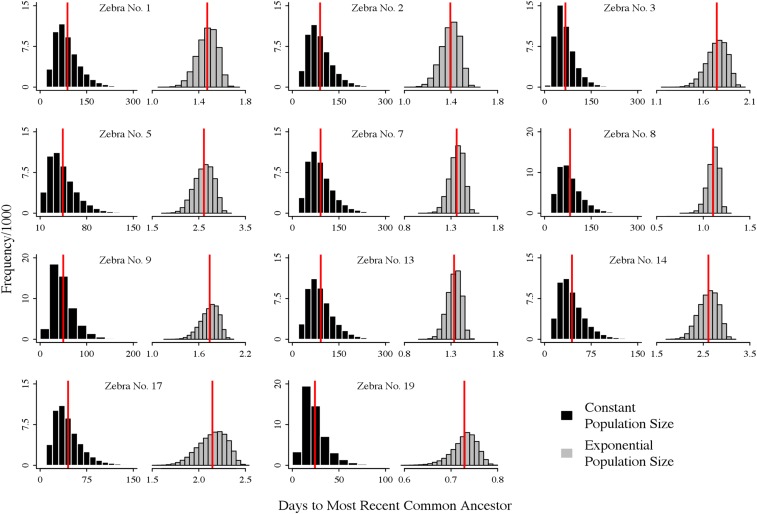
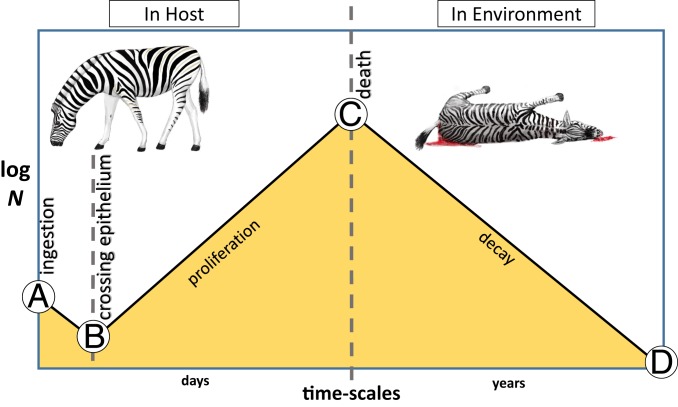
, the etiological agent of anthrax, is a well-established model organism. For and most other infectious diseases, knowledge regarding transmission and infection parameters in natural systems, in large part, comprises data gathered from closely controlled laboratory experiments. Fatal, natural anthrax infections transmit the bacterium through new host-pathogen contacts at carcass sites, which can occur years after death of the previous host. For the period between contact and death, all of our knowledge is based upon experimental data from domestic livestock and laboratory animals. Here we use a noninvasive method to explore the dynamics of anthrax infections, by evaluating the terminal diversity of in anthrax carcasses. We present an application of population genetics theory, specifically, coalescence modeling, to intrainfection populations of to derive estimates for the duration of the acute phase of the infection and effective population size converted to the number of colony-forming units establishing infection in wild plains zebra (). Founding populations are small, a few colony-forming units, and infections are rapid, lasting roughly between 1 d and 3 d in the wild. Our results closely reflect experimental data, showing that small founding populations progress acutely, killing the host within days. We believe this method is amendable to other bacterial diseases from wild, domestic, and human systems.
炭疽杆菌是炭疽病的病原体,它是一种成熟的模式生物。对于炭疽病和大多数其他传染病,在自然系统中传播和感染参数的知识,在很大程度上包括从严格控制的实验室实验中收集的数据。在炭疽病的自然感染中,致命的炭疽杆菌通过新的宿主-病原体接触在尸骸部位传播,这种接触可能在上一个宿主死亡数年后发生。在接触到死亡之间的这段时间里,我们所有的知识都基于来自家畜和实验动物的实验数据。在这里,我们使用一种非侵入性的方法来探索炭疽感染的动态,通过评估炭疽尸骸中炭疽杆菌的终端多样性来评估炭疽感染的动态。我们应用了种群遗传学理论,特别是合并模型,对炭疽杆菌的内感染种群进行分析,以得出感染急性阶段的持续时间和有效种群大小的估计值,并将其转换为在野生平原斑马()中建立感染的菌落形成单位数。创始种群规模较小,只有几个菌落形成单位,感染迅速,在野外大约持续 1 到 3 天。我们的结果与实验数据非常吻合,表明小的创始种群会迅速发展为急性感染,在数天内杀死宿主。我们相信这种方法适用于来自野生、家养和人类系统的其他细菌性疾病。