German Center for Vertigo and Balance Disorders, Ludwig-Maximilians University of Munich, University Hospital Grosshadern, Munich, Germany.
Schoen Clinic Bad Aibling, Department of Neurology, Bad Aibling, Germany.
Sci Rep. 2020 Feb 13;10(1):2545. doi: 10.1038/s41598-020-59374-9.
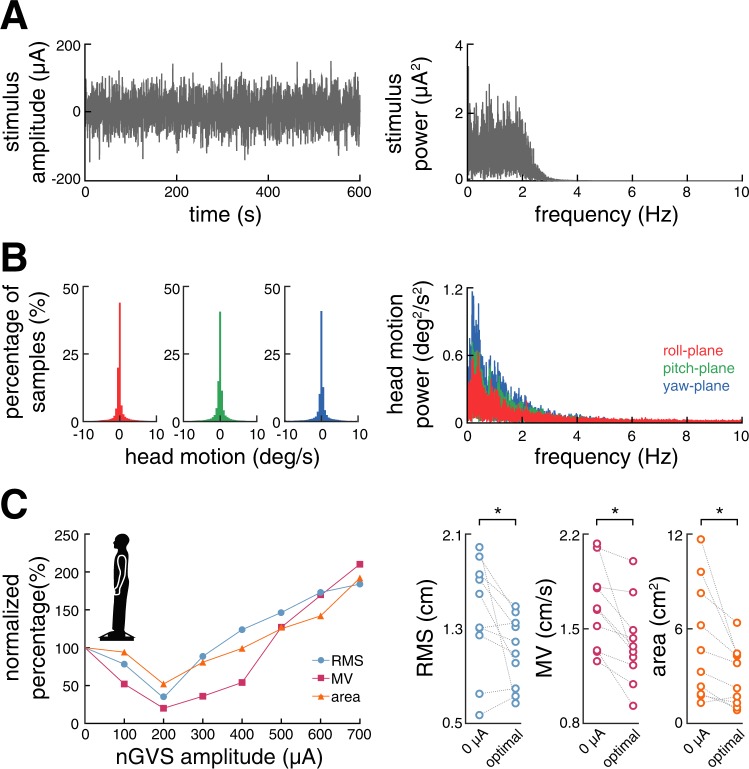
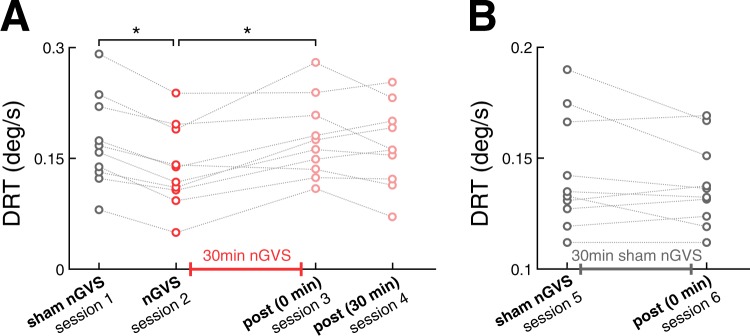
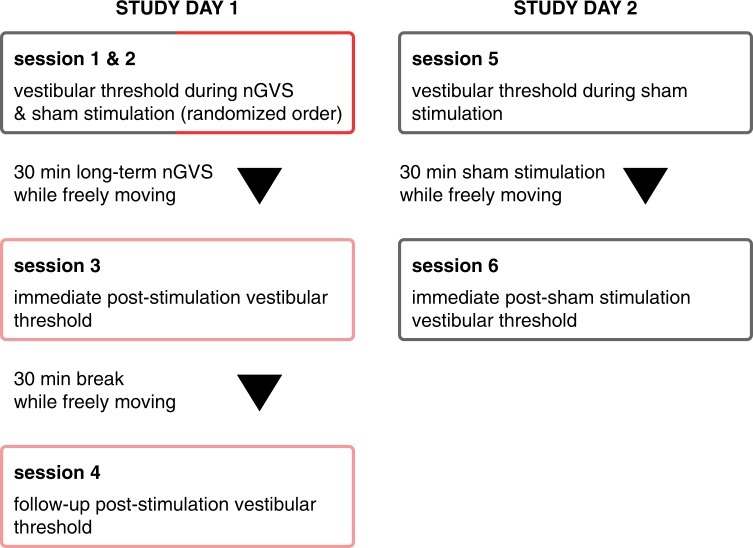
Noisy galvanic vestibular stimulation (nGVS) delivered at imperceptible intensities can improve vestibular function in health and disease. Here we evaluated whether nGVS effects on vestibular function are only present during active stimulation or may exhibit relevant post-stimulation after-effects. Initially, nGVS amplitudes that optimally improve posture were determined in 13 healthy subjects. Subsequently, effects of optimal nGVS amplitudes on vestibular roll-tilt direction recognition thresholds (DRT) were examined during active and sham nGVS. Ten of 13 subjects exhibited reduced DRTs during active nGVS compared to sham stimulation (p < 0.001). These 10 participants were then administered to 30 mins of active nGVS treatment while being allowed to move freely. Immediately post-treatment , DRTs were increased again (p = 0.044), reverting to baseline threshold levels (i.e. were comparable to the sham nGVS thresholds), and remained stable in a follow-up assessment after 30 min. After three weeks, participants returned for a follow-up experiment to control for learning effects, in which DRTs were measured during and immediately after 30 min application of sham nGVS. DRTs during both assessments did not differ from baseline level. These findings indicate that nGVS does not induce distinct post-stimulation effects on vestibular motion perception and favor the development of a wearable technology that continuously delivers nGVS to patients in order to enhance vestibular function.
在可感知强度下进行噪声电前庭刺激 (nGVS) 可以改善健康和疾病中的前庭功能。在这里,我们评估了 nGVS 对前庭功能的影响是否仅在主动刺激期间存在,或者是否可能表现出相关的刺激后效应。最初,在 13 名健康受试者中确定了最佳改善姿势的 nGVS 幅度。随后,在主动和假 nGVS 期间检查了最佳 nGVS 幅度对前庭滚倾斜方向识别阈值 (DRT) 的影响。与假刺激相比,13 名受试者中有 10 名在主动 nGVS 期间表现出较低的 DRT(p<0.001)。然后,这 10 名参与者接受了 30 分钟的主动 nGVS 治疗,同时可以自由移动。治疗后立即,DRT 再次增加(p=0.044),恢复到基线阈值水平(即与假 nGVS 阈值相当),并在 30 分钟后的后续评估中保持稳定。三周后,参与者返回进行后续实验以控制学习效应,在此期间和 30 分钟的假 nGVS 应用后立即测量 DRT。两次评估中的 DRT 均与基线水平无差异。这些发现表明,nGVS 不会对前庭运动感知产生明显的刺激后效应,并有利于开发一种可穿戴技术,以便连续向患者提供 nGVS,以增强前庭功能。