Sripongpun Pimsiri, Tangkijvanich Pisit, Chotiyaputta Watcharasak, Charatcharoenwitthaya Phunchai, Chaiteerakij Roongruedee, Treeprasertsuk Sombat, Bunchorntavakul Chalermrat, Sobhonslidsuk Abhasnee, Leerapun Apinya, Khemnark Suparat, Poovorawan Kittiyod, Siramolpiwat Sith, Chirapongsathorn Sakkarin, Pan-Ngum Wirichada, Soonthornworasiri Ngamphol, Sukeepaisarnjaroen Wattana
Department of Internal Medicine Faculty of Medicine, Prince of Songkla University Hat Yai Thailand.
Center of Excellence in Hepatitis and Liver Cancer Chulalongkorn University Bangkok Thailand.
JGH Open. 2019 Jun 26;4(1):69-74. doi: 10.1002/jgh3.12219. eCollection 2020 Feb.
Fibrotic stage (FS) assessment is essential in chronic hepatitis C treatment cascade. Liver stiffness measurement (LSM) using transient elastography (TE) is reliable and correlated with liver biopsy. However, TE may not be widely available. This study aimed to evaluate the diagnostic performances of aspartate aminotransferase to platelet ratio index (APRI) and fibrosis 4 (FIB-4) scores compared with TE.
We conducted a multicenter, cross-sectional study, including all chronic hepatitis C virus (HCV) monoinfection patients with successful and reliable LSM, at 10 centers in Thailand from 2012 to 2017. Characteristics and laboratory data within 3 months of TE were retrospectively reviewed. Using TE as a reference standard, the diagnostic performances of APRI and FIB-4 were evaluated. TE cut-off levels of 7.1 and 12.5 kPa represented significant fibrosis (SF) and cirrhosis, respectively.
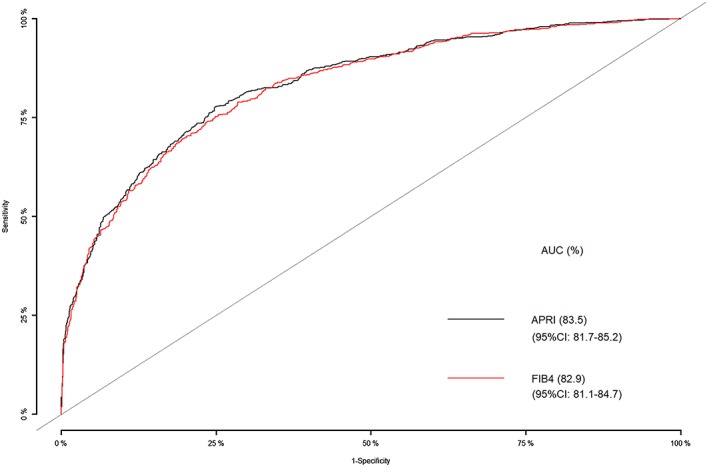
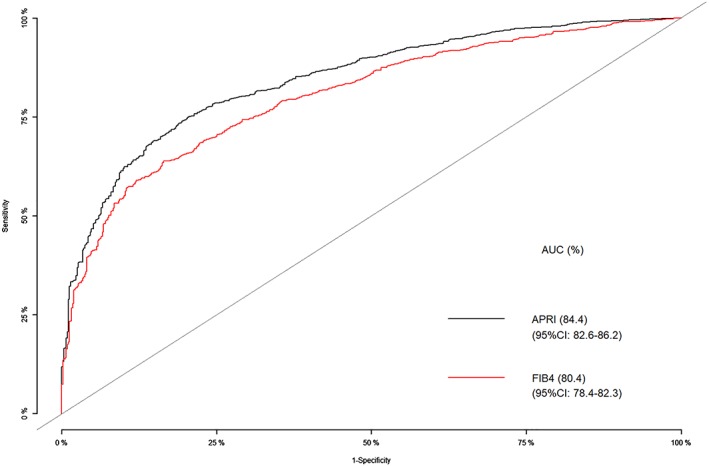
The distribution of FS by TE in 2000 eligible patients was as follows: no SF 28.3%, SF 31.4%, and cirrhosis 40.3%. APRI ≥ 1 provided 70.1% sensitivity and 80.6% specificity, with an area under the receiver operator characteristics curve (AUROC) of 0.834 for cirrhosis. The specificity increased to 96.3% when using a cut-off level of APRI ≥ 2. FIB-4 ≥ 1.45 provided a sensitivity, specificity, and AUROC of 52.4%, 91.0%, and 0.829 for cirrhosis, respectively. For SF, APRI performed better than FIB-4, with an AUROC of 0.84 0.80 ( < 0.001). APRI score < 0.5 and FIB-4 score > 1.45 yielded sensitivities of 82.3% and 74.4% and specificities of 65.4% and 69.8%, respectively.
APRI and FIB-4 scores had good diagnostic performances for FS assessment compared with TE, especially for cirrhosis. APRI may be used as the noninvasive assessment in resource-limited settings for HCV patients' management.
纤维化分期(FS)评估在慢性丙型肝炎治疗流程中至关重要。使用瞬时弹性成像(TE)进行肝脏硬度测量(LSM)是可靠的,且与肝活检相关。然而,TE可能无法广泛应用。本研究旨在评估天冬氨酸氨基转移酶与血小板比值指数(APRI)和纤维化4(FIB-4)评分相较于TE的诊断性能。
我们于2012年至2017年在泰国的10个中心开展了一项多中心横断面研究,纳入所有慢性丙型肝炎病毒(HCV)单一感染且LSM成功且可靠的患者。回顾性分析TE检查前3个月内的患者特征和实验室数据。以TE作为参考标准,评估APRI和FIB-4的诊断性能。TE的截断值7.1和12.5 kPa分别代表显著纤维化(SF)和肝硬化。
2000例符合条件患者的TE纤维化分期分布如下:无显著纤维化28.3%,显著纤维化31.4%,肝硬化40.3%。APRI≥1时,肝硬化诊断的敏感性为70.1%,特异性为80.6%,受试者操作特征曲线下面积(AUROC)为0.834。当APRI截断值≥2时,特异性增至96.3%。FIB-4≥1.45时,肝硬化诊断的敏感性、特异性和AUROC分别为52.4%、91.0%和0.829。对于显著纤维化,APRI的表现优于FIB-4,AUROC为0.84对0.80(P<0.001)。APRI评分<0.5和FIB-4评分>1.45时,敏感性分别为82.3%和74.4%,特异性分别为65.4%和69.8%。
与TE相比,APRI和FIB-4评分在FS评估中具有良好的诊断性能,尤其是对于肝硬化。在资源有限的环境中,APRI可作为HCV患者管理的无创评估方法。