Department of Pediatrics, University of Iowa, Iowa City, Iowa, USA.
Medical Scientist Training Program, University of Iowa, Iowa City, Iowa, USA.
J Neurotrauma. 2020 Jun 15;37(12):1463-1480. doi: 10.1089/neu.2019.6725. Epub 2020 Mar 16.
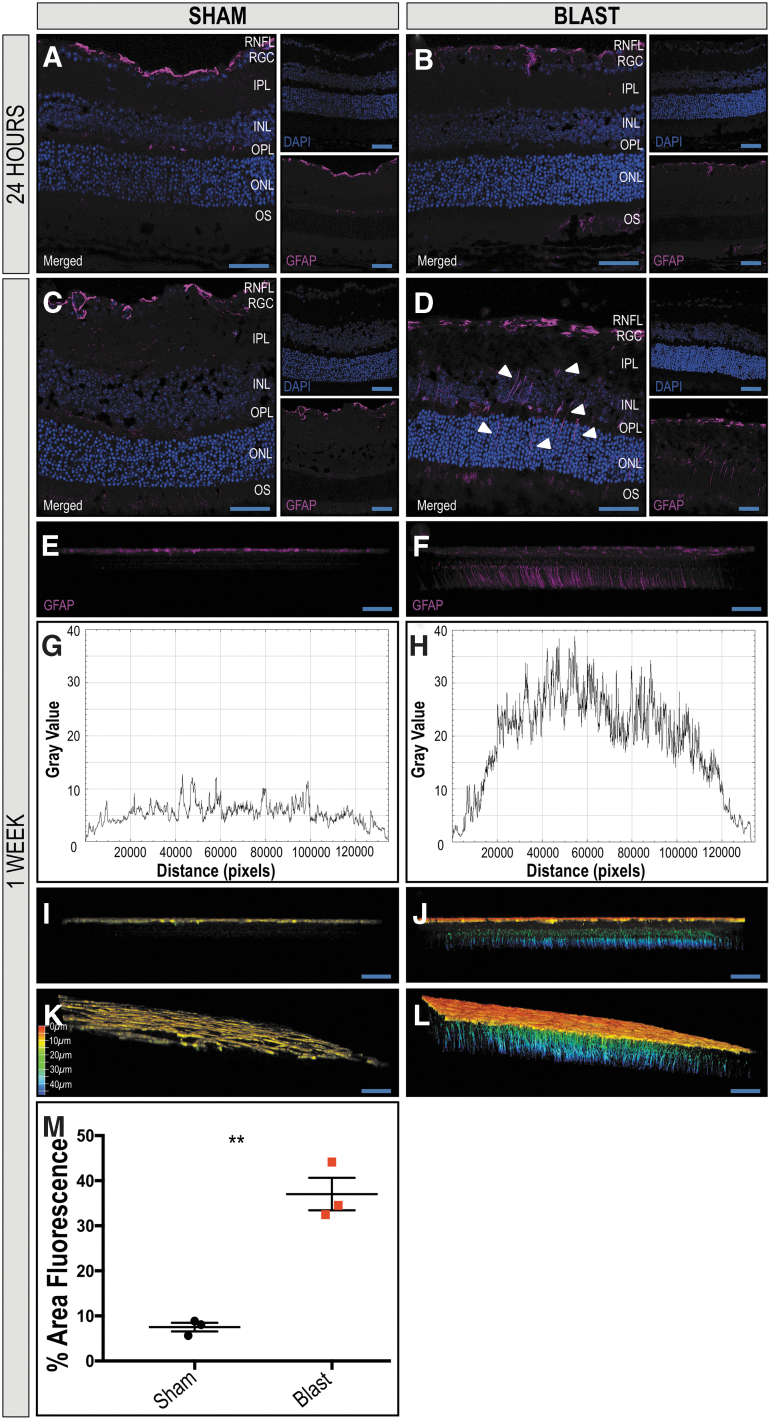
The purpose of this study was to characterize acute changes in inflammatory pathways in the mouse eye after blast-mediated traumatic brain injury (bTBI) and to determine whether modulation of these pathways could protect the structure and function of retinal ganglion cells (RGC). The bTBI was induced in C57BL/6J male mice by exposure to three 20 psi blast waves directed toward the head with the body shielded, with an inter-blast interval of one hour. Acute cytokine expression in retinal tissue was measured through reverse transcription-quantitative polymerase chain reaction (RT-qPCR) four hours post-blast. Increased retinal expression of ( and was observed in bTBI mice exposed to blast when compared with shams, which was associated with activation of microglia and macroglia reactivity, assessed via immunohistochemistry with ionized calcium binding adaptor molecule 1 and glial fibrillary acidic protein, respectively, one week post-blast. Blockade of the IL-1 pathway was accomplished using anakinra, an IL-1RI antagonist, administered intra-peritoneally for one week before injury and continuing for three weeks post-injury. Retinal function and RGC layer thickness were evaluated four weeks post-injury using pattern electroretinogram (PERG) and optical coherence tomography (OCT), respectively. After bTBI, anakinra treatment resulted in a preservation of RGC function and RGC structure when compared with saline treated bTBI mice. Optic nerve integrity analysis demonstrated a trend of decreased damage suggesting that IL-1 blockade also prevents axonal damage after blast. Blast exposure results in increased retinal inflammation including upregulation of pro-inflammatory cytokines and activation of resident microglia and macroglia. This may explain partially the RGC loss we observed in this model, as blockade of the acute inflammatory response after injury with the IL-1R1 antagonist anakinra resulted in preservation of RGC function and RGC layer thickness.
这项研究的目的是描述在爆炸介导的创伤性脑损伤(bTBI)后小鼠眼睛中炎症途径的急性变化,并确定是否可以调节这些途径来保护视网膜神经节细胞(RGC)的结构和功能。bTBI 通过暴露于三个朝向头部的 20 psi 爆炸波来诱导 C57BL/6J 雄性小鼠,身体用盾牌屏蔽,间隔一小时进行一次爆炸。爆炸后 4 小时通过逆转录定量聚合酶链反应(RT-qPCR)测量视网膜组织中的急性细胞因子表达。与假手术组相比,暴露于爆炸中的 bTBI 小鼠的视网膜表达增加了 (和 ),这与通过离子钙结合适应分子 1 和神经胶质纤维酸性蛋白的免疫组织化学评估的小胶质细胞和大胶质细胞反应性的激活有关,分别为爆炸后一周。IL-1 途径的阻断是通过用 IL-1RI 拮抗剂 anakinra 来实现的,在损伤前一周腹腔内给药,并在损伤后继续给药三周。损伤后四周分别通过图形视网膜电图(PERG)和光学相干断层扫描(OCT)评估视网膜功能和 RGC 层厚度。与盐水处理的 bTBI 小鼠相比,bTBI 后 anakinra 治疗导致 RGC 功能和 RGC 结构的保留。视神经完整性分析表明,损伤后 IL-1 阻断也可防止轴突损伤。爆炸暴露导致视网膜炎症增加,包括促炎细胞因子的上调和常驻小胶质细胞和大胶质细胞的激活。这可能部分解释了我们在该模型中观察到的 RGC 损失,因为在损伤后用 IL-1R1 拮抗剂 anakinra 阻断急性炎症反应导致 RGC 功能和 RGC 层厚度的保留。