Usher Institute, University of Edinburgh, Teviot Place, Edinburgh, EH8 9AG, UK.
Clinical R&D, Dykebar Hospital, Grahamstone Road, Paisley, PA2 7DE, UK.
Trials. 2020 Feb 14;21(1):183. doi: 10.1186/s13063-019-4042-8.
Eighty per cent of UK women have at least one baby, making pregnancy an opportunity to help women stop smoking before their health is irreparably compromised. Smoking cessation during pregnancy helps protect infants from miscarriage, still birth, low birth weight, asthma, attention deficit disorder and adult cardiovascular disease. UK national guidelines highlight lack of evidence for effectiveness of financial incentives to help pregnant smokers quit. This includes a research recommendation: within a UK context, are incentives an acceptable, effective and cost-effective way to help pregnant women who smoke to quit?
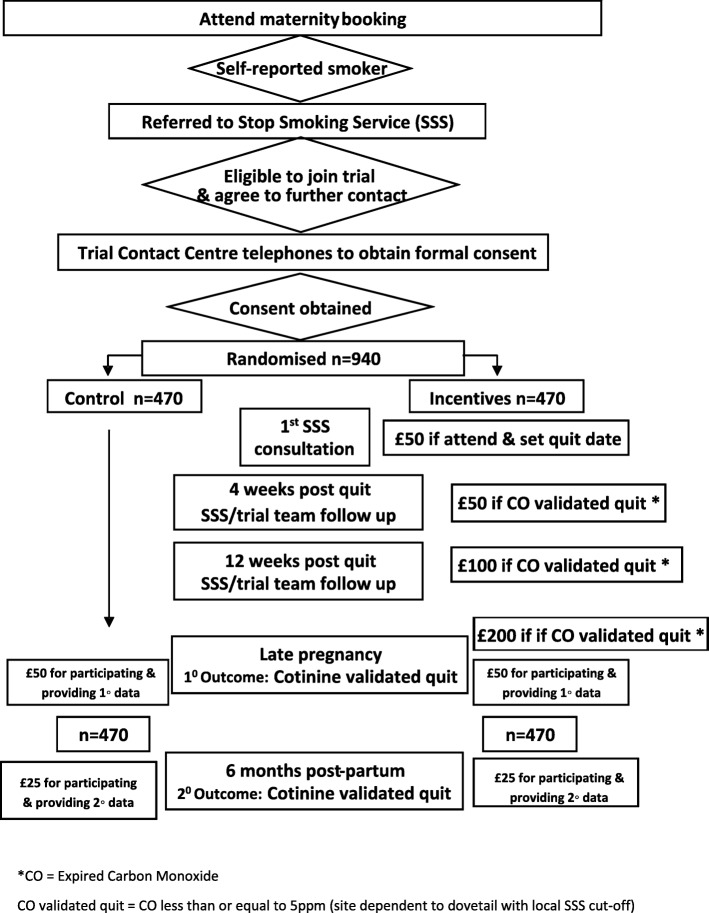
The Cessation in Pregnancy Incentives Trial (CPIT) III is a pragmatic, 42-month, multi-centre, parallel-group, individually randomised controlled superiority trial of the effect on smoking status of adding to usual Stop Smoking Services (SSS) support, the offer of up to £400 of financial voucher incentives, compared with usual support alone, to quit smoking during pregnancy. Participants (n = 940) are pregnant smokers (age > 16 years, < 24 weeks pregnant, English speaking), who consent via telephone to take part and are willing to be followed-up in late pregnancy and 6 months after birth. The primary outcome is cotinine/anabasine-validated abstinence from smoking in late pregnancy. Secondary outcomes include engagement with SSS, quit rates at 4 weeks from agreed quit date and 6 months after birth, and birth weight. Outcomes will be analysed by intention to treat, and regression models will be used to compare treatment effects on outcomes. A meta-analysis will include data from the feasibility study in Glasgow. An economic evaluation will assess cost-effectiveness from a UK NHS perspective. Process evaluation using a case-study approach will identify opportunities to improve recruitment and learning for future implementation. Research questions include: what is the therapeutic efficacy of incentives; are incentives cost-effective; and what are the potential facilitators and barriers to implementing incentives in different parts of the UK?
This phase III trial in Scotland, England and Northern Ireland follows a successful phase II trial in Glasgow, UK. The participating sites have diverse SSS that represent most cessation services in the UK and serve demographically varied populations. If found to be acceptable and cost-effective, this trial could demonstrate that financial incentives are effective and transferable to most UK SSS for pregnant women.
Current Controlled Trials, ISRCTN15236311. Registered on 9 October 2017.
80%的英国女性至少生育过一个孩子,因此怀孕为帮助女性在健康受到不可逆转的损害之前戒烟提供了一个机会。怀孕期间戒烟有助于保护婴儿免受流产、死产、低出生体重、哮喘、注意力缺陷障碍和成人心血管疾病的影响。英国国家指南强调缺乏证据表明经济激励措施有助于帮助怀孕的吸烟者戒烟。这包括一项研究建议:在英国背景下,激励措施是否是帮助吸烟孕妇戒烟的一种可接受、有效且具有成本效益的方法?
妊娠戒烟激励试验(CPIT)III 是一项实用的、为期 42 个月、多中心、平行组、个体随机对照优效试验,旨在评估在常规戒烟服务(SSS)支持的基础上,增加高达 400 英镑的财务券激励措施,与仅提供常规支持相比,对妊娠期间吸烟的孕妇的吸烟状况的影响。参与者(n=940)为怀孕吸烟者(年龄>16 岁,<24 周妊娠,会说英语),通过电话同意参加并愿意在妊娠晚期和分娩后 6 个月接受随访。主要结局是通过考替宁/阿纳巴斯汀验证的妊娠晚期吸烟戒断。次要结局包括与 SSS 的互动、从商定的戒烟日期起 4 周和分娩后 6 个月的戒烟率,以及出生体重。将通过意向治疗进行分析,并使用回归模型比较治疗对结局的影响。荟萃分析将包括来自格拉斯哥可行性研究的数据。经济评估将从英国国家医疗服务体系的角度评估成本效益。使用案例研究方法进行的经济评价将确定在英国不同地区实施激励措施的机会,以提高招募和学习效果。研究问题包括:激励措施的治疗效果如何;激励措施是否具有成本效益;以及在英国不同地区实施激励措施的潜在促进因素和障碍是什么?
这项在苏格兰、英格兰和北爱尔兰进行的 III 期试验是在英国格拉斯哥成功的 II 期试验之后进行的。参与的地点有多样化的 SSS,代表了英国大多数戒烟服务,并为人口统计学上不同的人群提供服务。如果被发现是可以接受且具有成本效益的,那么这项试验可以证明经济激励措施对英国大多数 SSS 的孕妇是有效且可转移的。
当前对照试验,ISRCTN81762514。于 2017 年 10 月 9 日注册。