Department of Physical Medicine, Rehabilitation and Occupational Medicine, Medical University of Vienna, Waehringer Guertel 18-20, 1090, Vienna, Austria.
Orthopaedic City Center-medCLINIC, Dominikanerbastei 3, 1010, Vienna, Austria.
Wien Klin Wochenschr. 2020 Mar;132(5-6):115-123. doi: 10.1007/s00508-020-01616-x. Epub 2020 Feb 14.
The purpose of this qualitative study was the assessment of the feasibility and acceptance of orthopedists prescribing individualized therapeutic exercises via a smartphone app to patients suffering from non-specific back pain.
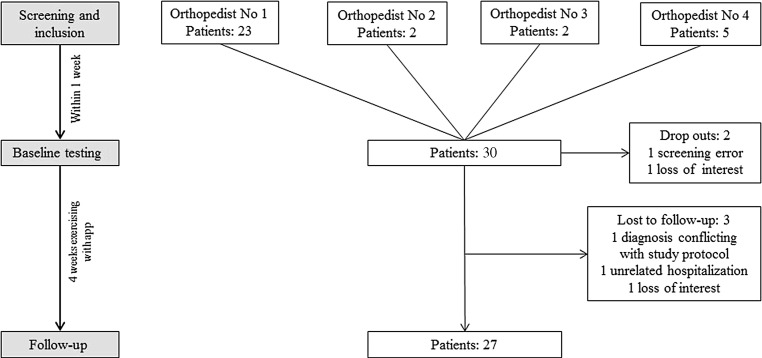
A total of 27 patients (mean age 44.8 ± 13.2 years) diagnosed with acute non-specific back pain were prescribed individually chosen therapy exercises via a smartphone app. Before the patients started and after 4 weeks of exercising all participants went through an assessment protocol consisting of questionnaires (Oswestry Disability Index [ODI], Short Form-36 [SF-36], International Physical Activity Questionnaire [IPAQ], Work Ability Index [WAI], Visual Analogue Scale [VAS] back pain, sociodemographic parameters), assessment of functional parameters (handgrip strength, timed up and go test). With 16 randomly chosen patients semi-structured interviews were undertaken at the end of the intervention period. Interview transcripts were analyzed using thematic analysis. Power analysis and a priori sample size calculations were undertaken with the quantitative data.
From the interviews four thematic categories emerged: prior exercise experience, evaluation of exercise intensity, communication with physician via smartphone app, and variability of exercise location. Quantitative analysis of secondary data showed significant improvements in back pain (ODI) as well as quality of life domains "physical functioning", "bodily pain" and "vitality" (SF-36) of which "bodily pain" was sufficiently powered with the current sample size.
The prescription of therapeutic exercises via smartphone app to patients suffering from non-specific back pain is feasible and well-accepted in patients at all ages. Pilot data additionally pointed towards efficacy of the intervention.
本定性研究的目的是评估骨科医生通过智能手机应用程序为患有非特异性腰痛的患者开具个性化治疗运动的可行性和可接受性。
总共 27 名(平均年龄 44.8 ± 13.2 岁)被诊断为急性非特异性腰痛的患者通过智能手机应用程序开具了个别选择的治疗运动。在患者开始运动之前和 4 周后,所有参与者都要经过一个评估方案,包括问卷(Oswestry 残疾指数 [ODI]、简短形式 36 项健康调查 [SF-36]、国际体力活动问卷 [IPAQ]、工作能力指数 [WAI]、视觉模拟量表 [VAS]腰痛、社会人口学参数)、功能参数评估(握力、计时起立行走测试)。在干预期末,对 16 名随机选择的患者进行了半结构式访谈。使用主题分析对访谈记录进行了分析。使用定量数据进行了功率分析和先验样本量计算。
从访谈中得出了四个主题类别:以前的运动经验、运动强度评估、通过智能手机应用程序与医生交流、以及运动地点的变化。对次要数据的定量分析显示,腰痛(ODI)以及生活质量领域“身体机能”、“躯体疼痛”和“活力”(SF-36)有显著改善,其中“躯体疼痛”的样本量足够大。
通过智能手机应用程序为患有非特异性腰痛的患者开具治疗性运动处方在各年龄段的患者中是可行且可接受的。初步数据还表明该干预措施具有疗效。