Hamburg Center for Health Economics (HCHE), Universität Hamburg, Esplanade 36, 20354, Hamburg, Germany.
Appl Health Econ Health Policy. 2020 Aug;18(4):567-578. doi: 10.1007/s40258-019-00551-x.
Unipolar depression is the most common form of depression and demand for treatment, such as psychotherapy, is high. However, waiting times for psychotherapy often considerably exceed their recommended maximum. As a potentially less costly alternative treatment, internet-based cognitive behavior therapy (ICBT) might help reduce waiting times. We therefore analyzed the cost-utility of ICBT compared to face-to-face CBT (FCBT) as an active control treatment, taking differences in waiting time into account.
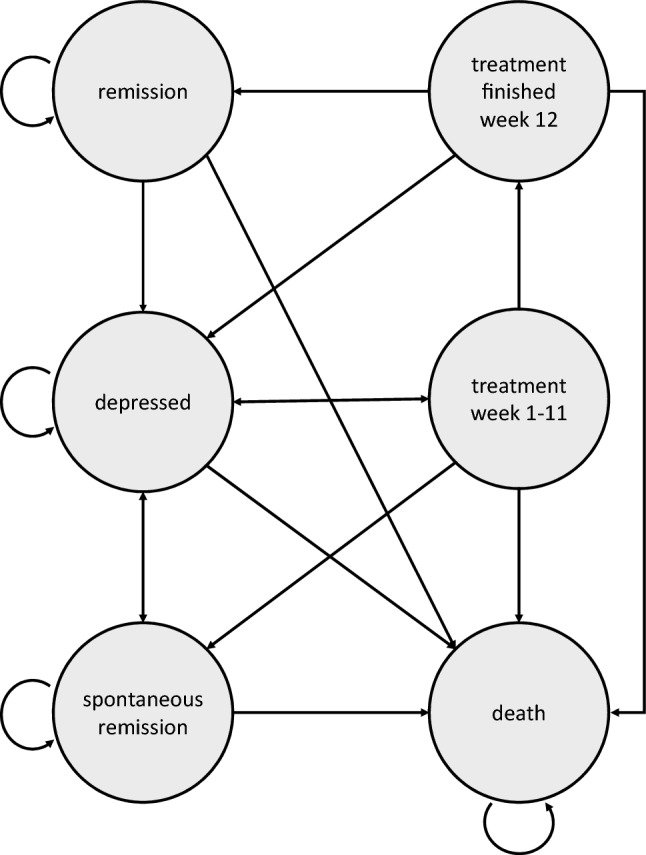
We constructed a Markov model to simulate costs and health outcomes measured in quality-adjusted life years (QALYs) for ICBT and FCBT in Germany. We modeled a time horizon of 3 years using six states (remission, depressed, spontaneous remission, undergoing treatment, treatment finished, death). The societal perspective was adopted. We obtained parameters for transition probabilities, depression-specific QoL, and cost data from the literature. Deterministic and probabilistic sensitivity analyses were conducted. Within a scenario analysis, we simulated different time-to-treatment combinations. Half-cycle correction was applied.
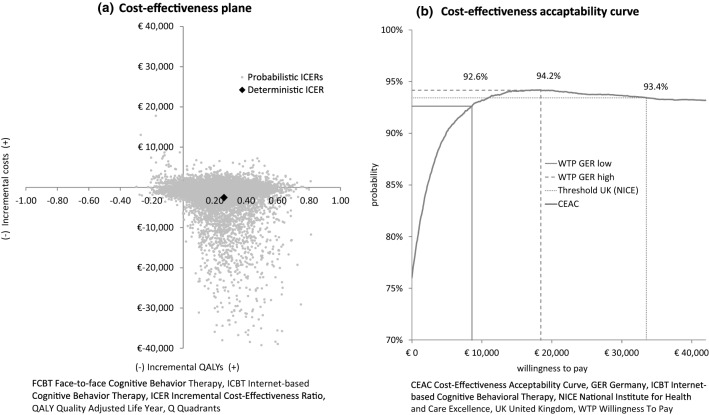
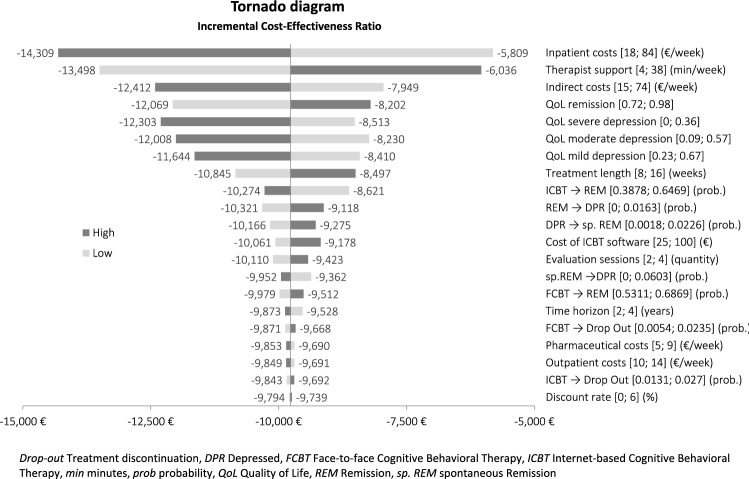
In our simulation, ICBT generated 0.260 QALYs and saved €2536 per patient compared to FCBT. Our deterministic sensitivity analysis suggests that the base-case results were largely unaffected by parameter uncertainty and are therefore robust. Our probabilistic sensitivity analysis suggests that ICBT is highly likely to be more effective (91.5%), less costly (76.0%), and the dominant strategy (69.7%) compared to FCBT. The scenario analysis revealed that the base-case results are robust to variations in time-to-treatment differences.
ICBT has a strong potential to balance demand and supply of CBT in unipolar depression by reducing therapist time per patient. It is highly likely to generate more QALYs and reduce health care expenditure. In addition, ICBT may have further positive external effects, such as freeing up capacities for the most severely depressed patients.
单相抑郁是最常见的抑郁形式,对治疗(如心理治疗)的需求较高。然而,心理治疗的等待时间往往大大超过了建议的最长时间。作为一种潜在的成本较低的替代治疗方法,基于互联网的认知行为疗法(ICBT)可能有助于缩短等待时间。因此,我们分析了与面对面认知行为疗法(FCBT)相比,ICBT 的成本效益,将等待时间的差异考虑在内。
我们构建了一个马尔可夫模型,以模拟德国的 ICBT 和 FCBT 的成本和健康结果(用质量调整生命年来衡量)。我们使用六个状态(缓解、抑郁、自发缓解、接受治疗、治疗结束、死亡)来模拟 3 年的时间范围。采用了社会视角。我们从文献中获得了转移概率、抑郁特异性生活质量和成本数据的参数。进行了确定性和概率敏感性分析。在情景分析中,我们模拟了不同的治疗时间组合。应用了半周期校正。
在我们的模拟中,与 FCBT 相比,ICBT 产生了 0.260 个质量调整生命年,并为每位患者节省了 2536 欧元。我们的确定性敏感性分析表明,基础案例结果受参数不确定性的影响不大,因此具有稳健性。我们的概率敏感性分析表明,与 FCBT 相比,ICBT 更有可能具有更高的疗效(91.5%)、更低的成本(76.0%)和主导策略(69.7%)。情景分析表明,基础案例结果对治疗时间差异的变化具有稳健性。
ICBT 通过减少每位患者的治疗师时间,具有平衡单相抑郁认知行为治疗需求和供应的强大潜力。它很可能会产生更多的质量调整生命年并减少医疗保健支出。此外,ICBT 可能会产生进一步的积极外部效应,例如为最严重的抑郁患者腾出治疗能力。