Division of Cardiovascular Medicine Tsuchiura Kyodo General Hospital Ibaraki Japan.
Harvard T.H. Chan School of Public Health Boston MA.
J Am Heart Assoc. 2020 Feb 18;9(4):e014458. doi: 10.1161/JAHA.119.014458. Epub 2020 Feb 17.
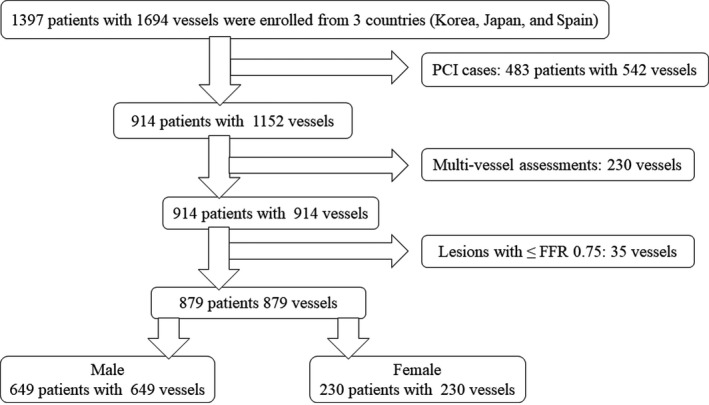
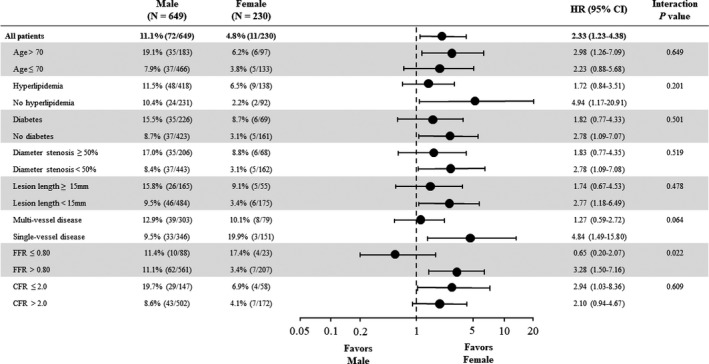
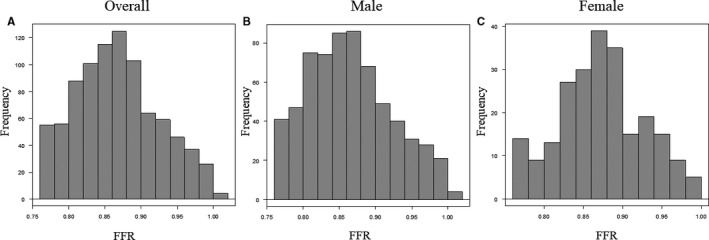
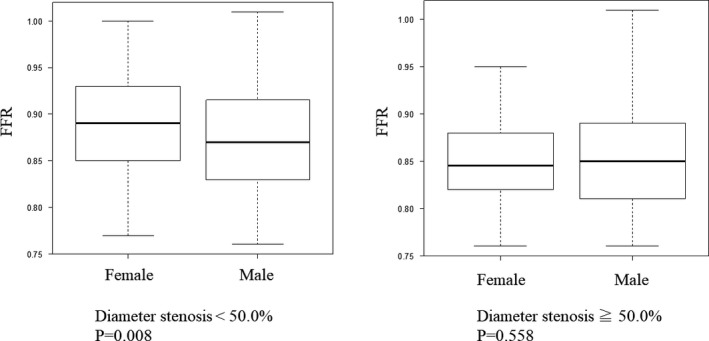
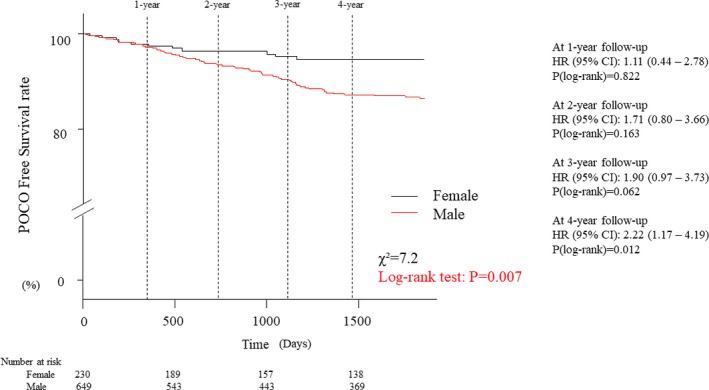
Background Sex-specific differences may influence prognosis after deferred revascularization following fractional flow reserve (FFR) measurement. This study sought to investigate the sex differences in long-term prognosis of patients with deferred revascularization following FFR assessment. Methods and Results A total of 879 patients (879 vessels) with deferred revascularization with FFR >0.75 who underwent FFR and coronary flow reserve measurements were enrolled from 3 countries (Korea, Japan, and Spain). Long-term outcomes were assessed in 649 men and 230 women by the patient-oriented composite outcome (POCO, a composite of any death, any myocardial infarction, and any revascularization). We applied inverse-probability weighting based on propensity scores to account for differences at baseline between women and men (age, hyperlipidemia, diabetes mellitus, diameter stenosis, lesion length, multivessel disease, FFR, coronary flow reserve. The median follow-up duration was 1855 days (745-1855 days). Median FFR values were 0.88 (0.83-0.93) in men and 0.89 (0.85-0.94) in women, respectively. The occurrences of POCO were significantly high in men compared with that in women (10.5% versus 4.2%, =0.007). Kaplan-Meier analysis revealed that women had a significantly lower risk of POCO (χ=7.2, =0.007). Multivariate COX proportional hazards regression analysis revealed that age, male, diabetes mellitus, diameter stenosis, lesion length, and coronary flow reserve were independent predictors of POCO. After applying IPW, the hazard ratio of males for POCO was 2.07 (95% CI, 1.07-4.04, =0.032). Conclusions This large multinational study reveals that long-term outcome differs between women and men in favor of women after FFR-guided revascularization deferral. Clinical Trial Registration URL: http://www.ClinicalTrials.gov. Unique identifier: NCT02186093.
在基于分数流储备(FFR)测量进行延迟血运重建后,性别特异性差异可能会影响预后。本研究旨在探讨 FFR 评估后延迟血运重建患者的长期预后性别差异。
共纳入来自 3 个国家(韩国、日本和西班牙)的 879 例 FFR>0.75 且行 FFR 和冠状动脉血流储备测量的患者(879 支血管)。通过以患者为中心的复合结局(POCO,包括任何死亡、任何心肌梗死和任何血运重建)评估 649 名男性和 230 名女性的长期结局。我们应用基于倾向评分的逆概率加权(Inverse Probability Weighting,IPW)来解释男性和女性之间的基线差异(年龄、高血脂、糖尿病、直径狭窄、病变长度、多血管疾病、FFR、冠状动脉血流储备)。中位随访时间为 1855 天(745-1855 天)。男性和女性的中位 FFR 值分别为 0.88(0.83-0.93)和 0.89(0.85-0.94)。男性 POCO 的发生率明显高于女性(10.5%比 4.2%,=0.007)。Kaplan-Meier 分析显示,女性 POCO 的风险显著降低(χ=7.2,=0.007)。多变量 COX 比例风险回归分析显示,年龄、男性、糖尿病、直径狭窄、病变长度和冠状动脉血流储备是 POCO 的独立预测因素。应用 IPW 后,男性 POCO 的风险比为 2.07(95%CI,1.07-4.04,=0.032)。
这项大型跨国研究表明,FFR 指导的血运重建延迟后,女性的长期预后优于男性。