Ungerer Marietjie J, Santos-Carballal David, Cadi-Essadek Abdelaziz, van Sittert Cornelia G C E, de Leeuw Nora H
Laboratory for Applied Molecular Modelling, Research Focus Area: Chemical Resource Beneficiation, North-West University, Private Bag X6001, Potchefstroom 2520, South Africa.
School of Chemistry, Cardiff University, Main Building, Park Place, Cardiff CF10 3AT, United Kingdom.
J Phys Chem C Nanomater Interfaces. 2019 Nov 14;123(45):27465-27476. doi: 10.1021/acs.jpcc.9b06136. Epub 2019 Sep 25.
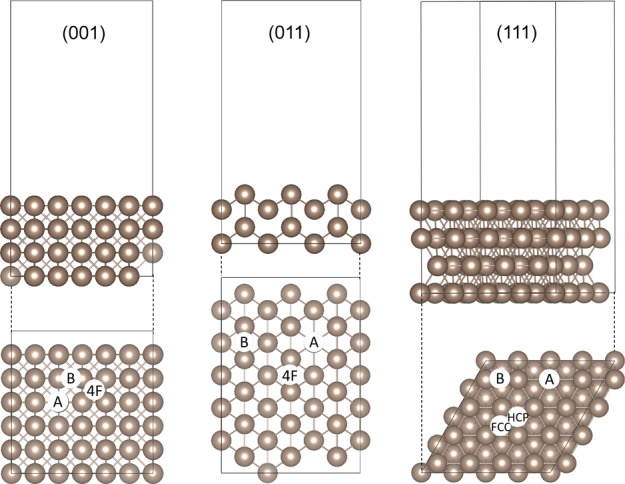
Platinum is a noble metal that is widely used for the electrocatalytic production of hydrogen, but the surface reactivity of platinum toward water is not yet fully understood, even though the effect of water adsorption on the surface free energy of Pt is important in the interpretation of the morphology and catalytic properties of this metal. In this study, we have carried out density functional theory calculations with long-range dispersion corrections [DFT-D3-(BJ)] to investigate the interaction of HO with the Pt (001), (011), and (111) surfaces. During the adsorption of a single HO molecule on various Pt surfaces, it was found that the lowest adsorption energy ( ) was obtained for the dissociative adsorption of HO on the (001) surface, followed by the (011) and (111) surfaces. When the surface coverage was increased up to a monolayer, we noted an increase in /HO with increasing coverage for the (001) surface, while for the (011) and (111) surfaces, /HO decreased. Considering experimental conditions, we observed that the highest coverage was obtained on the (011) surface, followed by the (111) and (001) surfaces. However, with an increase in temperature, the surface coverage decreased on all the surfaces. Total desorption occurred at temperatures higher than 400 K for the (011) and (111) surfaces, but above 850 K for the (001) surface. From the morphology analysis of the Pt nanoparticle, we noted that, when the temperature increased, only the electrocatalytically active (111) surface remained.
铂是一种贵金属,广泛用于电催化制氢,但尽管水吸附对铂表面自由能的影响在解释这种金属的形态和催化性能方面很重要,但铂对水的表面反应性尚未完全了解。在本研究中,我们进行了带有长程色散校正的密度泛函理论计算[DFT-D3-(BJ)],以研究HO与Pt(001)、(011)和(111)表面的相互作用。在单个HO分子吸附到各种铂表面的过程中,发现HO在(001)表面的解离吸附获得了最低吸附能( ),其次是(011)和(111)表面。当表面覆盖率增加到单层时,我们注意到(001)表面的 /HO随覆盖率增加而增加,而对于(011)和(111)表面, /HO降低。考虑到实验条件,我们观察到(011)表面获得的覆盖率最高,其次是(111)和(001)表面。然而,随着温度升高,所有表面的表面覆盖率均降低。对于(011)和(111)表面,在高于400 K的温度下发生完全脱附,但对于(001)表面,在高于850 K时发生完全脱附。从铂纳米颗粒的形态分析中,我们注意到,当温度升高时,仅保留了电催化活性的(111)表面。