Montaudié Henri, Viotti Julien, Combemale Patrick, Dutriaux Caroline, Dupin Nicolas, Robert Caroline, Mortier Laurent, Kaphan Régis, Duval-Modeste Anne-Bénédicte, Dalle Stéphane, De Quatrebarbes Julie, Stefan Andrea, Brunet-Possenti Florence, Kogay Maria, Picard-Gauci Alexandra, Poissonnet Gilles, Peyrade Frédéric
Department of Dermatology, University Hospital of Nice, Nice, France.
Epidemiology, Biostatistics and Health Data Departments, Antoine Lacassagne Center, Nice, France.
Oncotarget. 2020 Jan 28;11(4):378-385. doi: 10.18632/oncotarget.27434.
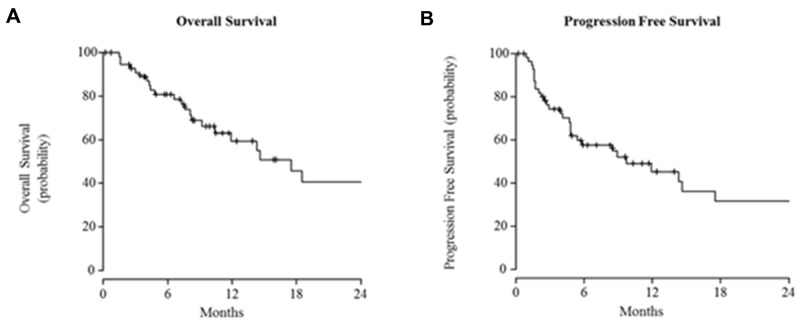
There is no standard of care for unresectable cutaneous squamous cell carcinoma (cSCC). Chemotherapy, alone or combined with radiotherapy, is commonly used mostly as palliative treatment; moreover, its poor safety profile limits its use most of the time, especially in elderly patients. Thus, alternative options are needed. Targeted molecular inhibitors, such as the epidermal growth factor receptor inhibitor cetuximab, seem promising, but data are limited. We retrospectively evaluated clinical outcomes of cetuximab as a single agent in this indication. The primary endpoint was the Disease Control Rate (DCR) at 6 weeks according to RECIST criteria. Secondary endpoints included DCR at 12 weeks, objective response rate (ORR) at 6 and 12 weeks, progression-free-survival (PFS), overall survival (OS), and safety profile. Fifty-eight patients received cetuximab as monotherapy. The median age was 83.2 (range, 47.4 to 96.1). The majority of patients was chemotherapy naïve. The median follow-up was 11.7 months (95% CI: 9.6-30.1). The DCR at 6 and 12 weeks was 87% and 70%, respectively. The ORR was 53% and 42%, respectively, at 6 and 12 weeks. The median PFS and OS were 9.7 months (95% CI: 4.8-43.4) and 17.5 months (95% CI: 9.4-43.1), respectively. Fifty-one patients (88%) experienced toxicity, and 67 adverse events related to cetuximab occurred. Most of them (84%) were grade 1 to 2. Our study shows that cetuximab is safe and efficient for the treatment of patients, even elderly ones, with advanced cSCC. These results indicate that cetuximab is a promising agent to test in new combinations, especially with immune checkpoint inhibitors such as anti-PD-1 agents.
对于不可切除的皮肤鳞状细胞癌(cSCC),目前尚无标准治疗方案。化疗单独或联合放疗,通常主要用作姑息治疗;此外,其较差的安全性在大多数情况下限制了其应用,尤其是在老年患者中。因此,需要其他选择。靶向分子抑制剂,如表皮生长因子受体抑制剂西妥昔单抗,似乎很有前景,但数据有限。我们回顾性评估了西妥昔单抗作为单一药物在该适应症中的临床疗效。主要终点是根据RECIST标准在6周时的疾病控制率(DCR)。次要终点包括12周时的DCR、6周和12周时的客观缓解率(ORR)、无进展生存期(PFS)、总生存期(OS)和安全性。58例患者接受了西妥昔单抗单药治疗。中位年龄为83.2岁(范围47.4至96.1岁)。大多数患者未接受过化疗。中位随访时间为11.7个月(95%CI:9.6 - 30.1)。6周和12周时的DCR分别为87%和70%。6周和12周时的ORR分别为53%和42%。中位PFS和OS分别为9.7个月(95%CI:4.8 - 43.4)和17.5个月(95%CI:9.4 - 43.1)。51例患者(88%)出现毒性反应,发生了67例与西妥昔单抗相关的不良事件。其中大多数(84%)为1至2级。我们的研究表明,西妥昔单抗对于治疗晚期cSCC患者,甚至老年患者,是安全有效的。这些结果表明,西妥昔单抗是一种有前景的药物,可用于测试新的联合用药方案,尤其是与抗PD - 1药物等免疫检查点抑制剂联合使用。