Division of Pharmacy and Optometry, University of Manchester; Faculty of Biology, Medicine and Health, Manchester, UK.
Pharmacy Department, Royal Manchester Children's Hospital, Manchester, UK.
Eur J Hosp Pharm. 2020 Jan;27(1):3-8. doi: 10.1136/ejhpharm-2018-001624. Epub 2018 Oct 23.
Medication error is the most common type of medical error, and intravenous medicines are at a higher risk as they are complex to prepare and administer. The WHO advocates a 50% reduction of harmful medication errors by 2022, but there is a lack of data in the UK that accurately estimates the true rate of intravenous medication errors. This study aimed to estimate the number of intravenous medication errors per 1000 administrations in the UK National Health Service and their associated economic costs. The rate of errors in prescribing, preparation and administration, and rate of different types of errors were also extracted.
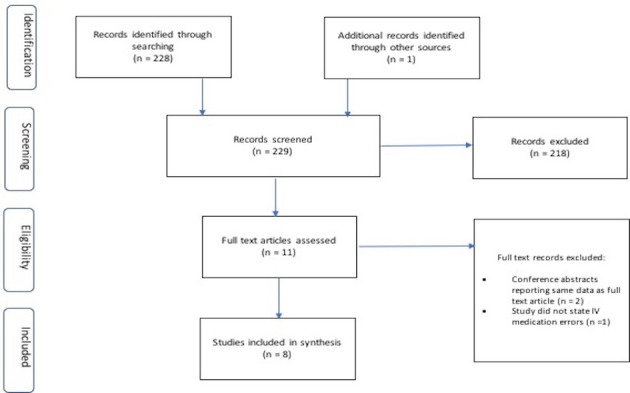
MEDLINE, Embase, Cochrane central register of clinical trials, Database of Abstracts of Reviews of Effectiveness, National Health Service Economic Evaluation Database and the Health Technology Appraisals Database were searched from inception to July 2017. Epidemiological studies to determine the incidence of intravenous medication errors set wholly or in part in the UK were included. 228 studies were identified, and after screening, eight papers were included, presenting 2576 infusions. Data were reviewed and extracted by a team of five reviewers with discrepancies in data extraction agreed by consensus.
Five of eight studies used a comparable denominator, and these data were pooled to determine a weighted mean incidence of 101 intravenous medication errors per 1000 administrations (95% CI 84 to 121). Three studies presented prevalence data but these were based on spontaneous reports only; therefore it did not support a true estimate. 32.1% (95% CI 30.6% to 33.7%) of intravenous medication errors were administration errors and 'wrong rate' errors accounted for 57.9% (95% CI 54.7% to 61.1%) of these.
Intravenous medication errors in the UK are common, with half these of errors related to medication administration. National strategies are aimed at mitigating errors in prescribing and preparation. It is now time to focus on reducing administration error, particularly wrong rate errors.
用药错误是最常见的医疗差错类型,而静脉用药由于其配制和给药过程复杂,风险更高。世界卫生组织(WHO)倡导到 2022 年将有害用药错误减少 50%,但英国缺乏准确估计静脉用药错误真实发生率的数据。本研究旨在估计英国国家医疗服务体系(NHS)中每 1000 次静脉给药的用药错误数量及其相关经济成本。还提取了处方、配制和给药错误率以及不同类型错误率的数据。
从建库至 2017 年 7 月,检索 MEDLINE、Embase、Cochrane 临床对照试验数据库、疗效评价文摘数据库、英国 NHS 经济评价数据库和卫生技术评估数据库。纳入完全或部分在英国开展的旨在确定静脉用药错误发生率的流行病学研究。共识别出 228 篇研究,经筛选后纳入 8 篇文献,共报道了 2576 次静脉输注。由 5 名评审员对数据进行审查和提取,对数据提取的分歧通过共识解决。
8 项研究中有 5 项使用了可比的分母,这些数据被汇总以确定每 1000 次给药 101 次静脉用药错误的加权平均值(95%CI 84 至 121)。3 项研究报告了患病率数据,但这些数据仅基于自发报告,因此不支持真实估计。32.1%(95%CI 30.6%至 33.7%)的静脉用药错误为给药错误,其中“错误率”错误占 57.9%(95%CI 54.7%至 61.1%)。
英国的静脉用药错误很常见,其中一半与药物给药有关。国家策略旨在减少处方和配制错误。现在是时候集中精力减少给药错误,特别是错误率错误了。