Wang Lili, Miao Yongzhi, Chen Tianwen, Sun Dengzhong, Ge Sitang, Zuo Lugen, Liu Mulin
Department of Gastrointestinal Surgery, The First Affiliated Hospital of Bengbu Medical College, Bengbu, Anhui 233004, P.R. China.
Mol Clin Oncol. 2020 Mar;12(3):196-201. doi: 10.3892/mco.2020.1980. Epub 2020 Jan 17.
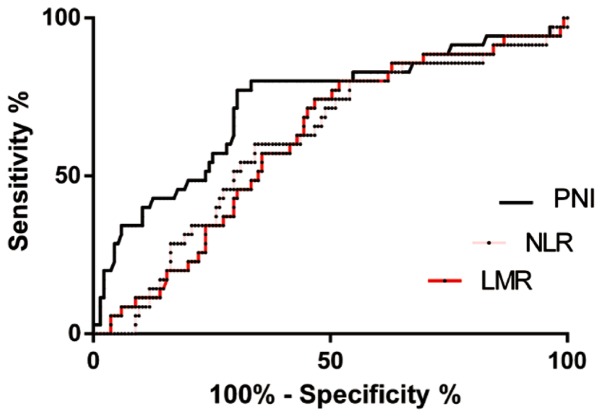
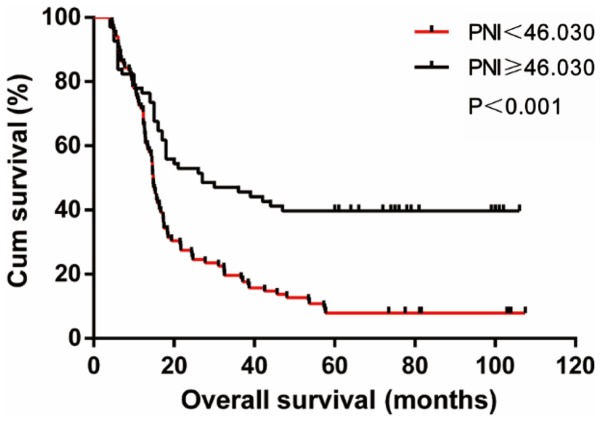
Preoperative prognostic nutritional index (PNI) has been widely used for the clinical evaluation of patients with cancer. The present study assessed the prognostic value of preoperative PNI in patients after gastric cancer (GC) radical surgery. The clinical case and follow-up data of 170 patients undergoing GC radical surgery were retrospectively analyzed. The receiver operating characteristic (ROC) curve was used to compare the predictive ability of each inflammatory index: The PNI, neutrophil-to-lymphocyte ratio (NLR) and lymphocyte-to-monocyte ratio (LMR). The correlation between the preoperative PNI and overall survival (OS) was also analyzed via Kaplan-Meier (K-M) curves and multivariate Cox regression analyses. The results revealed that the optimal PNI cut-off was 46.030. According to this cut-off value, the whole sample was divided into PNI <46.030 (low PNI group) and PNI ≥46.030 (high PNI group). These groups were comprised of 102 and 68 cases, respectively. The area under the curve value of the PNI was 0.725, which was greater than that of traditional inflammatory indices, including the NLR and LMR. K-M survival analysis revealed that the 5 year survival rate of patients in the low PNI group was significantly lower than that of patients in the high PNI group (P<0.01). Univariate analysis and Cox multiple regression model analysis demonstrated that the T stage, N stage, pathological grade and PNI were independent risk factors for the 5 year survival rate after radical gastrectomy (P<0.05). In conclusion, the preoperative PNI is an independent risk factor for 5 year survival after radical gastrectomy and has clinical value for the prognostic evaluation of patients with GC.
术前预后营养指数(PNI)已广泛应用于癌症患者的临床评估。本研究评估了术前PNI在胃癌(GC)根治术后患者中的预后价值。回顾性分析了170例行GC根治术患者的临床病例及随访资料。采用受试者工作特征(ROC)曲线比较各炎症指标的预测能力:PNI、中性粒细胞与淋巴细胞比值(NLR)和淋巴细胞与单核细胞比值(LMR)。还通过Kaplan-Meier(K-M)曲线和多因素Cox回归分析,分析术前PNI与总生存期(OS)之间的相关性。结果显示,PNI的最佳截断值为46.030。根据该截断值,将整个样本分为PNI<46.030(低PNI组)和PNI≥46.030(高PNI组)。这两组分别包括102例和68例。PNI的曲线下面积值为0.725,大于包括NLR和LMR在内的传统炎症指标。K-M生存分析显示,低PNI组患者的5年生存率显著低于高PNI组患者(P<0.01)。单因素分析和Cox多元回归模型分析表明,T分期、N分期、病理分级和PNI是根治性胃切除术后5年生存率的独立危险因素(P<0.05)。总之,术前PNI是根治性胃切除术后5年生存的独立危险因素,对GC患者的预后评估具有临床价值。