Creissen Charles E, Warnan Julien, Antón-García Daniel, Farré Yoann, Odobel Fabrice, Reisner Erwin
Christian Doppler Laboratory for Sustainable SynGas Chemistry, Department of Chemistry, University of Cambridge, Lensfield Road, Cambridge CB2 1EW, U.K.
Université LUNAM, Université de Nantes, CNRS, Chimie et Interdisciplinarité: Synthèse, Analyse, Modélisation (CEISAM), UMR 6230, 2 rue de la Houssinière, 44322 Nantes cedex 3, France.
ACS Catal. 2019 Oct 4;9(10):9530-9538. doi: 10.1021/acscatal.9b02984. Epub 2019 Sep 9.
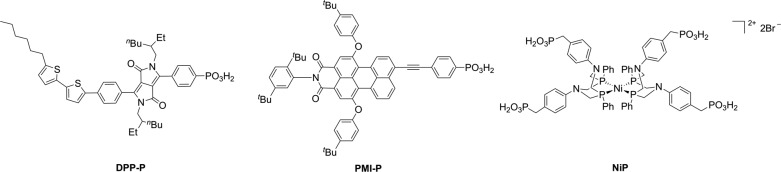
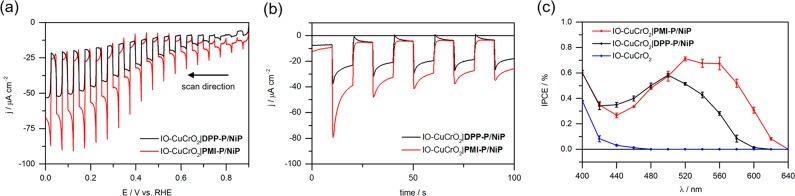
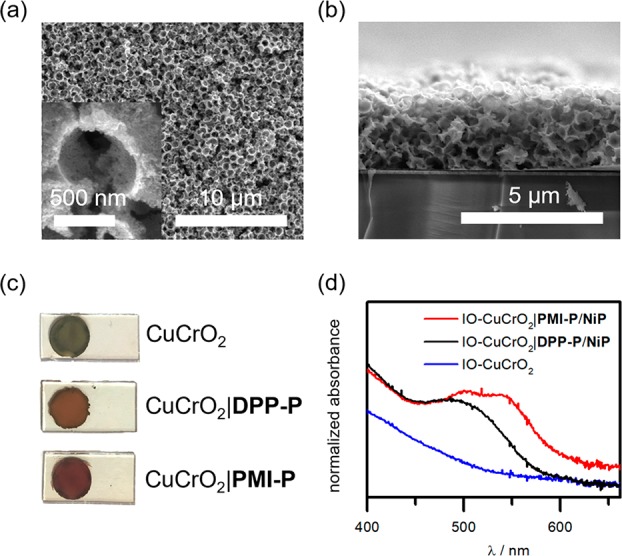
Dye-sensitized photoelectrochemical (DSPEC) cells are an emerging approach to producing solar fuels. The recent development of delafossite CuCrO as a p-type semiconductor has enabled H generation through the coassembly of catalyst and dye components. Here, we present a CuCrO electrode based on a high-surface-area inverse opal (IO) architecture with benchmark performance in DSPEC H generation. Coimmobilization of a phosphonated diketopyrrolopyrrole () or perylene monoimide () dye with a phosphonated molecular Ni catalyst () demonstrates the ability of IO-CuCrO to photogenerate H. A positive photocurrent onset potential of approximately +0.8 V vs RHE was achieved with these photocathodes. The -based photoelectrodes delivered photocurrents of -18 μA cm and generated 160 ± 24 nmol of H cm, whereas the -based photocathodes displayed higher photocurrents of -25 μA cm and produced 215 ± 10 nmol of H cm at 0.0 V vs RHE over the course of 2 h under visible light illumination (100 mW cm, AM 1.5G, λ > 420 nm, 25 °C). The high performance of the PMI-constructed system is attributed to the well-suited molecular structure and photophysical properties for p-type sensitization. These precious-metal-free photocathodes highlight the benefits of using bespoke IO-CuCrO electrodes as well as the important role of the molecular dye structure in DSPEC fuel synthesis.
染料敏化光电化学(DSPEC)电池是一种新兴的太阳能燃料生产方法。最近,作为p型半导体的铜铬矿CuCrO的发展使得通过催化剂和染料成分的共组装来产生氢气成为可能。在此,我们展示了一种基于高表面积反蛋白石(IO)结构的CuCrO电极,其在DSPEC产氢方面具有基准性能。将膦酸化的二酮吡咯并吡咯()或苝单酰亚胺()染料与膦酸化的分子镍催化剂()共固定,证明了IO-CuCrO光生氢的能力。这些光阴极实现了相对于可逆氢电极(RHE)约+0.8 V的正光电流起始电位。基于的光电极产生了-18 μA cm的光电流,并产生了160±24 nmol的H cm,而基于的光阴极在可见光照射(100 mW cm,AM 1.5G,λ>420 nm,25°C)下2小时的过程中,在相对于RHE为0.0 V时显示出更高的-25 μA cm的光电流,并产生了215±10 nmol的H cm。PMI构建系统的高性能归因于其适合p型敏化的分子结构和光物理性质。这些无贵金属的光阴极突出了使用定制的IO-CuCrO电极的好处以及分子染料结构在DSPEC燃料合成中的重要作用。