Sarikaya Ismet, Albatineh Ahmed N, Sarikayaa Ali
Department of Nuclear Medicine, Faculty of Medicine, Mubarak Al-Kabeer Hospital, Kuwait University, Kuwait.
Department of Community Medicine and Behavioral Sciences, Faculty of Medicine, Kuwait University, Kuwait.
Asia Ocean J Nucl Med Biol. 2020 Winter;8(1):46-53. doi: 10.22038/aojnmb.2019.14418.
Studies have mainly assessed the effect of hyperglycemia on F-fluorodeoxyglucose (FDG) uptake in the brain. In this study, we assessed the FDG uptake of the brain not only in normo- and hyperglycemia but also in hypoglycemia to compare the effect of various blood glucose levels on regional FDG uptake in the brain.
This retrospective study was conducted on whole-body FDG positron emission tomography/computed tomography (PET/CT) images including the brain. The inclusion criteria included adult patients with no known history of diseases or symptoms affecting the brain, lack of abnormal brain findings on both PET and CT images, no image artifacts, and lack of any factors affecting brain FDG uptake. Maximum standardized uptake values (SUV) were measured in the lateral and medial frontal, temporal, parietal, and occipital cortices, lateral cerebellar cortex, posterior cingulate cortex, caudate nucleus, putamen, thalamus, brain stem (BS), and scalp in patients with normal (91-100 mg/dl), low (61-70 mg/dl), and high (171-200 mg/dl) blood glucose (BG) levels. Mean SUV of the brain regions for each BG range was calculated and statistically analyzed.
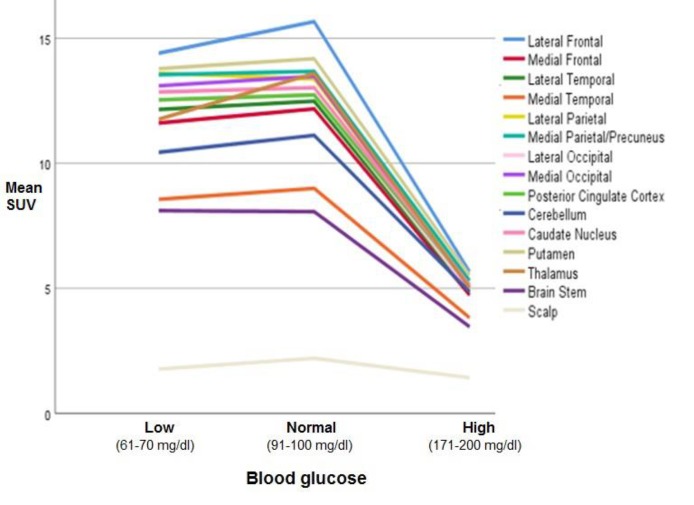
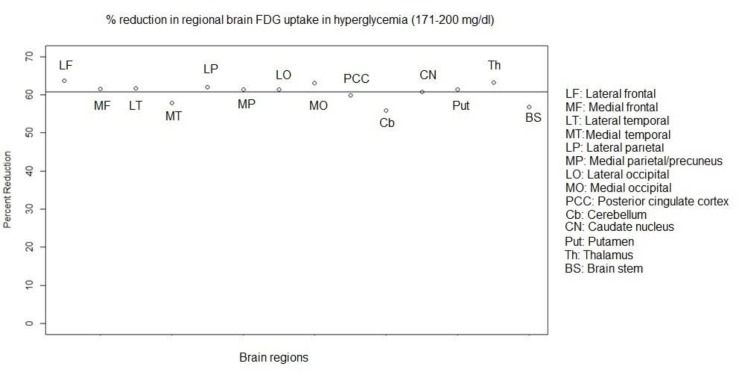
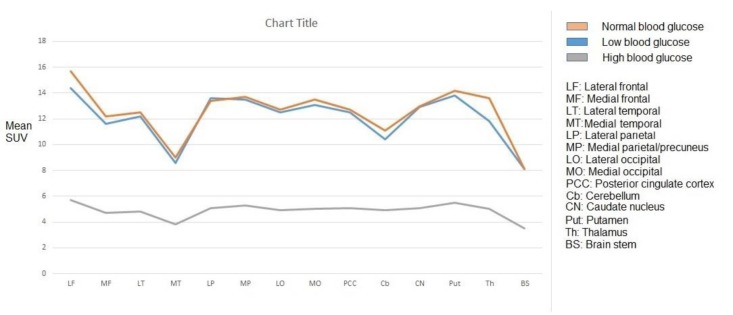
In all BG levels, FDG uptake was at the highest level in the lateral frontal cortex and lowest level in the medial temporal cortex (MTC) and BS. The SUV in all assessed brain regions was significantly lower in hyperglycemia (P<0.001). However, this value was not significantly different in hypoglycemia (P>0.05) as compared to that in normoglycemia. At the BG range of 171-200 mg/dl, hyperglycemia-induced reduction in regional SUV had a range of 55.9-63.7% (60%±2.4%). This reduction was below 60% in the MTC, cerebellum, and BS and above 60% in other regions. Scalp activity was lower in hyperglycemia (P<0.001) and not different in hypoglycemia (P>0.05) as compared to normoglycemia.
The FDG uptake appears to be at the highest level in the lateral frontal cortex and the lowest level in the MTC and BS in normo-, hypo-, and hyperglycemia. Hyperglycemia-induced reduction in FDG uptake was approximately the same as that in various regions of the brain. However, the MTC, cerebellum, and BS may be slightly less affected than the other regions. Hypoglycemia does not seem to have a significant effect on FDG uptake in the brain.
以往研究主要评估高血糖对大脑中氟脱氧葡萄糖(FDG)摄取的影响。在本研究中,我们不仅评估了正常血糖和高血糖状态下大脑的FDG摄取情况,还评估了低血糖状态下的情况,以比较不同血糖水平对大脑局部FDG摄取的影响。
本回顾性研究基于包含大脑的全身FDG正电子发射断层扫描/计算机断层扫描(PET/CT)图像进行。纳入标准包括无已知影响大脑的疾病史或症状、PET和CT图像上均无异常脑部表现、无图像伪影且无任何影响大脑FDG摄取的因素的成年患者。在血糖正常(91 - 100mg/dl)、低(61 - 70mg/dl)和高(171 - 200mg/dl)水平的患者中,测量其外侧和内侧额叶、颞叶、顶叶和枕叶皮质、外侧小脑皮质、后扣带回皮质、尾状核、壳核、丘脑、脑干(BS)和头皮的最大标准化摄取值(SUV)。计算每个血糖范围大脑区域的平均SUV并进行统计学分析。
在所有血糖水平下,FDG摄取在外侧额叶皮质最高,在内侧颞叶皮质(MTC)和脑干最低。高血糖时所有评估脑区的SUV均显著降低(P<0.001)。然而,低血糖时该值与正常血糖时相比无显著差异(P>0.05)。在血糖范围为171 - 200mg/dl时,高血糖导致的局部SUV降低幅度为55.9 - 63.7%(60%±2.4%)。MTC、小脑和脑干的降低幅度低于60%,其他区域高于60%。高血糖时头皮活性降低(P<0.001),低血糖时与正常血糖相比无差异(P>0.05)。
在正常血糖、低血糖和高血糖状态下,FDG摄取似乎在外侧额叶皮质最高,在MTC和脑干最低。高血糖导致的FDG摄取降低在大脑各区域大致相同。然而,MTC、小脑和脑干受影响程度可能略低于其他区域。低血糖似乎对大脑FDG摄取无显著影响。