The University of Queensland, School of Chemistry & Molecular Biosciences, Lucia, QLD 4072, Australia.
School of Health and Biomedical Sciences, RMIT University, Victoria 3083, Australia.
Sci Adv. 2020 Jan 29;6(5):eaax2285. doi: 10.1126/sciadv.aax2285. eCollection 2020 Jan.
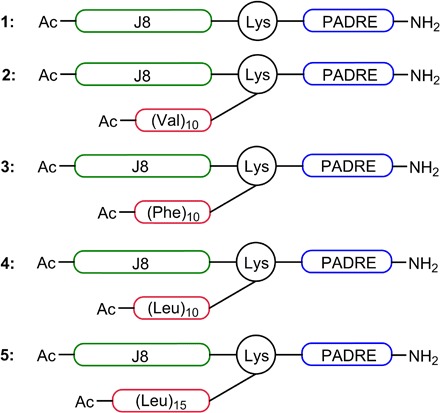
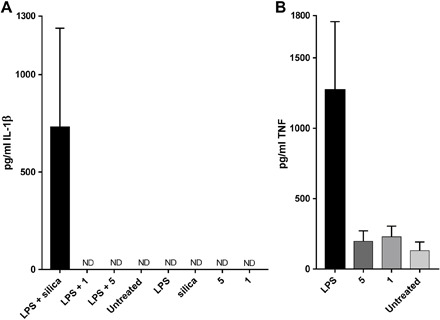
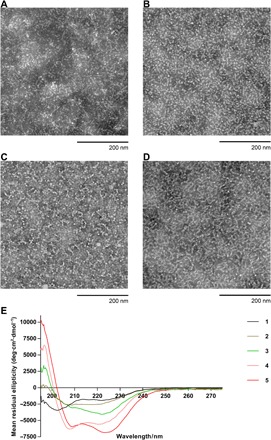
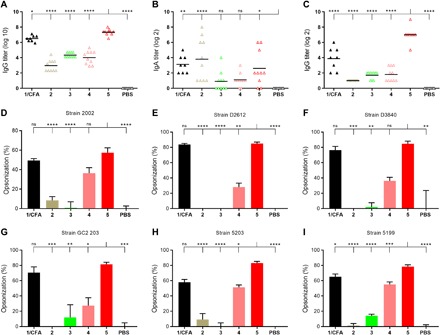
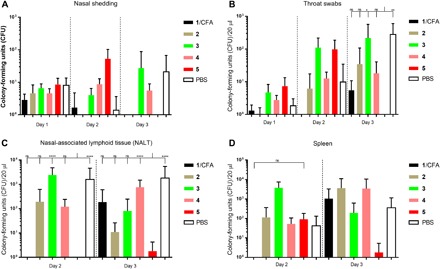
To be optimally effective, peptide-based vaccines need to be administered with adjuvants. Many currently available adjuvants are toxic, not biodegradable; they invariably invoke adverse reactions, including allergic responses and excessive inflammation. A nontoxic, biodegradable, biocompatible, self-adjuvanting vaccine delivery system is urgently needed. Herein, we report a potent vaccine delivery system fulfilling the above requirements. A peptide antigen was coupled with poly-hydrophobic amino acid sequences serving as self-adjuvanting moieties using solid-phase synthesis, to produce fully defined single molecular entities. Under aqueous conditions, these molecules self-assembled into distinct nanoparticles and chain-like aggregates. Following subcutaneous immunization in mice, these particles successfully induced opsonic epitope-specific antibodies without the need of external adjuvant. Mice immunized with entities bearing 15 leucine residues were able to clear bacterial load from target organs without triggering the release of soluble inflammatory mediators. Thus, we have developed a well-defined and effective self-adjuvanting delivery system for peptide antigens.
为了达到最佳效果,基于肽的疫苗需要与佐剂一起使用。许多现有的佐剂具有毒性,不可生物降解;它们不可避免地会引起不良反应,包括过敏反应和过度炎症。因此,迫切需要一种无毒、可生物降解、生物相容、自佐剂的疫苗传递系统。在此,我们报告了一种满足上述要求的有效疫苗传递系统。采用固相合成技术,将肽抗原与作为自佐剂的多亲水性氨基酸序列偶联,生成完全定义的单一分子实体。在水相中,这些分子自组装成不同的纳米颗粒和链状聚集体。在小鼠的皮下免疫后,这些颗粒在没有外部佐剂的情况下成功诱导了调理表位特异性抗体。携带 15 个亮氨酸残基的实体免疫的小鼠能够清除靶器官中的细菌负荷,而不会引发可溶性炎症介质的释放。因此,我们已经开发出一种用于肽抗原的明确且有效的自佐剂传递系统。