Department of Psychological and Brain Sciences, Dartmouth College, HB 6207 Moore Hall, Hanover, NH 03755, USA.
Soc Cogn Affect Neurosci. 2020 Jan 30;15(1):63-73. doi: 10.1093/scan/nsaa022.
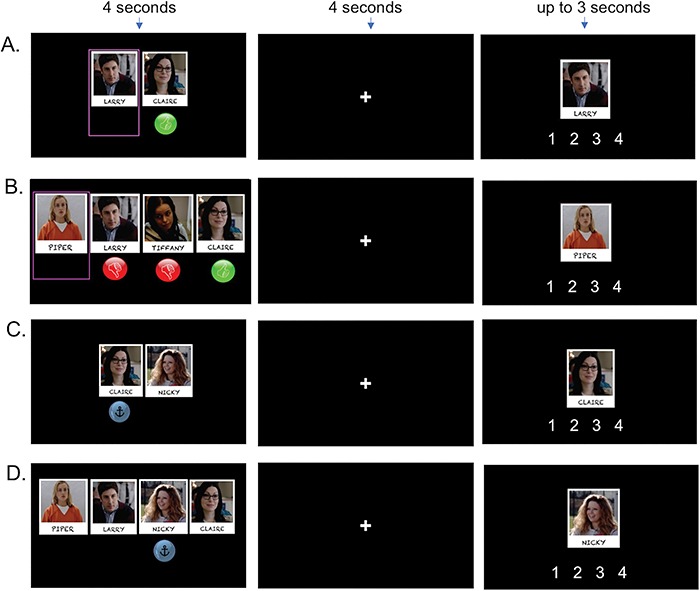
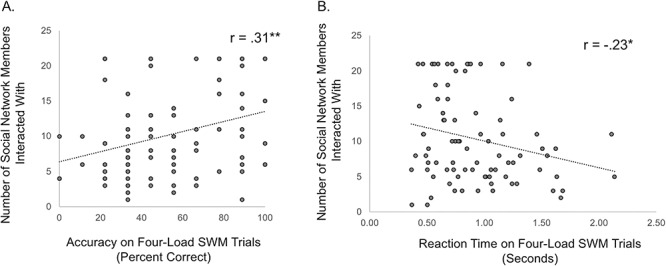
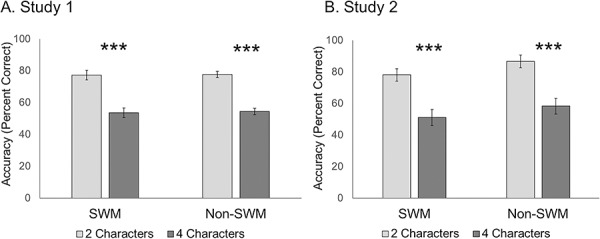
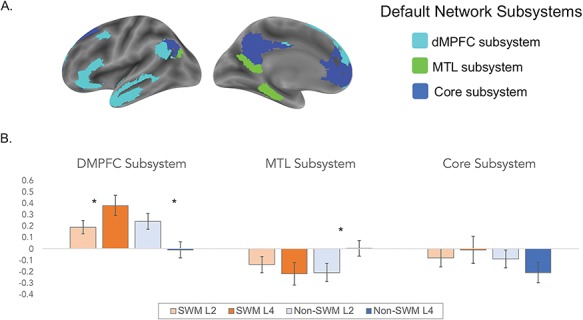
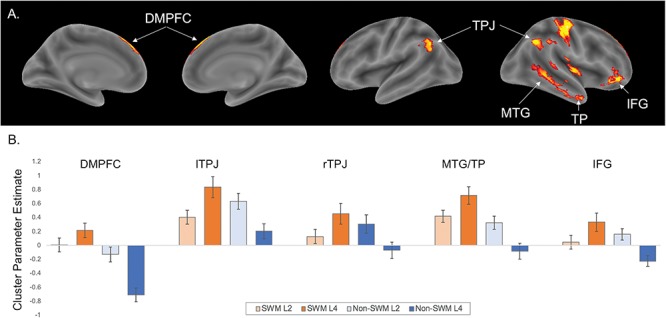
We often interact with multiple people at a time and consider their various points of view to facilitate smooth social interaction. Yet, how our brains track multiple mental states at once, and whether skill in this domain links to social integration, remains underspecified. To fill this gap, we developed a novel social working memory paradigm in which participants manage two- or four-people's mental states in working memory, as well as control trials in which they alphabetize two- or four-people's names in working memory. In Study 1, we found that the dorsomedial subsystem of the default network shows relative increases in activity with more mental states managed in working memory. In contrast, this subsystem shows relative decreases in activity with more non-mental state information (the number of names alphabetized) managed in working memory. In Study 2, only individual differences in managing mental states in working memory, specifically on trials that posed the greatest mental state load to working memory, correlated with social integration. Collectively, these findings add further support to the hypothesis that social working memory relies on partially distinct brain systems and may be a key ingredient to success in a social world.
我们经常同时与多个人互动,并考虑他们的各种观点,以促进顺利的社会互动。然而,我们的大脑如何同时跟踪多个心理状态,以及在这个领域的技能是否与社会融合有关,仍然没有明确的说明。为了填补这一空白,我们开发了一种新的社会工作记忆范式,参与者在工作记忆中管理两个人或四个人的心理状态,以及控制试验,在工作记忆中对两个人或四个人的名字进行字母排序。在研究 1 中,我们发现默认网络的背内侧子系统在工作记忆中管理更多的心理状态时表现出相对较高的活动水平。相比之下,这个子系统在工作记忆中管理更多的非心理状态信息(字母排序的名字数量)时表现出相对较低的活动水平。在研究 2 中,只有在工作记忆中管理心理状态的个体差异,特别是在对工作记忆的心理状态负荷最大的试验中,与社会融合相关。总的来说,这些发现进一步支持了这样的假设,即社会工作记忆依赖于部分不同的大脑系统,并且可能是在社会世界中取得成功的关键因素。