Garagnani Max
Department of Computing, Goldsmiths - University of London, London, UK.
Brain Language Laboratory, Department of Philosophy and Humanities, Freie Universität Berlin, Berlin, Germany.
Cogn Neurodyn. 2024 Dec;18(6):3383-3400. doi: 10.1007/s11571-023-10061-1. Epub 2024 Feb 4.
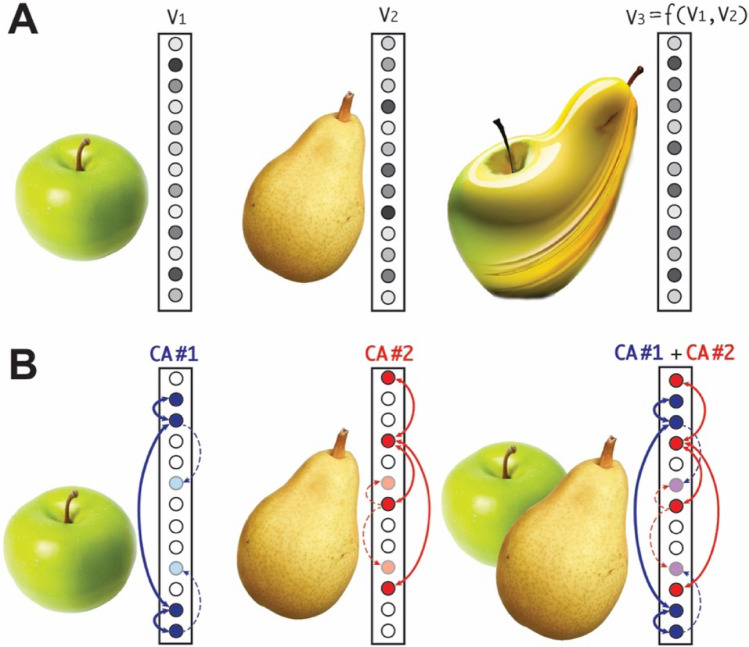
The ability to coactivate (or "superpose") multiple conceptual representations is a fundamental function that we constantly rely upon; this is crucial in complex cognitive tasks requiring multi-item working memory, such as mental arithmetic, abstract reasoning, and language comprehension. As such, an artificial system aspiring to implement any of these aspects of general intelligence should be able to support this operation. I argue here that standard, feed-forward deep neural networks (DNNs) are unable to implement this function, whereas an alternative, fully brain-constrained class of neural architectures spontaneously exhibits it. On the basis of novel simulations, this proof-of-concept article shows that deep, brain-like networks trained with biologically realistic Hebbian learning mechanisms display the spontaneous emergence of internal circuits (cell assemblies) having features that make them natural candidates for supporting superposition. Building on previous computational modelling results, I also argue that, and offer an explanation as to why, in contrast, modern DNNs trained with gradient descent are generally unable to co-activate their internal representations. While deep brain-constrained neural architectures spontaneously develop the ability to support superposition as a result of (1) neurophysiologically accurate learning and (2) cortically realistic between-area connections, backpropagation-trained DNNs appear to be unsuited to implement this basic cognitive operation, arguably necessary for abstract thinking and general intelligence. The implications of this observation are briefly discussed in the larger context of existing and future artificial intelligence systems and neuro-realistic computational models.
共同激活(或“叠加”)多个概念表征的能力是我们持续依赖的一项基本功能;这在需要多项目工作记忆的复杂认知任务中至关重要,比如心算、抽象推理和语言理解。因此,一个渴望实现通用智能这些方面中任何一个的人工系统应该能够支持这种操作。我在此论证,标准的前馈深度神经网络(DNN)无法实现此功能,而另一类完全受大脑约束的神经架构会自发地展现出这一功能。基于新颖的模拟,这篇概念验证文章表明,用符合生物学现实的赫布学习机制训练的深度、类脑网络会自发出现具有使其成为支持叠加的自然候选特征的内部回路(细胞集合)。基于之前的计算建模结果,我还论证了,并且解释了为什么,相比之下,用梯度下降训练的现代DNN通常无法共同激活其内部表征。虽然深度受大脑约束的神经架构由于(1)神经生理学上准确的学习和(2)符合皮层现实的区域间连接而自发发展出支持叠加的能力,但反向传播训练的DNN似乎不适合实现这一基本认知操作,而这一操作对于抽象思维和通用智能来说可以说是必要的。在现有和未来人工智能系统以及神经现实计算模型的更大背景下,简要讨论了这一观察结果的影响。