Department of Molecular Biotechnology and Health Sciences, University of Torino, Torino, Italy.
Molecular Biotechnology Center, University of Torino, Torino, Italy.
Int J Cancer. 2020 Sep 15;147(6):1694-1706. doi: 10.1002/ijc.32925. Epub 2020 Feb 25.
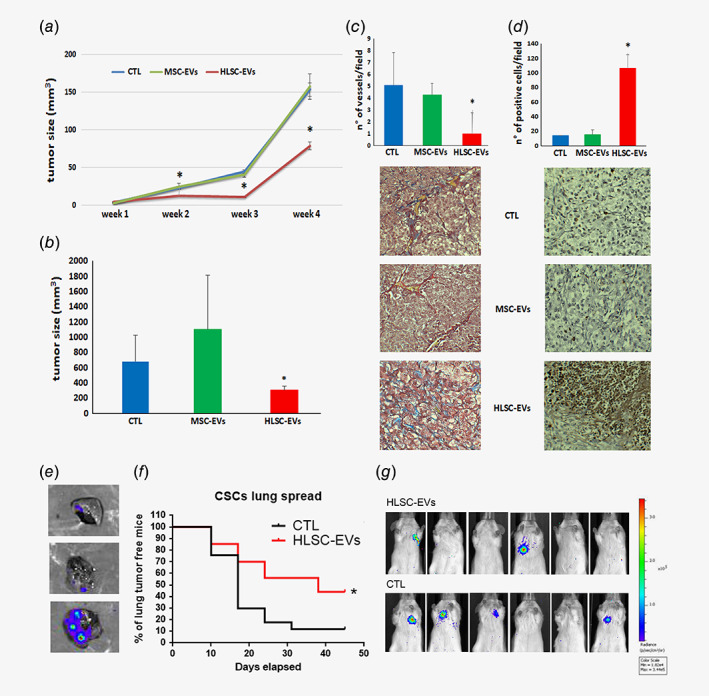
Cancer stem cells (CSCs) are considered as responsible for initiation, maintenance and recurrence of solid tumors, thus representing the key for tumor eradication. The antitumor activity of extracellular vesicles (EVs) derived from different stem cell sources has been investigated with conflicting results. In our study, we evaluated, both in vitro and in vivo, the effect of EVs derived from human bone marrow mesenchymal stromal cells (MSCs) and from a population of human liver stem cells (HLSCs) of mesenchymal origin on renal CSCs. In vitro, both EV sources displayed pro-apoptotic, anti-proliferative and anti-invasive effects on renal CSCs, but not on differentiated tumor cells. Pre-treatment of renal CSCs with EVs, before subcutaneous injection in SCID mice, delayed tumor onset. We subsequently investigated the in vivo effect of MSC- and HLSC-EVs systemic administration on progression of CSC-generated renal tumors. Tumor bio-distribution analysis identified intravenous treatment as best route of administration. HLSC-EVs, but not MSC-EVs, significantly impaired subcutaneous tumor growth by reducing tumor vascularization and inducing tumor cell apoptosis. Moreover, intravenous treatment with HLSC-EVs improved metastasis-free survival. In EV treated tumor explants, we observed both the transfer and the induction of miR-145 and of miR-200 family members. In transfected CSCs, the same miRNAs affected cell growth, invasion and survival. In conclusion, our results showed a specific antitumor effect of HLSC-EVs on CSC-derived renal tumors in vivo, possibly ascribed to the transfer and induction of specific antitumor miRNAs. Our study provides further evidence for a possible clinical application of stem cell-EVs in tumor treatment.
癌症干细胞(CSCs)被认为是实体瘤起始、维持和复发的原因,因此代表了肿瘤根除的关键。不同干细胞来源的细胞外囊泡(EVs)的抗肿瘤活性已被研究,但结果存在冲突。在我们的研究中,我们评估了来源于人骨髓间充质基质细胞(MSCs)和来源于间充质来源的人肝干细胞(HLSCs)的 EVs 对肾 CSCs 的体内外作用。在体外,两种 EV 来源均对肾 CSCs 表现出促凋亡、抗增殖和抗侵袭作用,但对分化的肿瘤细胞没有作用。在将肾 CSCs 皮下注射到 SCID 小鼠之前,用 EV 预处理肾 CSCs 可延迟肿瘤的发生。随后,我们研究了 MSC-和 HLSC-EVs 全身给药对 CSC 生成的肾肿瘤进展的体内作用。肿瘤生物分布分析表明静脉内治疗是最佳给药途径。HLSC-EVs 而非 MSC-EVs 通过减少肿瘤血管生成和诱导肿瘤细胞凋亡显著抑制皮下肿瘤生长。此外,HLSC-EVs 的静脉内治疗可改善无转移生存。在接受 EV 治疗的肿瘤标本中,我们观察到 miR-145 和 miR-200 家族成员的转移和诱导。在转染的 CSCs 中,相同的 miRNA 影响细胞生长、侵袭和存活。总之,我们的结果表明 HLSC-EVs 对体内 CSC 衍生的肾肿瘤具有特异性抗肿瘤作用,可能归因于特定的抗肿瘤 miRNA 的转移和诱导。我们的研究为干细胞-EVs 在肿瘤治疗中的可能临床应用提供了进一步的证据。