School of Medicine and Health Sciences Mulungushi University Livingstone Zambia.
Department of Biomedical Sciences School of Health Sciences University of Zambia Lusaka Zambia.
J Am Heart Assoc. 2020 Feb 18;9(4):e011450. doi: 10.1161/JAHA.118.011450. Epub 2020 Feb 17.
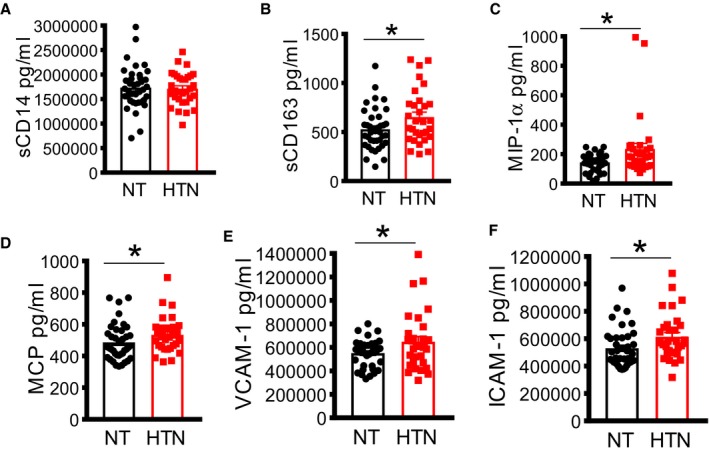
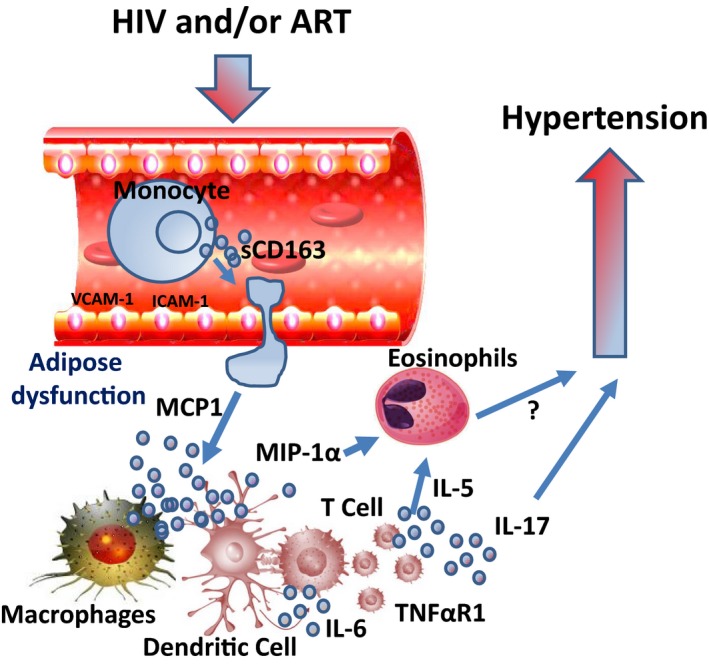
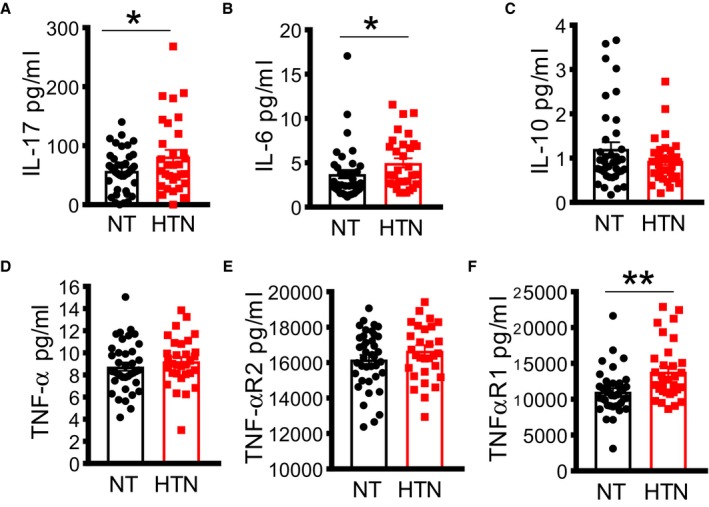
Background People living with HIV (PLWH) are at increased risk of cardiovascular disease, including hypertension, which persists despite effective plasma viral suppression on antiretroviral therapy. HIV infection is characterized by long-term alterations in immune function, but the contribution of immune factors to hypertension in PLWH is not fully understood. Prior studies have found that both innate and adaptive immune cell activation contributes to hypertension. Methods and Results We hypothesized that chronic inflammation may contribute to hypertension in PLWH. To test this hypothesis, we enrolled a cohort of 70 PLWH (44% hypertensive) on a long-term single antiretroviral therapy regimen for broad phenotyping of inflammation biomarkers. We found that hypertensive PLWH had higher levels of inflammatory cytokines, including tumor necrosis factor-α receptor 1, interleukin-6, interleukin-17, interleukin-5, intercellular adhesion molecule 1 and macrophage inflammatory protein-1α. After adjustment for age, sex, and fat mass index, the circulating eosinophils remained significantly associated with hypertension. On the basis of these results, we assessed the relationship of eosinophils and hypertension in 2 cohorts of 50 and 81 039 similar HIV-negative people; although eosinophil count was associated with prevalent hypertension, this relationship was abrogated by body mass index. Conclusions These findings may represent a unique linkage between immune status and cardiovascular physiological characteristics in HIV infection, which should be evaluated further.
HIV 感染者(PLWH)患心血管疾病(包括高血压)的风险增加,尽管接受抗逆转录病毒治疗后血浆病毒得到有效抑制,但高血压仍持续存在。HIV 感染的特征是免疫功能长期改变,但免疫因素对 PLWH 高血压的贡献尚不完全清楚。先前的研究发现,固有和适应性免疫细胞的激活都有助于高血压的发生。
我们假设慢性炎症可能导致 PLWH 发生高血压。为了验证这一假设,我们招募了 70 名长期接受单一抗逆转录病毒治疗方案的 PLWH(44%患有高血压),对炎症生物标志物进行广泛表型分析。我们发现,患有高血压的 PLWH 的炎症细胞因子水平较高,包括肿瘤坏死因子-α受体 1、白细胞介素-6、白细胞介素-17、白细胞介素-5、细胞间黏附分子 1 和巨噬细胞炎症蛋白-1α。在调整年龄、性别和脂肪质量指数后,循环嗜酸性粒细胞与高血压仍显著相关。基于这些结果,我们在两个分别包含 50 名和 81039 名相似 HIV 阴性人群的队列中评估了嗜酸性粒细胞与高血压的关系;尽管嗜酸性粒细胞计数与高血压的患病率相关,但这种关系被体重指数所消除。
这些发现可能代表了 HIV 感染中免疫状态与心血管生理特征之间的独特联系,值得进一步评估。