Big Data Institute, University of Oxford, Oxford, UK.
Radcliffe Department of Medicine, John Radcliffe Hospital, National Health Service Blood and Transplant, Oxford Centre and BRC Haematology Theme, Oxford, UK.
Transfusion. 2020 Mar;60(3):535-543. doi: 10.1111/trf.15705. Epub 2020 Feb 17.
Blood products are essential for modern medicine, but managing their collection and supply in the face of fluctuating demands represents a major challenge. As deterministic models based on predicted changes in population have been problematic, there remains a need for more precise and reliable prediction of demands. Here, we propose a paradigm incorporating four different time-series methods to predict red blood cell (RBC) issues 4 to 24 weeks ahead.
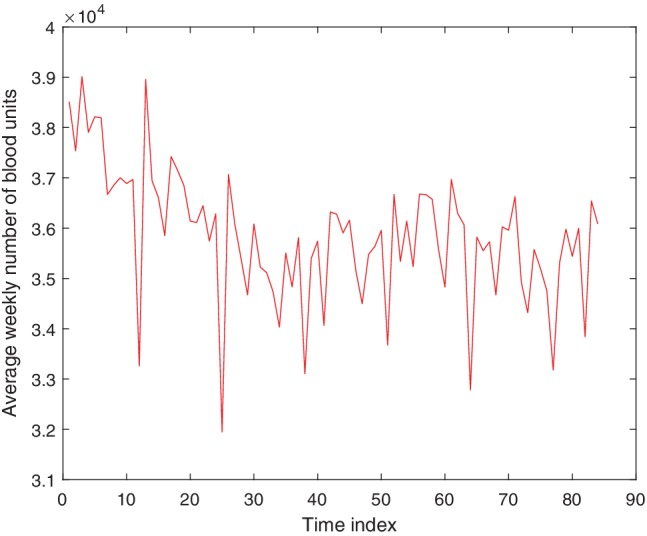
We used daily aggregates of RBC units issued from 2005 to 2011 from the National Health Service Blood and Transplant. We generated a new set of nonoverlapping weekly data by summing the daily data over 7 days and derived the average blood issues per week over 4-week periods. We used four methods for linear prediction of blood demand by computing the coefficients with the minimum mean squared error and weighted least squares error algorithms.
We optimized the time-window size, order of the prediction, and order of the polynomial fit for our data set. The four time-series methods, essentially using different weightings to data points, gave very similar results and predicted mean RBC issues with a standard deviation of the percentage error of 3.0% for 4 weeks ahead and 4.0% for 24 weeks ahead.
This paradigm allows prediction of demand for RBCs and could be developed to provide reliable and precise prediction up to 24 weeks ahead to improve the efficiency of blood services and sufficiency of blood supply with reduced costs.
血液制品是现代医学的必需品,但在面对波动的需求时,管理血液制品的采集和供应是一项重大挑战。由于基于人口预测变化的确定性模型存在问题,因此仍然需要更精确和可靠的需求预测。在这里,我们提出了一种范式,该范式结合了四种不同的时间序列方法,以预测 4 到 24 周内的红细胞 (RBC) 问题。
我们使用了 2005 年至 2011 年期间国家卫生服务部血液和移植中心每天发放的 RBC 单位的日常汇总数据。我们通过将每日数据相加 7 天来生成一组新的不重叠的每周数据,并得出 4 周期间每周平均的 RBC 问题数。我们使用了四种线性预测血液需求的方法,通过计算最小均方误差和加权最小二乘法算法的系数来实现。
我们优化了数据集的时间窗口大小、预测顺序和多项式拟合顺序。这四种时间序列方法本质上使用了不同的数据点权重,给出了非常相似的结果,并预测了 RBC 的平均问题,其 4 周和 24 周的百分比误差标准差分别为 3.0%和 4.0%。
该范式允许预测 RBC 的需求,并可进一步开发,以提供高达 24 周的可靠和精确预测,从而提高血液服务的效率,并以降低成本的方式确保血液供应的充足性。