Athinoula A. Martinos Center for Biomedical Imaging, Department of Radiology, Massachusetts General Hospital, Harvard Medical School, Boston, MA, USA.
Department of Psychology, University of Haifa, Haifa, Israel.
Neuroimage. 2020 May 1;211:116656. doi: 10.1016/j.neuroimage.2020.116656. Epub 2020 Feb 15.
Chronic pain and mood disorders share common neuroanatomical substrates involving disruption of the reward system. Although increase in negative affect (NA) and decrease in positive affect (PA) are well-known factors complicating the clinical presentation of chronic pain patients, our understanding of the mechanisms underlying the interaction between pain and PA/NA remains limited. Here, we used a validated task probing behavioral and neural responses to monetary rewards and losses in conjunction with functional magnetic resonance imaging (fMRI) to test the hypothesis that dysfunction of the striatum, a key mesolimbic structure involved in the encoding of motivational salience, relates to mood alterations comorbid with chronic pain.
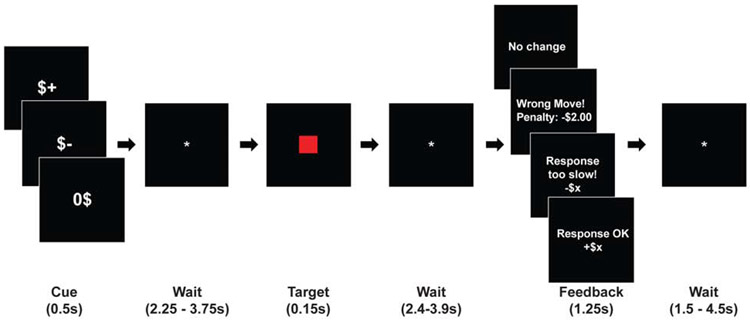
Twenty-eight chronic musculoskeletal pain patients (chronic low back pain, n=15; fibromyalgia, n=13) and 18 healthy controls underwent fMRI while performing the Monetary Incentive Delay (MID) task. Behavioral and neural responses were compared across groups and correlated against measures of depression (Beck Depression Inventory) and hedonic capacity (Snaith-Hamilton Pleasure Scale).
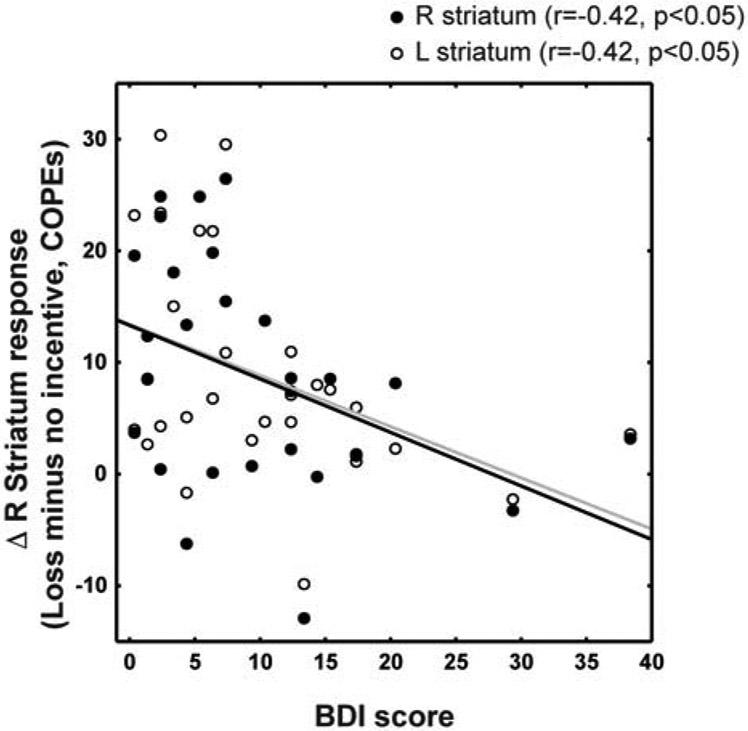
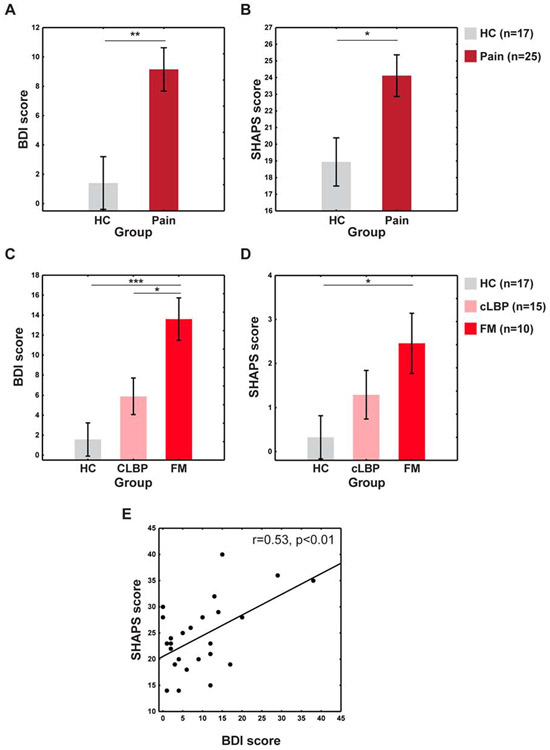
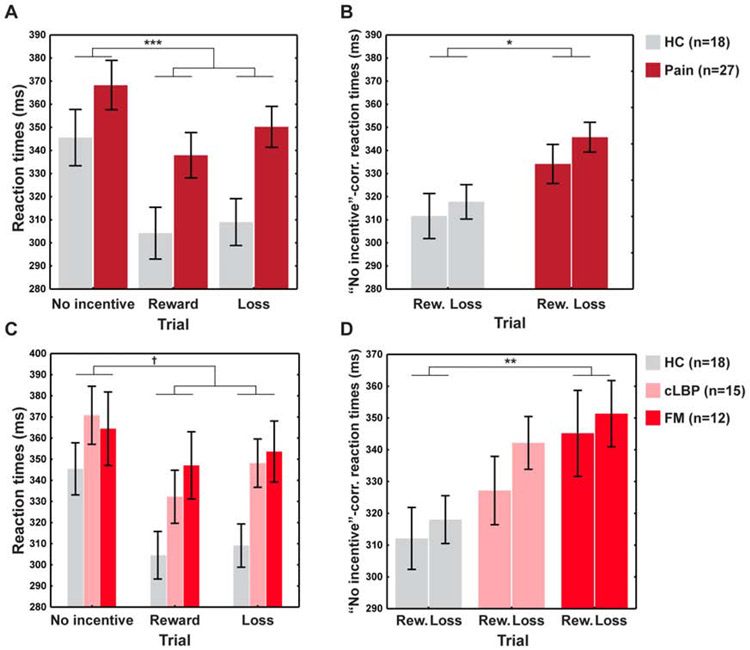
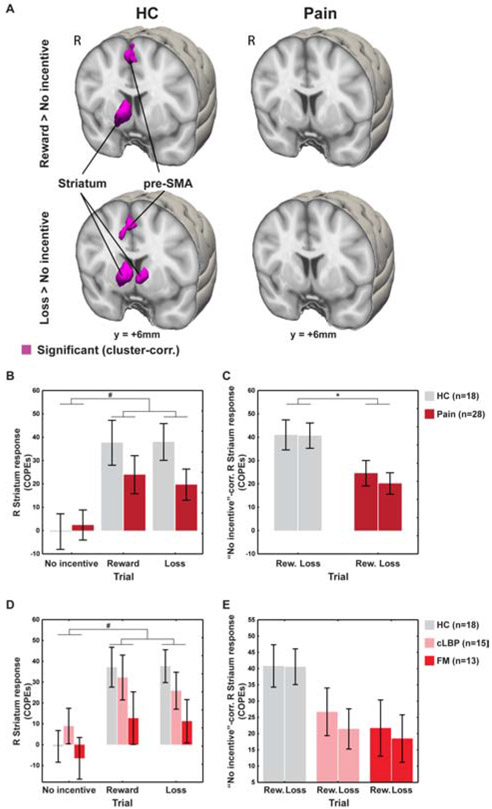
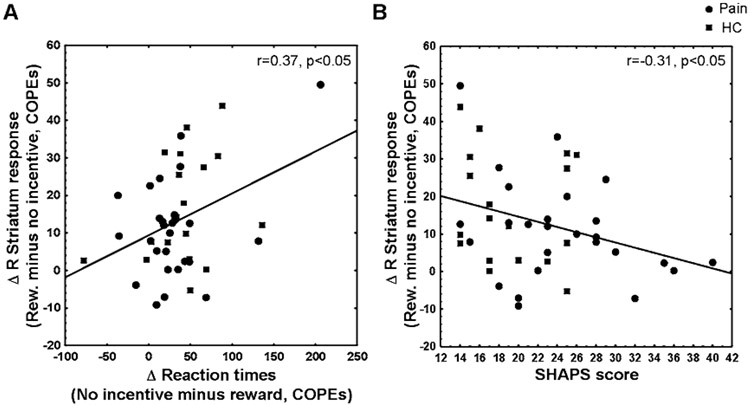
Compared to controls, patients demonstrated higher anhedonia and depression scores, and a dampening of striatal activation and incentive-related behavioral facilitation (reduction in reaction times) during reward and loss trials of the MID task (ps < 0.05). In all participants, lower activation of the right striatum during reward trials was correlated with lower incentive-related behavioral facilitation and higher anhedonia scores (ps < 0.05). Finally, among patients, lower bilateral striatal activation during loss trials was correlated with higher depression scores (ps < 0.05).
In chronic pain, PA reduction and NA increase are accompanied by striatal hypofunction as measured by the MID task.
慢性疼痛和情绪障碍共享共同的神经解剖学基础,涉及奖励系统的破坏。尽管负面情绪(NA)的增加和正面情绪(PA)的减少是使慢性疼痛患者临床表现复杂化的众所周知的因素,但我们对疼痛与 PA/NA 之间相互作用的机制的理解仍然有限。在这里,我们使用了一种经过验证的任务,该任务探测与金钱奖励和损失相关的行为和神经反应,结合功能磁共振成像(fMRI),以检验以下假设:中脑边缘结构(涉及动机显着性编码)的纹状体功能障碍与慢性疼痛合并的情绪改变有关。
28 名慢性肌肉骨骼疼痛患者(慢性下腰痛,n=15;纤维肌痛,n=13)和 18 名健康对照者在执行货币激励延迟(MID)任务时进行了 fMRI。比较了组间的行为和神经反应,并与抑郁(贝克抑郁量表)和享乐能力(Snaith-Hamilton 快感量表)的测量值相关。
与对照组相比,患者的快感缺失和抑郁评分较高,在 MID 任务的奖励和损失试验中纹状体的激活和激励相关的行为促进作用减弱(反应时间减少)(p<0.05)。在所有参与者中,奖励试验中右侧纹状体的激活较低与激励相关的行为促进作用较低和快感缺失评分较高相关(p<0.05)。最后,在患者中,损失试验中双侧纹状体的激活较低与抑郁评分较高相关(p<0.05)。
在慢性疼痛中,PA 减少和 NA 增加伴随着 MID 任务测量的纹状体功能低下。