Bachert S Emily, McDowell Anthony, Piecoro Dava, Baldwin Branch Lauren
Department of Pathology and Laboratory Medicine, University of Kentucky College of Medicine, Lexington, KY 40536, USA.
Department of Obstetrics and Gynecology, Division of Gynecologic Oncology, University of Kentucky College of Medicine, Lexington, KY 40536, USA.
Diagnostics (Basel). 2020 Feb 13;10(2):102. doi: 10.3390/diagnostics10020102.
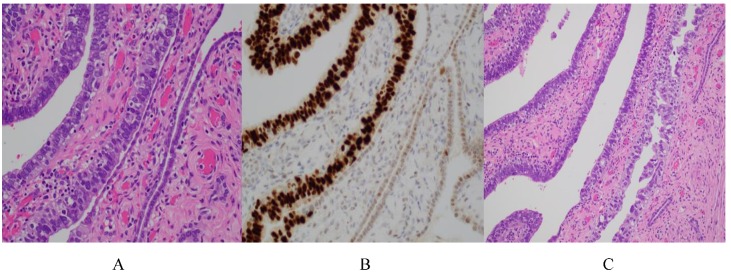
Ovarian cancer is the deadliest gynecologic malignancy, accounting for more than 14,000 deaths each year. With no established way to prevent or screen for it, the vast majority of cases are diagnosed as International Federation of Gynecology and Obstetrics (FIGO) stage III or higher. Individuals with germline mutations are at particularly high risk for epithelial ovarian cancer and have been the subject of many risk-reducing strategies. In the past ten years, studies looking at risk-reducing salpingo-oophorectomy (RRSO) in this population have uncovered an interesting association: up to 8% of women with or mutations who underwent RRSO had an associated serous tubal intraepithelial carcinoma (STIC). The importance of this finding is highlighted by the fact that up to 60% of ovarian cancer patients will also have an associated STIC. These studies have led to a paradigm shift that a subset of epithelial ovarian cancer originates not in the ovarian epithelium, but rather in the distal fallopian tube. In response to this, many providers have changed their practice by expanding the role of routine salpingectomy, hysterectomy, and sterilization procedures. The American College of Obstetricians and Gynecologists (ACOG) has acknowledged opportunistic salpingectomy as a safe strategy to reduce the risk of epithelial ovarian cancer in Committee Opinion #774. It is thus important for pathologists and clinicians to understand the definition of STIC; how it is diagnosed; and, most importantly, its clinical significance.
卵巢癌是最致命的妇科恶性肿瘤,每年导致超过14000人死亡。由于没有既定的预防或筛查方法,绝大多数病例在诊断时为国际妇产科联盟(FIGO)III期或更高分期。携带种系突变的个体患上皮性卵巢癌的风险特别高,并且一直是许多降低风险策略的研究对象。在过去十年中,针对该人群进行的降低风险输卵管卵巢切除术(RRSO)的研究发现了一个有趣的关联:接受RRSO的携带或突变的女性中,高达8%伴有浆液性输卵管上皮内癌(STIC)。高达60%的卵巢癌患者也伴有STIC,这一事实凸显了这一发现的重要性。这些研究导致了一种范式转变,即一部分上皮性卵巢癌并非起源于卵巢上皮,而是起源于远端输卵管。对此,许多医疗服务提供者通过扩大常规输卵管切除术、子宫切除术和绝育手术的作用改变了他们的做法。美国妇产科医师学会(ACOG)在第774号委员会意见中认可了机会性输卵管切除术是降低上皮性卵巢癌风险的一种安全策略。因此,病理学家和临床医生了解STIC的定义、诊断方法,以及最重要的是其临床意义非常重要。