Li Wenhui, Xu Ming, Li Yu, Huang Ziwei, Zhou Jun, Zhao Qiuyang, Le Kehao, Dong Fang, Wan Cheng, Yi Pengfei
Department of Breast and Thyroid Surgery, Union Hospital, Tongji Medical College, Huazhong University of Science and Technology, Wuhan, 430022, China.
Department of Nephrology, Union Hospital, Tongji Medical College, Huazhong University of Science and Technology, Wuhan, 430022, China.
J Transl Med. 2020 Feb 18;18(1):92. doi: 10.1186/s12967-020-02267-2.
Metabolic reprogramming, immune evasion and tumor-promoting inflammation are three hallmarks of cancer that provide new perspectives for understanding the biology of cancer. We aimed to figure out the relationship of tumor glycolysis and immune/inflammation function in the context of breast cancer, which is significant for deeper understanding of the biology, treatment and prognosis of breast cancer.
Using mRNA transcriptome data, tumor-infiltrating lymphocytes (TILs) maps based on digitized H&E-stained images and clinical information of breast cancer from The Cancer Genome Atlas projects (TCGA), we explored the expression and prognostic implications of glycolysis-related genes, as well as the enrichment scores and dual role of different immune/inflammation cells in the tumor microenvironment. The relationship between glycolysis activity and immune/inflammation function was studied by using the differential genes expression analysis, gene ontology (GO) analysis, Kyoto Encyclopedia of Genes and Genomes (KEGG) analysis, gene set enrichment analyses (GSEA) and correlation analysis.
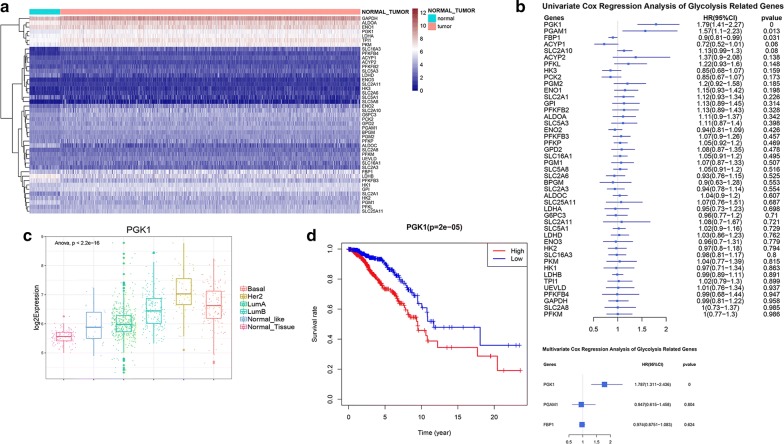
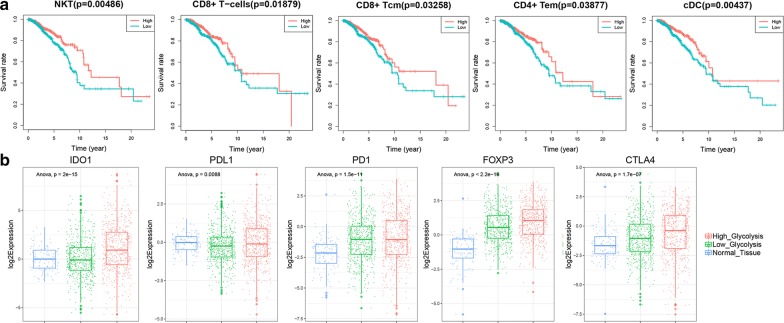
Most glycolysis-related genes had higher expression in breast cancer compared to normal tissue. Higher phosphoglycerate kinase 1 (PGK1) expression was associated with poor prognosis. High glycolysis group had upregulated immune/inflammation-related genes expression, upregulated immune/inflammation pathways especially IL-17 signaling pathway, higher enrichment of multiple immune/inflammation cells such as Th2 cells and macrophages. However, high glycolysis group was associated with lower infiltration of tumor-killing immune cells such as NKT cells and higher immune checkpoints expression such as PD-L1, CTLA4, FOXP3 and IDO1.
In conclusion, the enhanced glycolysis activity of breast cancer was associated with pro-tumor immunity. The interaction between tumor glycolysis and immune/inflammation function may be mediated through IL-17 signaling pathway.
代谢重编程、免疫逃逸和促肿瘤炎症是癌症的三个标志,为理解癌症生物学提供了新视角。我们旨在明确乳腺癌背景下肿瘤糖酵解与免疫/炎症功能的关系,这对于深入了解乳腺癌的生物学特性、治疗及预后具有重要意义。
利用来自癌症基因组图谱计划(TCGA)的mRNA转录组数据、基于数字化苏木精和伊红(H&E)染色图像的肿瘤浸润淋巴细胞(TILs)图谱以及乳腺癌的临床信息,我们探究了糖酵解相关基因的表达及其预后意义,以及不同免疫/炎症细胞在肿瘤微环境中的富集分数和双重作用。通过差异基因表达分析、基因本体(GO)分析、京都基因与基因组百科全书(KEGG)分析、基因集富集分析(GSEA)和相关性分析,研究了糖酵解活性与免疫/炎症功能之间的关系。
与正常组织相比,大多数糖酵解相关基因在乳腺癌中表达较高。磷酸甘油酸激酶1(PGK1)表达较高与预后不良相关。高糖酵解组免疫/炎症相关基因表达上调,免疫/炎症通路尤其是白细胞介素-17(IL-17)信号通路上调,多种免疫/炎症细胞如Th2细胞和巨噬细胞的富集程度更高。然而,高糖酵解组与杀伤肿瘤的免疫细胞如自然杀伤T细胞(NKT细胞)浸润较低以及免疫检查点如程序性死亡受体1(PD-L1)、细胞毒性T淋巴细胞相关抗原4(CTLA4)、叉头框蛋白P3(FOXP3)和吲哚胺2,3-双加氧酶1(IDO1)表达较高相关。
总之,乳腺癌增强的糖酵解活性与促肿瘤免疫相关。肿瘤糖酵解与免疫/炎症功能之间的相互作用可能通过IL-17信号通路介导。