Department of Anatomy, Howard University, Washington D.C., 20059, USA; Developmental Neuropsychopharmacology Laboratory, Howard University College of Medicine, Washington D.C., 20059, USA.
Western University Health Science Center, Graduate School of Biomedical Sciences, Pomona, CA, 91766 USA; Institute of Psychology, ELTE Eötvös Loránd University, Budapest, Hungary.
Behav Brain Res. 2020 May 15;385:112563. doi: 10.1016/j.bbr.2020.112563. Epub 2020 Feb 15.
Excessive alcohol intake is a serious but preventable public health problem in the United States and worldwide. Alcohol and other substance use disorders occur co-morbid with more generalized reward deficiency disorders, characterized by a reduction in dopamine (DA) signaling within the reward pathway, and classically associated with increased impulsivity, risk taking and subsequent drug seeking behavior. It is postulated that increasing dopamine availability and thus restoring DA homeostasis in the mesocorticolimbic system could reduce the motivation to seek and consume ethanol. Here, we treated animals with a neuro-nutrient, KB220Z also known as Synaptamine, designed to augment DA signaling.
KB220Z was administered to genetically alcohol-preferring (P) adult male and female rats by oral gavage (PO), intraperioneally (IP), or subcutaneously (SQ) for 4 consecutive days at a 3.4 mL/Kg rat equivalent dose and compared to saline (SQ, IP) or water (PO) controls. Subsequent to treatment, lever pressing and consumption of 10 % ethanol or control 3% sucrose during operant responding was assessed using a drinking in the dark multiple scheduled access (DIDMSA) binge drinking protocol. Locomotor and elevated zero maze activity, and DRD2 mRNA expression via in situ hybridization (ISH) were assessed independently following 4 days of a SQ regimen of KB220Z.
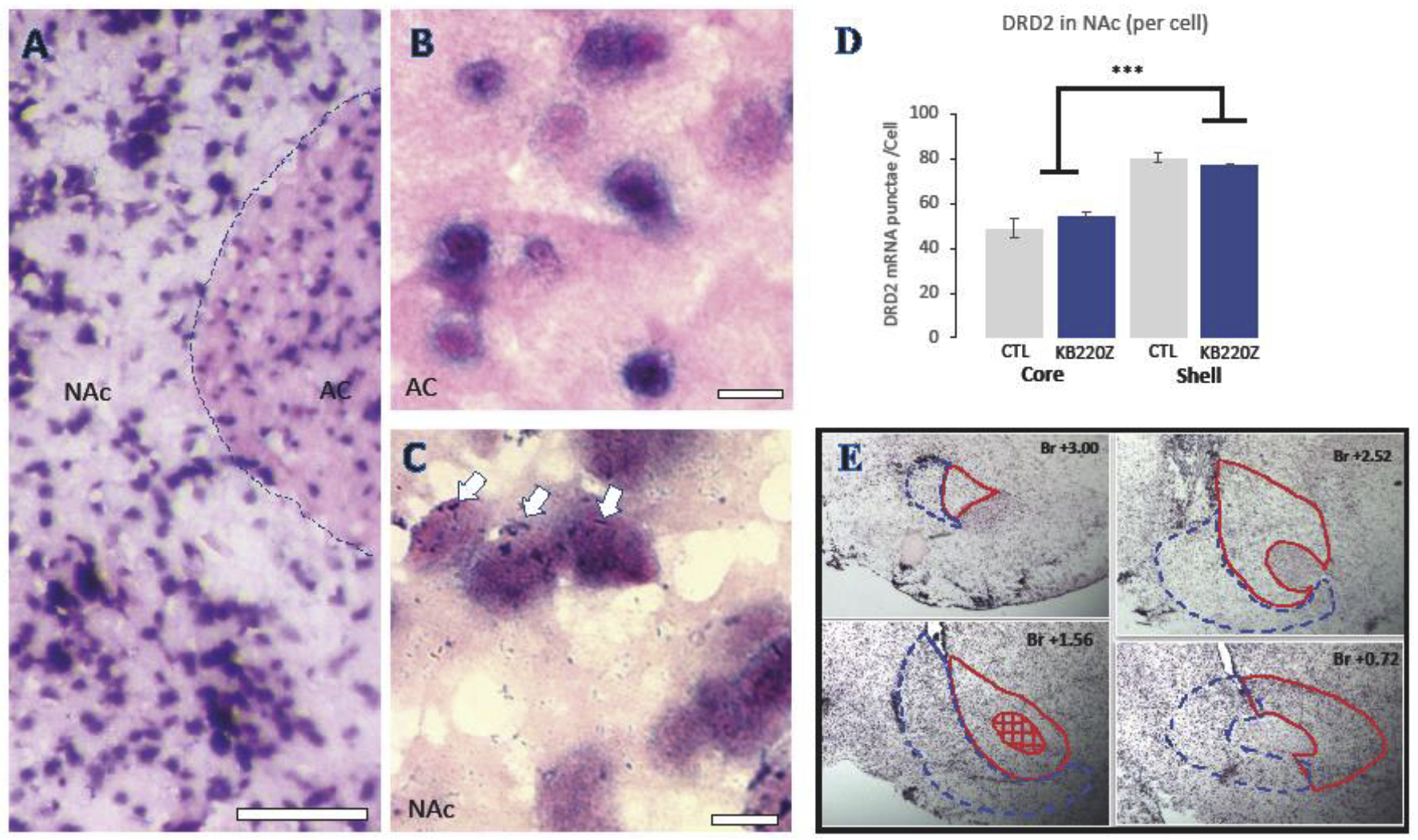
KB220Z administered via IP and SQ markedly and immediately reduced binge drinking of 10 % ethanol in both male and female rats whereas PO administration took at least 3 days to decrease lever pressing for ethanol in both male and female rats. There was no effect of SQ KB220Z on 3% sucrose drinking. Elevated activity in the open field was significantly decreased, and time spent in the open arm of the EZM was moderately reduced. The regimen of SQ KB220Z did not impact the number of DRD2 punctae in neurons of the NAc, but the NAc shell expressed more DRD2 mRNA/cell than NAc core independent of KB220Z.
KB220Z attenuates ethanol drinking and other RDS behaviors in P rats possibly by acting on the dopaminergic system, but not by effecting an increase in NAc DRD2 mRNA expression.
过度饮酒在美国和全球范围内是一个严重但可预防的公共卫生问题。酒精和其他物质使用障碍与更广泛的奖励缺陷障碍共同发生,其特征是奖励途径中的多巴胺(DA)信号减少,并且与冲动性增加、冒险行为和随后的药物寻求行为有关。据推测,增加多巴胺的可用性,从而恢复中脑边缘系统中的 DA 动态平衡,可以降低寻求和消耗乙醇的动机。在这里,我们用一种神经营养素 KB220Z(也称为 Synaptamine)治疗具有遗传酒精偏好的成年雄性和雌性大鼠,通过口服灌胃(PO)、腹膜内(IP)或皮下(SQ)给药,连续 4 天,剂量为 3.4mL/Kg 大鼠等效剂量,并与盐水(SQ、IP)或水(PO)对照进行比较。治疗后,使用暗室多时段访问(DIDMSA) binge drinking 协议评估操作反应期间的 lever 按压和 10%乙醇或对照 3%蔗糖的消耗。在 SQ 方案的 KB220Z 治疗 4 天后,分别通过原位杂交(ISH)评估运动和高架零迷宫活动以及 DRD2 mRNA 表达。
通过 IP 和 SQ 给予 KB220Z 可显著且立即减少雄性和雌性大鼠的 10%乙醇 binge 饮酒,而 PO 给药至少需要 3 天才能减少雄性和雌性大鼠的乙醇 lever 按压。SQ KB220Z 对 3%蔗糖饮酒没有影响。高架开放场活动明显减少,EZM 开放臂的时间适度减少。SQ KB220Z 方案不会影响 NAc 神经元中的 DRD2 punctae 数量,但 NAc 壳比 NAc 核表达更多的 DRD2 mRNA/细胞,与 KB220Z 无关。
KB220Z 通过作用于多巴胺能系统减弱 P 大鼠的乙醇饮酒和其他 RDS 行为,但不会通过增加 NAc DRD2 mRNA 表达来实现。