Rattanawong Pattara, Kewcharoen Jakrin, Techorueangwiwat Chol, Kanitsoraphan Chanavuth, Mekritthikrai Raktham, Prasitlumkum Narut, Puttapiban Prapaipan, Mekraksakit Poemlarp, Vutthikraivit Wasawat, Sorajja Dan
Department of Cardiovascular Medicine Mayo Clinic Phoenix AZ USA.
Faculty of Medicine Ramathibodi Hospital Mahidol University Bangkok Thailand.
J Arrhythm. 2019 Dec 27;36(1):143-152. doi: 10.1002/joa3.12290. eCollection 2020 Feb.
Brugada syndrome (BrS) is an inherited arrhythmic disease associated with an increased risk of major arrhythmic events (MAE). Previous studies reported that a wide QRS complex may be useful as a predictor of MAE in BrS patients. We aimed to assess the correlation of wide QRS complex with MAE by a systematic review and meta-analysis.
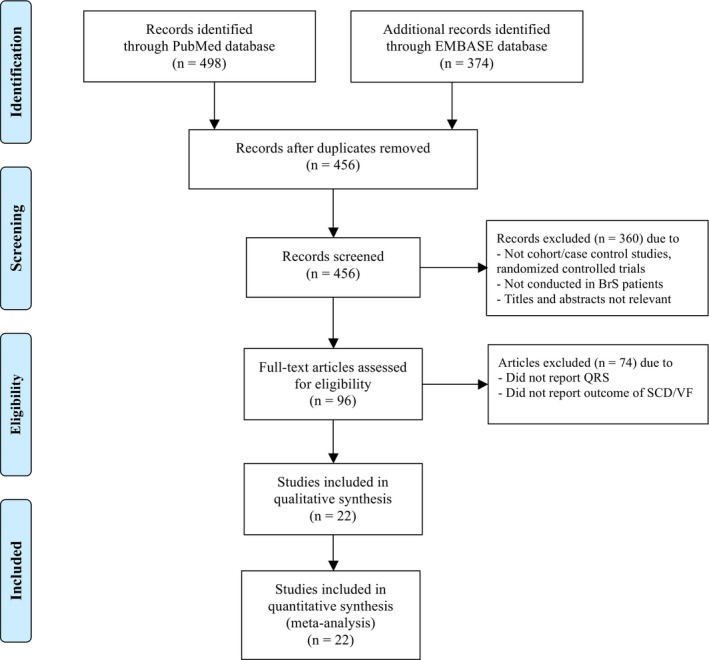
We comprehensively searched the databases of MEDLINE and EMBASE from inception to June 2019. Included studies were cohort and case control studies that reported QRS duration and the relationship between wide QRS complex (>120 milliseconds) and MAE (sudden cardiac death, sudden cardiac arrest, ventricular fibrillation, sustained ventricular tachycardia, or appropriate shock). Data from each study were combined using the random-effects model.
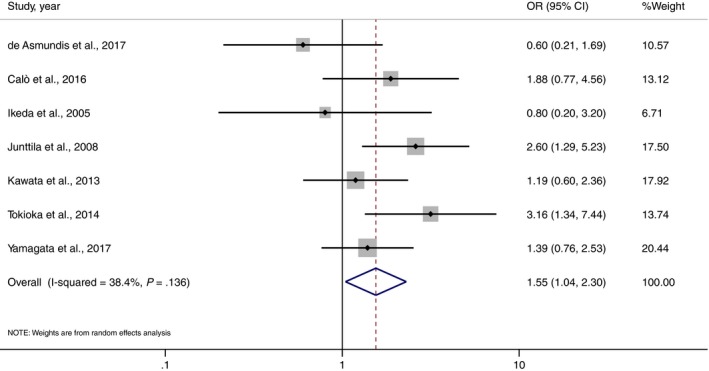
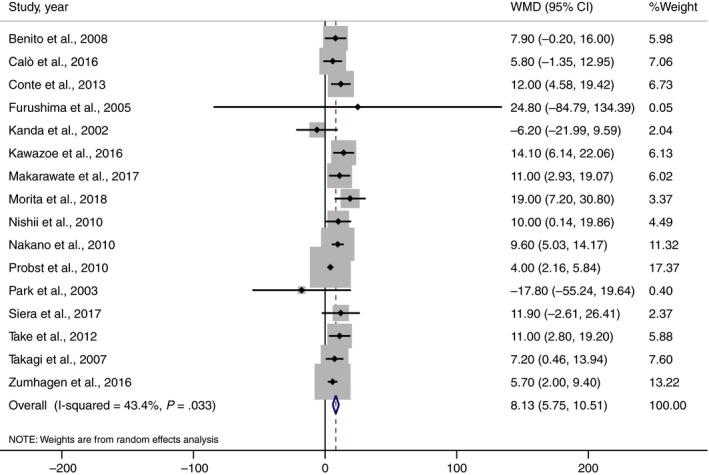
Twenty-two studies from 2007 to 2018 were included in this meta-analysis involving 4,814 BrS patients. The mean age was 46.1 ± 12.8 years. The patients were predominately men (77.6%). Wide QRS duration was an independent predictor of MAE (pooled risk ratio 1.55, 95% confidence interval: 1.04-2.30, = .30, = 38.4%). QRS duration was wider in BrS who had history of MAE (weight mean difference = 8.12 milliseconds, 95% confidence interval: 5.75-10.51 milliseconds).
Our study demonstrated that QRS duration is wider in BrS who had history of MAE, and a wide QRS complex is associated with 1.55 times higher risk of MAE in BrS populations. Wide QRS complex can be considered for risk stratification in prediction of MAE in patients with BrS, especially when considering implantable cardioverter-defibrillator placement in asymptomatic patients.
布加综合征(BrS)是一种遗传性心律失常疾病,与主要心律失常事件(MAE)风险增加相关。既往研究报道,宽QRS波群可能有助于预测BrS患者的MAE。我们旨在通过系统评价和荟萃分析评估宽QRS波群与MAE的相关性。
我们全面检索了MEDLINE和EMBASE数据库,检索时间从建库至2019年6月。纳入的研究为队列研究和病例对照研究,这些研究报告了QRS波时限以及宽QRS波群(>120毫秒)与MAE(心源性猝死、心脏骤停、心室颤动、持续性室性心动过速或适当电击)之间的关系。使用随机效应模型合并每项研究的数据。
本荟萃分析纳入了2007年至2018年的22项研究,涉及4814例BrS患者。平均年龄为46.1±12.8岁。患者以男性为主(77.6%)。宽QRS波时限是MAE的独立预测因子(合并风险比1.55,95%置信区间:1.04 - 2.30,P = 0.30,I² = 38.4%)。有MAE病史的BrS患者QRS波时限更宽(加权均数差 = 8.12毫秒,95%置信区间:5.75 - 10.51毫秒)。
我们的研究表明,有MAE病史的BrS患者QRS波时限更宽,宽QRS波群与BrS人群中MAE风险高1.55倍相关。在预测BrS患者的MAE时,尤其是考虑对无症状患者植入植入式心脏复律除颤器时,宽QRS波群可用于风险分层。