Falk Brekke Anders, Overgaard Søren, Hróbjartsson Asbjørn, Holsgaard-Larsen Anders
Department of Orthopaedic Surgery and Traumatology, Odense University Hospital, Odense, Denmark.
Department of Clinical Research, University of Southern Denmark, Odense, Denmark.
EFORT Open Rev. 2020 Jan 29;5(1):37-45. doi: 10.1302/2058-5241.5.190017. eCollection 2020 Jan.
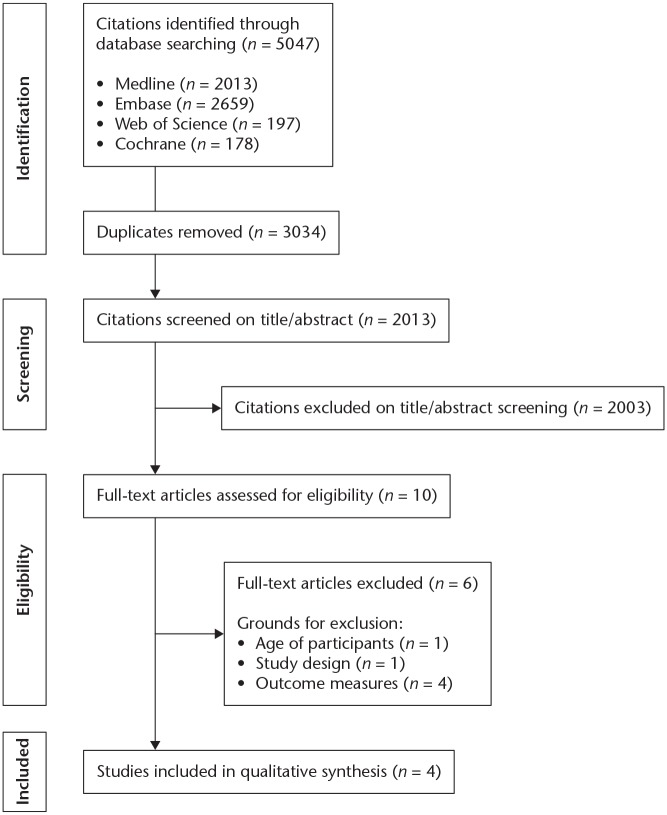
Excessive anterior pelvic tilt is suspected of causing femoroacetabular impingement, low back pain, and sacroiliac joint pain. Non-surgical treatment may decrease symptoms and is seen as an alternative to invasive and complicated surgery. However, the effect of non-surgical modalities in adults is unclear. The aim of this review was to investigate patient- and observer-reported outcomes of non-surgical intervention in reducing clinical symptoms and/or potential anterior pelvic tilt in symptomatic and non-symptomatic adults with excessive anterior pelvic tilt, and to evaluate the certainty of evidence.MEDLINE, EMBASE, Web of Science and Cochrane (CENTRAL) databases were searched up to March 2019 for eligible studies. Two reviewers assessed risk of bias independently, using the Cochrane Risk of Bias tool for randomized trials and the ROBINS-I tool for non-randomized studies. Data were synthesized qualitatively. The GRADE approach was used to assess the overall certainty of evidence.Of 2013 citations, two randomized controlled trials (RCTs) ( = 72) and two non-RCTs ( = 23) were included. One RCT reported a small reduction (< 2°) in anterior pelvic tilt in non-symptomatic men. The two non-RCTs reported a statistically significant reduction in anterior pelvic tilt, pain, and disability in symptomatic populations. The present review was based on heterogeneous study populations, interventions, and very low quality of evidence.No overall evidence for the effect of non-surgical treatment in reducing excessive anterior pelvic tilt and potentially related symptoms was found. High-quality studies targeting non-surgical treatment as an evidence-based alternative to surgical interventions for conditions related to excessive anterior pelvic tilt are warranted. Cite this article: 2020;5:37-45. DOI: 10.1302/2058-5241.5.190017.
骨盆前倾过度被怀疑会导致股骨髋臼撞击症、腰痛和骶髂关节疼痛。非手术治疗可能会减轻症状,被视为侵入性复杂手术的替代方案。然而,非手术方式对成年人的效果尚不清楚。本综述的目的是调查在有症状和无症状的骨盆前倾过度成年人中,非手术干预在减轻临床症状和/或潜在骨盆前倾方面患者和观察者报告的结果,并评估证据的确定性。检索了MEDLINE、EMBASE、科学网和Cochrane(CENTRAL)数据库至2019年3月的符合条件的研究。两名评价者独立评估偏倚风险,随机试验使用Cochrane偏倚风险工具,非随机研究使用ROBINS-I工具。对数据进行定性综合。采用GRADE方法评估证据的总体确定性。在2013篇文献中,纳入了两项随机对照试验(RCT)(n = 72)和两项非RCT(n = 23)。一项RCT报告无症状男性的骨盆前倾有小幅降低(< 2°)。两项非RCT报告有症状人群的骨盆前倾、疼痛和残疾有统计学显著降低。本综述基于异质性的研究人群、干预措施和极低质量的证据。未发现非手术治疗在减少骨盆前倾过度及潜在相关症状方面效果的总体证据。有必要开展高质量研究,将非手术治疗作为与骨盆前倾过度相关疾病手术干预的循证替代方案。引用本文:2020;5:37-45。DOI: 10.1302/2058-5241.5.190017。