Xu Hong-Tao, Lee Chien-Wei, Li Ming-Yan, Wang Yu-Fan, Yung Patrick Shu-Hang, Lee Oscar Kuang-Sheng
Department of Orthopaedics and Traumatology, Faculty of Medicine, Prince of Wales Hospital, The Chinese University of Hong Kong, Hong Kong Special Administrative Region, China.
School of Biomedical Sciences, Faculty of Medicine, The Chinese University of Hong Kong, Hong Kong Special Administrative Region, China.
J Orthop Translat. 2019 Dec 24;21:24-34. doi: 10.1016/j.jot.2019.11.009. eCollection 2020 Mar.
The role of macrophages (Mφs) in tendon injury healing is controversy. The aims of this study were to determine whether there is a shift in Mφs polarisation after an acute and chronic tendon injury and to assess whether the Mφs polarisation between the partial and complete rupture is different.
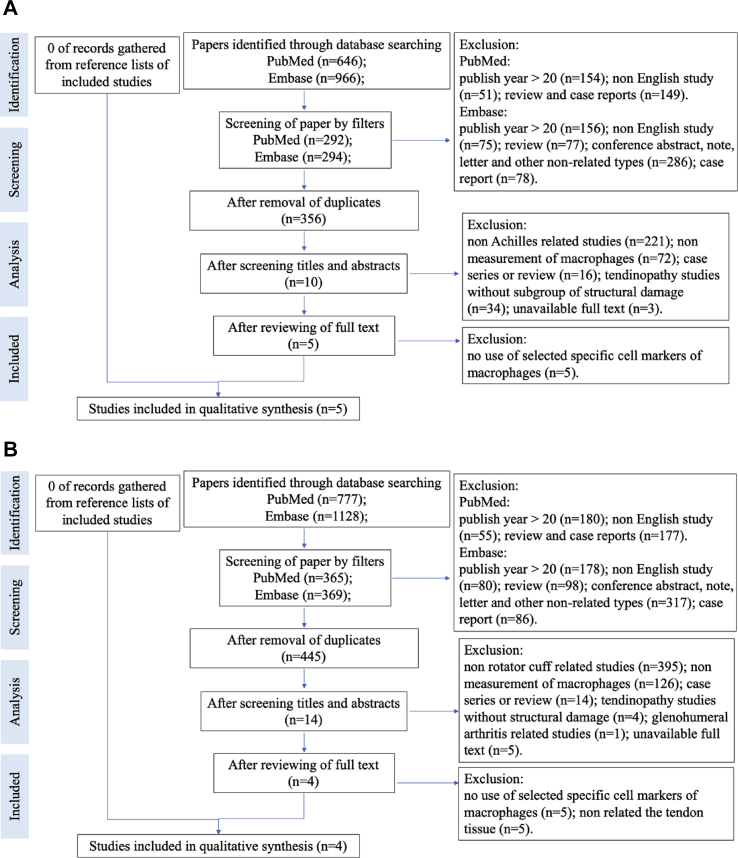
This systematic review of the scientific literature was based on the Preferred Reporting Items for Systematic Reviews and Meta-Analyses (PRISMA) and Cochrane guidelines. PubMed database and Excerpta Medica Database (EMBASE) were used for specific search criteria. Only studies measuring Mφs using specific cell markers in Achilles tendon tissue and rotator cuff tendon tissue were included, respectively.
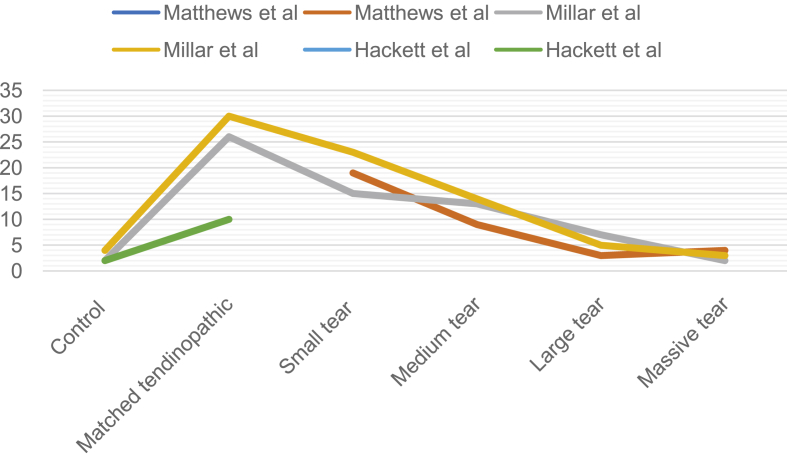
Five Achilles tendon injury studies and four rotator cuff injury studies were included. Expression of the pan Mϕs marker Cluster of Differentiation (CD) 68 was significantly upregulated in acute Achilles tendon ruptures compared to intact tendons, while no significant changes were found in Mφs polarisation markers CD80 (M1 Mφs) and CD206 (M2 Mφs). High levels of CD86 (M1 Mφs) and CD206 were observed in acute partial rupture. Expression of CD68 and CD206 were significantly upregulated in chronic rotator cuff tendinopathy and downregulated as structural failure increases. A low level of CD206 was observed in complete tendon rupture regardless of acute or chronic injury.
In spite of the limited number of articles included, findings from this study suggested that the process of inflammation plays an important role in acute Achilles tendon injuries, indicated by the increased expression of CD68+ Mφs. Low levels of CD206+ Mφs were constantly observed in complete Achilles tendon rupture, while high levels of CD80+ Mφs and CD206+ Mφs were observed in partial Achilles tendon rupture, which suggested the potential correlation between M2 Mφs and tendon structure. For chronic rotator cuff injury, CD68+ Mφs and CD206+ Mφs were higher in tendinopathic tissues in comparison to the intact control tissues. Both CD68+ Mφs and CD206+ Mφs has an inverse relation to the structural failure in the torn rotator cuff tendon. After tendon rupture, the time point of biopsy specimen collection is an important factor, which could occur in the acute phase or chronic phase. Collectively, the understanding of the roles in Mφs after tendon injury is inadequate, and more research efforts should be devoted to this direction.
This article provided a potential implication on how pan Mφs or M2 Mφs might be associated with ruptured or torn tendon structure. Managing Mφs numbers and phenotypes may lead to possible novel therapeutic approaches to the management of early tendinopathy, early acute tendon rupture, hence, promote healing after restoration surgery.
巨噬细胞(Mφs)在肌腱损伤愈合中的作用存在争议。本研究的目的是确定急性和慢性肌腱损伤后Mφs极化是否发生转变,并评估部分和完全断裂之间的Mφs极化是否不同。
本系统综述科学文献基于系统评价和Meta分析的首选报告项目(PRISMA)和Cochrane指南。使用PubMed数据库和医学文摘数据库(EMBASE)进行特定检索标准。仅纳入分别使用特定细胞标志物测量跟腱组织和肩袖肌腱组织中Mφs的研究。
纳入了五项跟腱损伤研究和四项肩袖损伤研究。与完整肌腱相比,急性跟腱断裂中泛Mϕs标志物分化簇(CD)68的表达显著上调,而Mφs极化标志物CD80(M1 Mφs)和CD206(M2 Mφs)未发现显著变化。在急性部分断裂中观察到高水平的CD86(M1 Mφs)和CD206。慢性肩袖肌腱病中CD68和CD206的表达显著上调,且随着结构破坏增加而下调。无论急性或慢性损伤,在完全肌腱断裂中均观察到低水平的CD206。
尽管纳入的文章数量有限,但本研究结果表明,炎症过程在急性跟腱损伤中起重要作用,表现为CD68+ Mφs表达增加。在完全跟腱断裂中持续观察到低水平的CD206+ Mφs,而在部分跟腱断裂中观察到高水平的CD80+ Mφs和CD206+ Mφs,这表明M2 Mφs与肌腱结构之间可能存在相关性。对于慢性肩袖损伤,与完整对照组织相比,肌腱病组织中的CD68+ Mφs和CD206+ Mφs更高。CD68+ Mφs和CD206+ Mφs均与撕裂的肩袖肌腱中的结构破坏呈负相关。肌腱断裂后,活检标本采集的时间点是一个重要因素,这可能发生在急性期或慢性期。总体而言,对肌腱损伤后Mφs作用的理解不足,应在这一方向投入更多研究精力。
本文对泛Mφs或M2 Mφs如何与破裂或撕裂的肌腱结构相关提供了潜在启示。控制Mφs数量和表型可能会带来治疗早期肌腱病、早期急性肌腱断裂的新治疗方法,从而促进修复手术后的愈合。