Pagé Gabrielle M, Lacasse Anaïs, Beaudet Nicolas, Choinière Manon, Deslauriers Simon, Diatchenko Luda, Dupuis Laurent, Grégoire Stéphanie, Hovey Richard, Leclair Erwan, Leonard Guillaume, Meloto Carolina B, Montagna Francesca, Parent Alexandre, Rainville Pierre, Roy Jean-Sébastien, Roy Mathieu, Ware Mark A, Wideman Timothy H, Stone Laura S
Department of Anesthesiology and Pain Medicine, Faculty of Medicine, Université de Montréal, Montreal, QC, Canada.
Centre de recherche du Centre hospitalier de l'Université de Montréal (CRCHUM), Montreal, QC, Canada.
Pain Rep. 2019 Dec 19;5(1):e799. doi: 10.1097/PR9.0000000000000799. eCollection 2020 Jan-Feb.
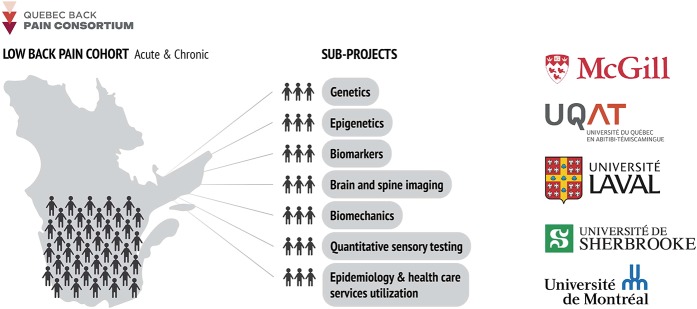
The neurobiological mechanisms underlying recovery from or persistence of low back pain (LBP) remain misunderstood, limiting progress toward effective management. We have developed an innovative two-tier design to study the transition from acute to chronic LBP. The objective of the first tier is to create a provincial web-based infrastructure to recruit and monitor the trajectory of individuals with acute LBP. The objective of the second tier is to fuel hypothesis-driven satellite data collection centers with specialized expertise to study the role of biomechanical, epigenetic, genetic, neuroanatomical, ontological, physiological, psychological, and socioeconomic factors in LBP chronicity.
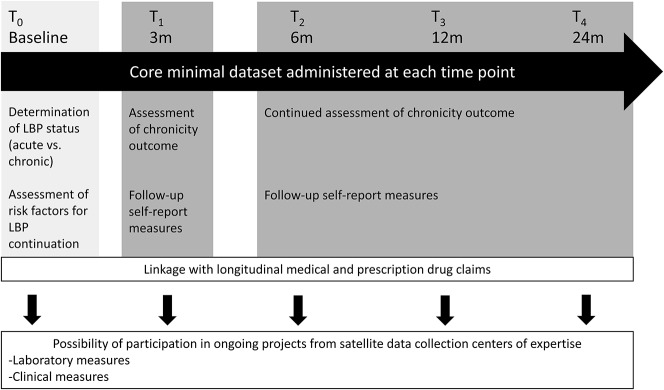
This article describes the first tier of the protocol: establishment of the Core Dataset and Cohort. Adults with acute LBP will be recruited through networks, media, and health care settings. A web-based interface will be used to collect self-reported variables at baseline and at 3, 6, 12, and 24 months. Acute LBP will be defined according to the Dionne 2008 consensus. Measurements will include the Canadian minimum data set for chronic LBP research, DN4 for neuropathic pain, comorbidities, EQ-5D-5L for quality of life, and linkage with provincial medico-administrative databases. The primary outcome will be the transition to chronic LBP, as defined by Deyo 2014. Secondary outcomes include health care resource utilization, disability, sick leave, mood, and quality of life.
This study brings together diverse research expertise to investigate the transition from acute to chronic LBP, characterize the progression to recovery or chronicity, and identify patterns associated with that progression.
下背痛(LBP)恢复或持续存在的神经生物学机制仍未得到充分理解,这限制了有效管理方面的进展。我们开发了一种创新的两层设计来研究从急性LBP向慢性LBP的转变。第一层的目标是创建一个省级基于网络的基础设施,以招募和监测急性LBP患者的病程。第二层的目标是为具有专业知识的假设驱动的卫星数据收集中心提供支持,以研究生物力学、表观遗传学、遗传学、神经解剖学、本体论、生理学、心理学和社会经济因素在LBP慢性化中的作用。
本文描述了该方案的第一层:核心数据集和队列的建立。患有急性LBP的成年人将通过网络、媒体和医疗保健机构招募。将使用基于网络的界面在基线以及3、6、12和24个月时收集自我报告的变量。急性LBP将根据2008年迪翁共识进行定义。测量将包括加拿大慢性LBP研究的最小数据集、用于神经性疼痛的DN4、合并症、用于生活质量的EQ-5D-5L,以及与省级医疗管理数据库的链接。主要结局将是根据2014年迪奥的定义向慢性LBP的转变。次要结局包括医疗保健资源利用、残疾、病假、情绪和生活质量。
本研究汇集了多种研究专业知识,以调查从急性LBP向慢性LBP的转变,描述恢复或慢性化的进程,并识别与该进程相关的模式。