Kornacka Monika, Czepczor-Bernat Kamila, Napieralski Piotr, Brytek-Matera Anna
Institute of Psychology, SWPS University of Social Sciences and Humanities, ul. Chodakowska 18/31, 03-815, Warsaw, Poland.
PSITEC EA 4072, University of Lille, Villeneuve d'Ascq, France.
Eat Weight Disord. 2021 Feb;26(1):273-285. doi: 10.1007/s40519-020-00857-z. Epub 2020 Feb 18.
The literature suggests that rumination (i.e., repetitive thinking about 1 or more negative concerns that is perceived as difficult to control) is linked to impaired emotional regulation and increases negative affect. Not only individuals suffering from overweight or obesity, but also healthy individuals might use emotional eating as a coping strategy to deal with negative affect caused by rumination. The aim of the present study was to determine the link between rumination and maladaptive eating strategies in participants with normal weight and overweight/obesity using trait and ecological momentary measures.
In Study 1, 88 individuals from overweight/obese (N = 33) and control group (N = 50) filled in a series of questionnaires assessing trait rumination, and eating behaviors. In Study 2 momentary affect, rumination and eating behavior of 26 participants were assessed using ecological momentary assessment (EMA) methodology.
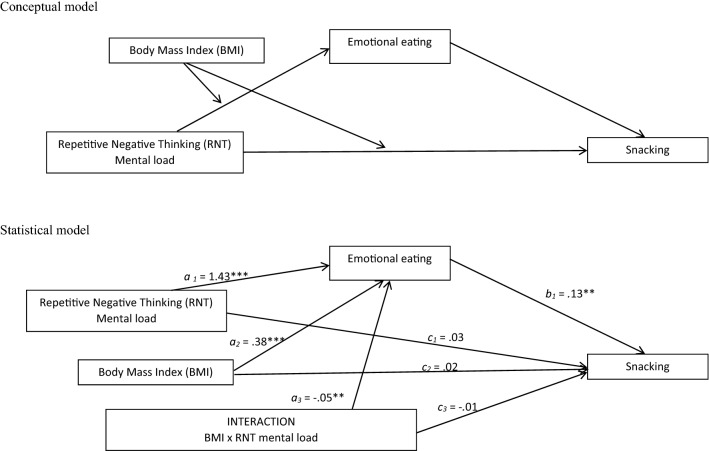
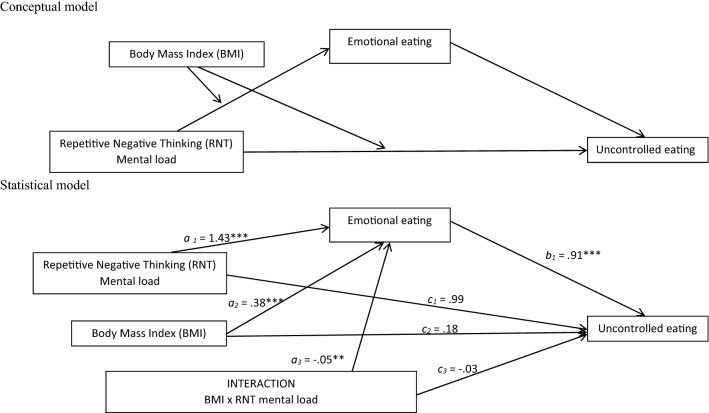
In Study 1, the moderated mediation model revealed that emotional eating mediates the link between rumination and uncontrolled eating or snacking, but only in healthy participants and not in the participants with overweight. The results of Study 2 suggest that when both momentary rumination and sad mood are entered into the model predicting momentary daily emotional eating, only rumination remains a significant predictor of emotional eating. This relationship is not modified by the fact that the participants are from healthy controls or the overweight/obese group.
Study 1 provided evidence on the differential role of emotional eating in participants with normal weight and with overweight. Study 2 provided initial insights into the role of momentary mood and momentary repetitive thinking in the use of emotional eating in participants' everyday lives. The differences in group effect in trait and EMA measures indicated also the importance of considering the consciousness of using rumination and emotional eating, while studying those processes in individuals with overweight.
Level III, case-control analytic study.
文献表明,反刍思维(即反复思考一个或多个被认为难以控制的负面问题)与情绪调节受损及负面影响增加有关。不仅超重或肥胖个体,健康个体也可能将情绪化进食作为应对反刍思维所导致负面影响的一种应对策略。本研究的目的是使用特质测量和生态瞬时测量方法,确定体重正常和超重/肥胖参与者中反刍思维与适应不良饮食策略之间的联系。
在研究1中,88名来自超重/肥胖组(N = 33)和对照组(N = 50)的个体填写了一系列评估特质反刍思维和饮食行为的问卷。在研究2中,使用生态瞬时评估(EMA)方法评估了26名参与者的瞬时情绪、反刍思维和饮食行为。
在研究1中,调节中介模型显示,情绪化进食介导了反刍思维与无节制进食或吃零食之间的联系,但仅在健康参与者中存在,超重参与者中不存在。研究2的结果表明,当将瞬时反刍思维和悲伤情绪纳入预测每日瞬时情绪化进食的模型时,只有反刍思维仍然是情绪化进食的显著预测因素。参与者来自健康对照组还是超重/肥胖组这一事实并不会改变这种关系。
研究1提供了关于情绪化进食在体重正常和超重参与者中不同作用的证据。研究2初步洞察了瞬时情绪和瞬时反复思考在参与者日常生活中使用情绪化进食方面的作用。特质测量和EMA测量中组效应的差异也表明,在研究超重个体的这些过程时,考虑使用反刍思维和情绪化进食的意识非常重要。
III级,病例对照分析研究。